CFTCpage 5

Organization · 568 articles
Share

Coverage, page 5

page 5 of 29

Senate crypto clarity bill fails cloture vote, bitcoin slides

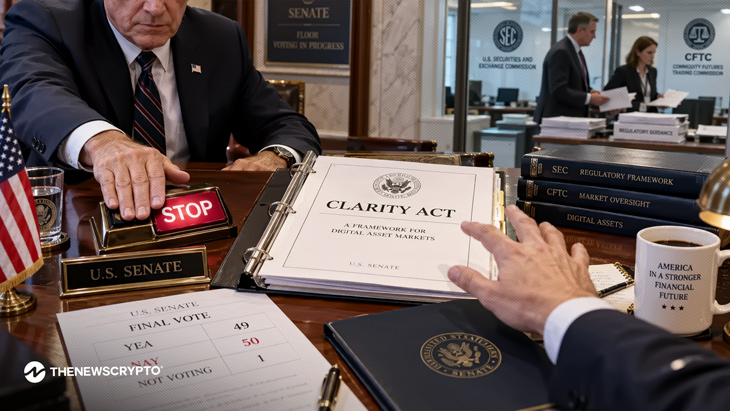
BTCUSD | 4H Technical Analysis — Sep 16, 2026 Bitcoin is under pressure after the US Senate failed to advance the Digital Asset Market Clarity Act, the comprehensive crypto market structure bill the industry has spent years lobbying for. A procedural vote to bring the bill to the floor fell short 49 to 50, well below the 60 votes needed for cloture, plunging crypto-related stocks including Coinbase and reigniting uncertainty over whether the CFTC will ever gain the unified regulatory authority the industry has been seeking. The sell-off was compounded by broad risk aversion ahead of tomorrow's FOMC rate decision, with markets reluctant to add risk into a binary macro event on top of the fresh regulatory setback. BTCUSD spent nearly three months, June through mid-August, chopping in a wide 58,000 to 67,000 range before a sharp spike in late August drove price directly to 70,000 and beyond, clearing the entire range in a matter of days. That move extended into early September, with price tagging a high near 82,000 before rolling over into a descending channel that has been in place ever since. The channel's upper boundary has capped every bounce near 80,000 to 82,000, while the lower boundary running through 74,300 has held on each retest so far. Price is now trading around 76,000, with the fast EMA at 77,055 just below the slow EMA at 77,626, a mildly bearish signal that reflects the stalling momentum since the early September peak. RSI has fallen to 36.72, its lowest reading since the pre-breakout consolidation in July and August, showing the Senate news and FOMC anxiety are actively pressuring price rather than just causing a pause. The 74,300 level is the one that matters most right now. It is both the descending channel's lower trendline and the same shelf that has provided support on at least two prior tests since the channel formed, making it the clearest line between an orderly pullback and a deeper breakdown back toward the August range. Key levels to watch: Resistance: 78,000 (recently lost support) / 82,000 (early September high) / 86,000 Support: 74,300 (channel lower trendline, prior support) / 72,500 / 70,000 (breakout level from the August range) Bear case: The failed Clarity Act vote removes a key regulatory tailwind the market had been pricing in, and with the FOMC decision still pending tomorrow, positioning is likely to stay defensive. A break below 74,300 would confirm the descending channel is resolving lower rather than consolidating, opening a retest of 70,000 and potentially the top of the old 60,000 to 67,000 range if risk sentiment deteriorates further around the rate decision. Bull case: The Clarity Act failure was a procedural setback, not a permanent rejection, and legislative efforts of this kind typically get reintroduced rather than abandoned outright. If the FOMC decision tomorrow leans dovish or simply removes uncertainty, a bounce off 74,300 back above 78,000 would suggest the pullback was sentiment-driven rather than structural, keeping the broader uptrend from the August breakout intact. Bias is neutral to cautiously bearish while price holds below 78,000, with the FOMC decision tomorrow the more immediate catalyst than the crypto-specific regulatory news. The descending channel and falling RSI both argue for near-term weakness, but 74,300 has held before and remains the level that decides whether this is a routine pullback within an uptrend or the start of a larger correction back toward the summer range.

TITradingView Ideas16 Sept

A Letter to Myself: Buy the Dip — Part II

We're still early. Not early in the sense that Bitcoin was in 2012. Early in the sense that we're watching an entirely new financial infrastructure develop in real time. This is phase one of a global technological financial system. Think about our parents' generation. If they had been able to park even a fraction of their cash into some of the technologies that ended up changing the world 10–20 years later, the long-term payoff could have been significant. But they didn't. And that's okay. They didn't know. They couldn't see what the internet would become. They couldn't have fully understood what social media, smartphones, cloud computing, artificial intelligence, or digital payments would eventually become. We have something they didn't: Hindsight + information + access. We now have the privilege of participating in technologies that were previously out of reach for everyday people because we couldn't even fathom what the future would look like. And cryptocurrency is part of that transition. So What Is Happening Right Now? This is why I'm paying attention to the CLARITY Act, which gets voted on tomorrow. (SEPT 15, 2026) In the simplest terms: The U.S. is trying to establish a rulebook for digital assets. For years, the crypto industry has operated with significant uncertainty around questions like: Is this a security? Is this a commodity? Who regulates this? What rules do exchanges follow? What are institutions actually allowed to do? The CLARITY Act attempts to create clearer lines between the SEC and CFTC and establish a regulatory framework for digital assets. That's important. Not because one piece of legislation magically makes Bitcoin go up. But because clarity creates confidence. And confidence creates participation. And participation creates liquidity. That's the bigger picture I'm watching. Adoption Curve This is also where the adoption curve theory comes into play. We're watching cryptocurrency move from something that most people couldn't explain... to something MOST people aren't aware of... to something people are experimenting with... to something increasingly integrated into financial infrastructure. Current research supports the idea that cryptocurrency adoption isn't simply about speculation; adoption is influenced by perceived usefulness, financial incentives, risk, accessibility and network effects. And we're seeing that participation expand. As of 2026, roughly 1 in 5 U.S. adults (19%) reported having invested in or used cryptocurrency, according to Pew Research Center. That doesn't mean we're guaranteed to see mass adoption. It means we're no longer talking about a technology being used by a handful of people on the internet. It's here. The question is how large the network becomes. And Then There's Government Regardless of sentiment, here's the play I'm watching: The infrastructure is being built. The U.S. established a Strategic Bitcoin Reserve and a U.S. Digital Asset Stockpile in March 2025. The executive order directed the government to maintain forfeited BTC in the reserve and created a framework for managing other government-held digital assets. That doesn't mean the government is buying every altcoin. It doesn't mean every cryptocurrency succeeds. It doesn't mean prices only go up. It means digital assets are increasingly being treated as part of the financial and technological conversation at the highest levels. This isn't just a financial race. It's a technological one. Countries are competing for the future of money, payments, computing, energy, and digital infrastructure. And the U.S. has made it increasingly clear that it wants to remain a major player in that system. At the 2024 Bitcoin Conference in Nashville, Donald Trump spoke directly about this vision, saying he wanted the United States to become the “crypto capital of the planet” and the “Bitcoin superpower of the world.” He also pledged to establish a strategic Bitcoin reserve and retain the government's existing Bitcoin holdings. Whether you agree with the politics or not, the signal is there. Are you paying attention? The conversation has shifted from: “Is crypto real?” to: “Who is going to lead the digital financial system?” That's the war most people don't even realize we're participating in. And my thesis is simple: I want to be positioned while that system is still being built — Early Majority — not after everyone finally understands what it became — Laggards. 🔄 Elliott Wave Structure — Strength in Numbers Now let's bring this back to the chart. My thesis is that we're observing a 1–5 multi-year impulse wave, followed by an A-B-C corrective phase. Impulse 1–5 The larger trend direction. Up. ABC Correction A retracement after a major trend leg. A: First leg down B: Bounce / retracement C: Final leg down My interpretation is that we're currently experiencing an ABC retracement within a larger uptrend. In other words: The market can correct without the entire thesis being broken. A correction doesn't automatically mean the cycle is over. It means we're watching the market determine where the next level of demand comes from. We're also approaching the 200-day moving average, which I'm watching as an important rolling support/resistance area. Not because one indicator can predict the future. But because price + structure + fundamentals + liquidity give us a better picture than any one signal by itself. So What's My Strategy? DCA. Dollar-cost averaging. Buy strength. Buy weakness. Build the position over time instead of trying to perfectly predict the bottom. Because I don't know where the exact bottom is. And neither does anybody else. The goal isn't to win every trade. The goal is to remain positioned. That gives us a disciplined strategy rather than an emotional one. 💰 The Money Flow Cycle Here's another theory I've been watching: Large Caps → Mid Caps → Small Caps → Micro Caps Historically, capital can rotate through different areas of the crypto market as risk appetite changes. BTC establishes direction. Then large-cap assets can respond. Then capital can move further down the risk curve. But here's the important part: The further down the market-cap ladder you go... the more risk you're taking. Higher potential reward comes with higher potential downside. So don't confuse "more upside potential" with "better investment." They're not the same thing. And That's Why I'm Still Watching VET Personally, I'm still heavy on #VeChain. Not because I think it's guaranteed to outperform. And not because I'm trying to convince anybody else to buy it. It's simply part of my personal thesis. I've watched VET survive multiple market environments and have made a huge portion of my profits from this project alone. My thoughts: if it's not broken, why would I try to fix it? It's an established Layer-1 network with an emphasis on enterprise use cases and sustainability, and its relatively low unit price makes it psychologically interesting to retail investors. But here's the part people need to understand: A coin being "cheap per coin" does NOT mean it's undervalued. Market cap matters. Token supply matters. Adoption matters. Execution matters. And ultimately: Price has to prove the thesis. I've been willing to wait because I've watched BTC since 2019 and I've seen how long it can take for capital to rotate. Sometimes the narrative moves first. Then Bitcoin. Then large caps. Then the rest of the market. Patience is part of the position. The Bigger Picture This is what I'm really trying to say. I'm not sitting here pretending I know exactly what Bitcoin will be worth tomorrow. I don't. Nobody does. I'm looking at something much bigger: A financial system becoming increasingly digital. Blockchain infrastructure. Digital assets. Tokenization. Stablecoins. Digital payments. Institutional custody. ETFs. Regulatory frameworks. Government involvement. Global adoption. All of these pieces are developing simultaneously. The CLARITY Act is just one piece of that puzzle. And tomorrow's Senate vote doesn't make or break crypto. If the procedural vote succeeds, there are still additional legislative steps before anything becomes law. But the fact that we're even having these conversations at this level tells me something: We're not talking about whether crypto exists anymore. We're talking about how crypto fits into the financial system. That's a very different conversation. 🧠 My Thesis My strategy has always been built around Elliott Wave Theory, but I'm not married to one way of looking at the market. If you have another theory, model, or framework you think makes sense, drop it in the comments. I'm genuinely interested in seeing how other people are interpreting the same data. Because the truth is: None of us knows if we're right. We can build the best thesis in the world and still be wrong. That's why I'm also looking at supply and demand zones and, more importantly, the amount of time Bitcoin has historically spent inside different ranges. Before the 2020 breakout, Bitcoin spent 1,000+ days developing in a lower range before eventually breaking into a new market regime. Then we spent roughly another 1,000 days developing within that broader range — including the COVID-era volatility — before breaking into the zones we're currently operating in. And now? We're roughly 970 days into this current range. Is that a perfect cycle? No. Does history have to repeat itself? Absolutely not. And this cycle is clearly different. We saw a new all-time high before the halving, which broke from the historical pattern, while the macroeconomic, regulatory, institutional, and geopolitical fundamentals surrounding Bitcoin have also changed. But that's exactly why I think it's worth watching. Maybe we break higher. Maybe we break lower. Maybe the timing is completely different this cycle. That's okay. Because the underlying thesis doesn't depend on me predicting the exact next candle. We're watching the continued development of a digital financial system, and I want to participate in that transition while it's still developing. Elliott Wave is my primary framework. Supply/demand and market structure are additional pieces of the puzzle. I'm not trying to predict the future with certainty. I'm trying to understand it well enough to participate responsibly. So if you have a different theory, drop it below im interested to hear your thoughts! Let's compare ideas instead of pretending any of us know the future because we don't. And at the end of the day, remember this: "Time in the market beats timing the market." — @Zaaylyfts

TITradingView Ideas14 Sept