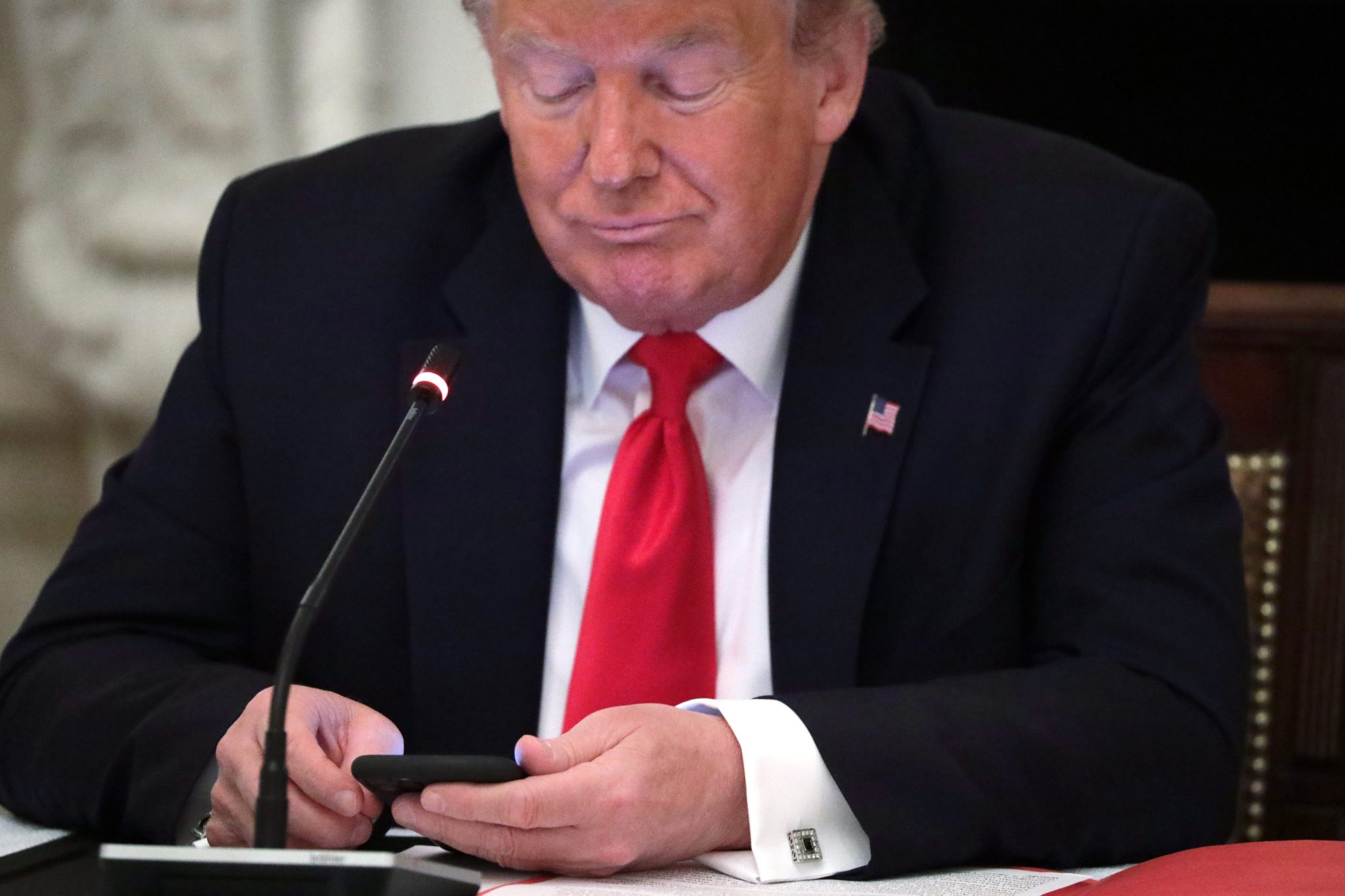
‘A huge problem’: Trump has traded more stocks than all of Congress combined. A Bush-era ethics lawyer explains why you should worry
The White House says the president's 28,700 trades are automated and hands-off.
- critical toward Donald Trump · 98%
The White House says the president's 28,700 trades are automated and hands-off.
The incident raises the possibility that top secret weapons technology may have been exposed to a foreign adversary — including China.
La Paz hopes the deal, awaiting final authorisation by the IMF’s executive board, will open other lines of finances from different institutions, like the World Bank, as the country works to restore its struggling credit status.
 Euronews19 Sept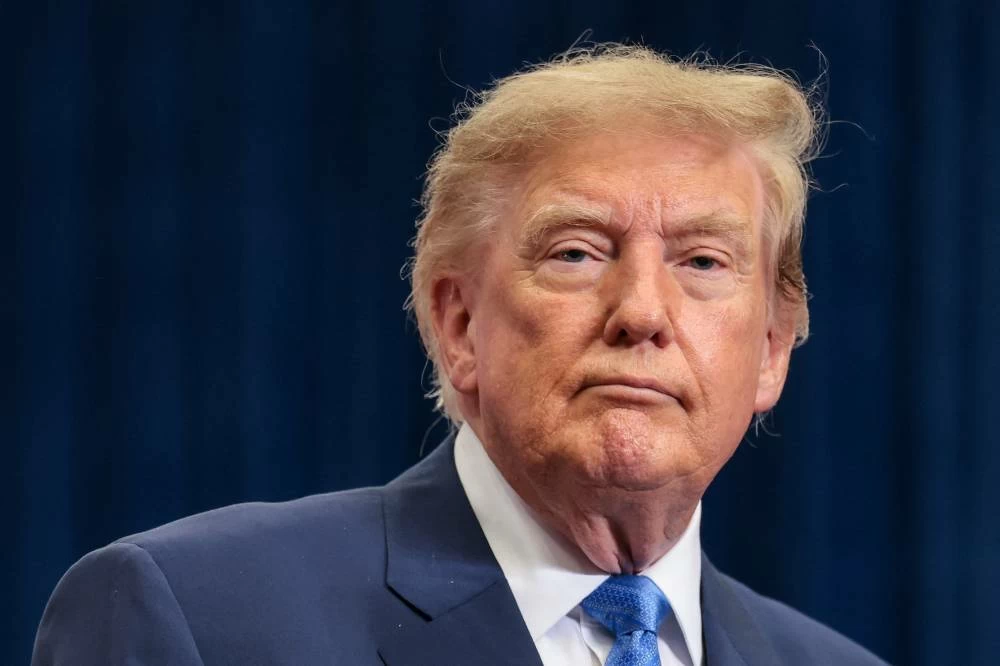
BOSTON: A US federal appeals court rejected on Friday a policy adopted by the Trump administration that allows authorities to rapidly deport migrants to countries other than their own without giving them a chance to raise safety concerns. Ruling in a case that is likely headed to the Supreme Court, a three-judge panel of the Boston-based 1st US Circuit Court of Appeals largely upheld a February decision by a lower-court judge that declared the Department of Homeland Security's policy unlawful. The ruling came in a class-action lawsuit filed by migrants subject to deportation orders that has become a key test of what due-process protections the government must provide before removing people to countries with which they have no connection. "This decision confirms that due process and the protections Congress enacted against persecution and torture cannot be circumvented by putting someone on a plane to a country that was never part of their removal proceedings," Trina Realmuto, a lawyer for the plaintiffs at the National Immigration Litigation Alliance, said. Under President Donald Trump, the administration has entered into a series of agreements that have allowed it to send more than 25,000 migrants to at least 29 third countries, in many cases Mexico, according to Third Country Deportation Watch, a project run by Refugees International and Human Rights First. The government is expected to appeal. Earlier in the case, the administration twice convinced the Supreme Court to lift a preliminary injunction protecting migrants' due-process rights, clearing the way for eight men to be deported to South Sudan. The administration has also carried out third-country deportations of people to nations including Uganda, Equatorial Guinea, Liberia and the Central African Republic. DHS General Counsel James Percival posted on X that the policy remains in force because the 1st Circuit's decision is not yet in effect. "If you claim fear in your home country, DHS has the right to send you elsewhere," he said. Third-country deportations In March 2025, DHS adopted a policy aimed at addressing individuals who were subject to final orders of deportation but had been granted protections in immigration court against being sent back to their countries of origin. The policy would allow migrants to be sent to alternative countries if immigration authorities have credible diplomatic assurances they will not be persecuted or tortured there. The policy called for only minimal notice before a migrant could be sent to a third country that had not given the State Department such assurances. US District Judge Brian Murphy, an appointee of Democratic President Joe Biden, set aside the policy and concluded that it failed to protect migrants' due-process rights and could lead to their swift deportation to unfamiliar and potentially dangerous countries, without notice. On appeal, the Trump administration contended that Murphy's order, if left intact, would usurp its authority to execute potentially thousands of valid orders of deportation to third countries. But US Circuit Judge Seth Aframe, writing for Friday's panel, said Murphy adopted a "sensible" interpretation of the immigration law requiring migrants be given a "meaningful" chance to raise any concerns before they are deported. "DHS's proposed interpretation would deny access to that protection to a substantial swath of noncitizens who are sent to third countries with no notice of their destination," Aframe wrote. "We decline to adopt such an interpretation." The panel included two Biden appointees, including Aframe, and a judge appointed by a Republican president. However, the 1st Circuit overturned one part of Murphy's ruling on procedural grounds. It concerned whether the government must first try to deport migrants to countries they have ties to before sending them to third countries.

Unions warn that fuel subsidy cuts in the IMF deal could trigger renewed protests and rising costs.
 Al Jazeera19 Sept
SESSION LESSON: Assemblymember Alex Bores would really like to take another swing at regulating Big Tech before he leaves office at the end of the year. The New York lawmaker faced the multimillion-dollar wrath of the tech industry after leading the charge on crafting state regulations for artificial intelligence, falling short in his quest to move on to the halls of Congress. But he said he’s optimistic about policymakers taking action amid growing public alarm over the risks of AI — and that he’d support a special session in Albany on the issue. “This is an urgent problem, and too frequently we have left it to California to set the nationwide standards,” Bores said. “We’ve got some pretty darn talented people here in New York … and I would love to give them the chance to lead.” The outgoing assemblymember, who has work experience in the industry, has positioned himself as a national leader on the issue with the launch of a $30 million group to develop the Democratic agenda on AI rules. There are currently no plans for a special session on AI, according to Gov. Kathy Hochul’s office. The lack of plans to return to Albany before January to work on AI rules contrasts with discussions in California, where Gov. Gavin Newsom has mused on the possibility of calling lawmakers back to Sacramento. Newsom signed an executive order today to speed up implementation of recently passed AI safety laws and consider proposals like requiring a “kill switch” for advanced AI models. New York regulators issued an order requiring gas, electric and water utilities to report on their use of AI yesterday, and New York Attorney General Letitia James urged employees at AI companies to report any rulebreaking. The jockeying between states to act on AI comes amid a crescendo of alarm, including from the industry itself, that the technology is outpacing humans’ abilities to monitor and control it. Hochul has also said she wants to take additional actions , but without offering specifics. The rhetorical flurry among state officials is also being sparked by the Trump administration’s dismissal of AI safety threats and a widespread sense that there’s little chance Congress will act on the issue anytime soon. Democratic lawmakers who’ll be returning to Albany in January are discussing their options — and gearing up for pushback from the industry. “The crux of the fight is in clawing back power from these oligarchs and putting real people in the driver's seat,” said state Sen. Kristen Gonzalez, chair of the Internet and Technology committee. Read the full story from POLITICO Pro’s Marie J. French. HEALTH CARE SETTLEMENT WATCH: NYU Langone agreed to pay $8.5 million and stop providing puberty blockers and hormonal treatment to minors under an agreement with the Justice Department announced today. DOJ has announced similar agreements with five other hospital groups, including the Mount Sinai Health System in New York City, as part of a nationwide investigation into gender-affirming care that came at the direction of President Donald Trump. NYU Langone spokesperson Steve Ritea said the DOJ agreement “protects our providers and secures the privacy and confidentiality of our patients and their families,” noting the health system denied any wrongdoing or liability as part of the agreement. “Under this agreement, DOJ has agreed to resolve its investigations, removing the threat that NYU Langone would have to provide the confidential information previously demanded about patients under 18 who received gender-affirming care at our institution,” Ritea said in a statement. NYU Langone’s statement echoes comments by Mount Sinai upon reaching a similar agreement with the Justice Department. — Maya Kaufman MEASLES ON THE RISE: In response to a growing number of measles cases in rural New York, state Health Commissioner James McDonald is calling on all New Yorkers to make sure they’ve received the measles, mumps and rubella vaccine. McDonald said yesterday at a Public Health and Health Planning Council meeting that there are 66 cases across the state, with roughly two-thirds of those in adults aged 18 years old and older. The state’s new measles dashboard reports 51 cases, but it hasn’t been updated since Saturday. The outbreak is primarily in rural and western parts of the state. Fifteen counties have reported at least one case, but the majority of cases are concentrated in Steuben, Seneca, Otsego and Allegany counties. McDonald said he’s been in contact with health officials in neighboring Pennsylvania, where 767 cases and four deaths have been reported in a fatal outbreak there, according to the Pennsylvania Department of Health dashboard . “I can’t explain why the federal government is being as confusing as they are about vaccines,” McDonald said yesterday. “But I’m not confused. There was no new research or new science when they did their executive order. Nothing changed in New York State. States determine what the required vaccines are.” He said the state has been working with local health departments to distribute more than 700 MMR vaccine doses to people living in the affected counties, where health officials traditionally face skepticism surrounding healthcare and vaccines. The push is part of a broader effort to overcome confusion over an executive order signed by President Trump last month that directs federal agencies to reduce the number of recommended vaccines children receive and spread the shots out over a longer time period. The executive order has ignited renewed hope among parents seeking exemptions from the state’s vaccine laws, which do not include a religious exemption and have proven to be a challenge when attempting to qualify for a medical exemption. — Katelyn Cordero FROM CITY HALL SCHOOL SAFETY: A longtime union leader is demanding Mayor Zohran Mamdani come up with a plan to keep classrooms safe amid recent weapons seizures at public schools. Gregory Floyd, who heads Teamsters Local 237, pointed to several recent incidents, including a student caught with a loaded gun at a Staten Island high school. His union represents nearly 2,000 municipal workers, including school safety officers. “He’s yet to say anything, he’s yet to address it,” Floyd told Playbook. “Before we get further into the school year, we want him to come up with a comprehensive plan to make sure that no one in the public school system is seriously injured or possibly killed.” Floyd decried a shortage of school safety agents, noting that the city has lost 2,000 agents since 2022. And the Mamdani administration, he said, isn’t hiring. A City Hall spokesperson did not immediately respond to a request for comment. The city saw a decrease in major felony crimes in schools, according to the mayor’s management report released Thursday. Mamdani faced criticism over the summer after eliminating vacant school safety agent positions , drawing backlash from parents and advocates as felony assaults in schools rose. Floyd pointed specifically to a lack of metal detectors. The most current version in schools, he said, has proven incapable of detecting smaller scalpels, which he described as an emerging threat in schools. Fewer than 100 schools currently have full-time scanners, according to Floyd. — Madina Touré IN OTHER NEWS — STOKING SPECULATION: Rep. Alexandria Ocasio-Cortez plans to campaign for candidates across New York, reigniting speculation she’ll run for senator or president in 2028. ( The New York Times ) — PRE-K PAY: After severe funding delays, providers of free childcare in New York City are finally being paid by the Mamdani administration, but some are still waiting. ( Gothamist ) — $10M PAYOUT: Family of Robert Brooks, man beaten to death by corrections officers, to get $10 million settlement. ( WPTZ ) Missed this morning’s New York Playbook? We forgive you. Read it here .

Republican nominee Joe Arminio was removed from a forum debate in Wilmington, Delaware after misgendering his opponent, Rep. Sarah McBride (D-Del.). During the debate between the candidates competing for Delaware’s lone congressional district, Arminio used the incorrect pronouns when referring to McBride – who made history in 2024 as the first openly transgender member of Congress. “I’m sorry to have…
 The Hill•Mira Bhakta18 Sept
After the CLARITY Act's failure, Bitwise CIO Matt Hougan said that the Bitcoin rally can continue without congressional approval.

Four bipartisan House commissioners are calling on the Senate to pass the Adams Memorial-Great American Heroes Act to establish a permanent memorial for the Adams family in Washington, D.C.
The Hill•Reps. Morgan Griffith (R-Va.), William R. Keating (D-Mass.), Stephen F. Lynch (D-Mass.), and John Moolenaar (R-Mich.), opinion contributors18 Sept
The agency submitted a prerule on crypto asset transactions and markets to the White House for review, signaling it will build a derivatives framework on its own authority after the Clarity Act's collapse.

 CoinDesk•Helene Braun18 Sept
A bipartisan group of lawmakers highlighted the integral role of staffers in the daily functions of Congress on Thursday at The Hill’s annual Notable Staffers event. Sens. Cynthia Lummis (R-Wyo.) and Cory Booker (D-N.J.), along with Reps. Jamie Raskin (D-Md.) and Bobby Scott (D-Va.), honored their staffers, who were all featured on this year’s list…
The Hill•Ryan J. Karlin18 Sept
In an appearance on CNBC's "Squawk Box," Rep. Chip Roy, R-Texas, said he supports congressional hearings on AI, but wasn't keen on additional regulations.
I wanted to begin this series for SCOTUSblog by discussing some fundamentals (and fundamental confusions) of federal Indian law. Despite the common understanding that federal Indian law is difficult and confounding , I teach my students that its foundational principles are actually fairly simple. Federal law is supreme in Indian affairs, preempting state law ( Washington v. Cougar Den ). Tribal nations (or “Indian tribes,” to use the parlance of the Constitution) are sovereign governments ( United States v. Lara ). The judiciary is to interpret ambiguous treaty and statutory provisions to the benefit of tribal interests ( Herrera v. Wyoming ). Congressional enactments rationally related to the fulfillment of that responsibility are constitutional ( Morton v. Mancari ). Despite this relative simplicity, Supreme Court justices regularly complain that federal Indian law precedents are difficult and even incompatible with the Constitution. Justice Clarence Thomas, known for regularly assailing federal Indian law precedents, decried in 2004 “ the confusion reflected in our precedent ” in a case involving the power of Congress to restore or reaffirm tribal nations’ inherent power to prosecute nonmember Indians. Justices Samuel Alito and Brett Kavanaugh repeatedly asserted during one oral argument that an equal protection challenge to the Indian Child Welfare Act (a 1978 federal law that seeks to keep Indian children with Indian families) raised “ difficult ” questions. (Kavanaugh even wrote separately to encourage a future vehicle to challenge aspects of the act .) They were joined by the federal government’s counsel, there to defend the statute, who nevertheless opined during a series of hypothetical scenarios from the court that these questions were “difficult to defend.” In fact, in the entire history of federal Indian affairs enactments, only two federal statutes have been struck down by the Supreme Court. One case, 1911’s Muskrat v. United States , taught in federal courts classes nationally, involved a strange statutory provision that allowed Cherokee tribal citizens to challenge an act of Congress only potentially impacting them, essentially authorizing the federal judiciary to render an advisory opinion. The second law, struck down twice by the court, allowed first the Interior Department and then tribal nations to confiscate “de minimus” property interests in Indian lands without compensation (see Hodel v. Irving and Babbitt v. Youpee ). And yet the litany of judges figuratively throwing up their hands in frustrated confusion continues. Perhaps it’s useful to separate the areas of confusion into three buckets. The first bucket is Congress. Thanks to the Indian commerce clause and to the exercise of the treaty power , Congress has first stab at making Indian affairs policy. In the history of federal Indian law and policy, Congressional policy has vacillated between two opposing poles. On one hand, from the founding until the late 1960s or early 1970s, Congressional policy more or less consistently favored the slow eradication of tribal governments and Indigenous land holdings. Congress wavered on how to go about this project. At times, Congress directly sought to scrub out whole regions of Indian country, as it did during the early- to mid-19th century’s Removal Era and the mid-20th century’s Termination Era . Mostly, Congress sought to create incredibly difficult conditions for tribal nations that might force them into oblivion, such as the Allotment and Assimilation Era of the latter half of the 19th century . In the 1970s until the current period, an era we call the Self-Determination Era, Congress has aggressively supported tribal interests – the polar opposite policy from removal, termination, and assimilation. Despite congressional consistency for the last 50 years, Thomas still has referred to Indian affairs policy by the inaccurate and questionable label, “ schizophrenic .” This is because such vacillating policies, for Thomas, create inconsistent precedents. The second bucket is jurisprudential. Recently, the court lamented the “confusion” in its precedents that have sustained congressional power without identifying the source or scope of that power (see Haaland v. Brackeen ). As far back as 1886, in United States v. Kagama , for example, the court described the relationship of Indian tribes to the national government as “an anomalous one, and of a complex character.” Perhaps the most infamous incidence of confusion was in Oliphant v. Suquamish Indian Tribe and United States v. Wheeler , decided 16 days apart in 1978. In the first case, the court concluded that inherent tribal powers can be divested through an “unspoken assumption” of federal, state, and tribal actors in the absence of an act of Congress regulating or abrogating that power, while in the second, the court concluded that tribal powers are retained absent explicit divestiture through an act of Congress. The third bucket of confusion arises from the court’s musings about the policy implications of its decisions. For example, complexities involving Indian country criminal jurisdiction long have perplexed the judiciary, with Congress doing little to better the situation (see Washington v. Yakima Indian Nation ). Luckily, tribes and local governments usually choose to reach agreement amongst themselves about how to police Indian country (see United States v. Cooley ). In recent years, the court has both identified jurisdictional complexity as a problem (see McGirt v. Oklahoma ’s dissent arguing against a shift from state to federal criminal jurisdiction on the Creek Reservation) and attempted to resolve it by acknowledging additional state authority over Indian country crime (see Oklahoma v. Castro-Huerta ). All this despite the court’s documented lack of institutional capacity to make sound policy judgments in Indian affairs . Where does this leave us? Recently, scholars such as Michelle Bryan and Kekek Stark have taken up suggestion from Justices Neil Gorsuch and Thomas that the court’s Indian law precedents arising from an “ atmosphere ” of colonialism be reconsidered. Undoing some of the most odious precedents of the past that are inconsistent with the modern tribal self-determination would undoubtedly clear up most of the confusion. But it is my sense that those judges most likely to express frustration with the precedents may also be frustrated with the very idea of tribal sovereignty. So we may be stuck going in circles, with a federal Indian law that is both needlessly confusing and difficult. Throughout this series, I will attempt to further unpack how those difficulties have been addressed and how that circle might be squared.
 SCOTUSblog•Matthew L.M. Fletcher18 Sept
A crop of Democratic medical professionals are running for Congress campaigning to reduce healthcare costs.
 ABC News18 Sept
The Commodity Futures Trading Commission isn't sitting idle — the agency has sent its crypto rulemaking to the White House for review.
 The Block•Sarah Wynn18 Sept
Naturally, Republicans running for Congress should campaign on President Donald Trump’s promise to pay adult Americans $5,000 if the GOP wins the midterm elections
ABC News18 Sept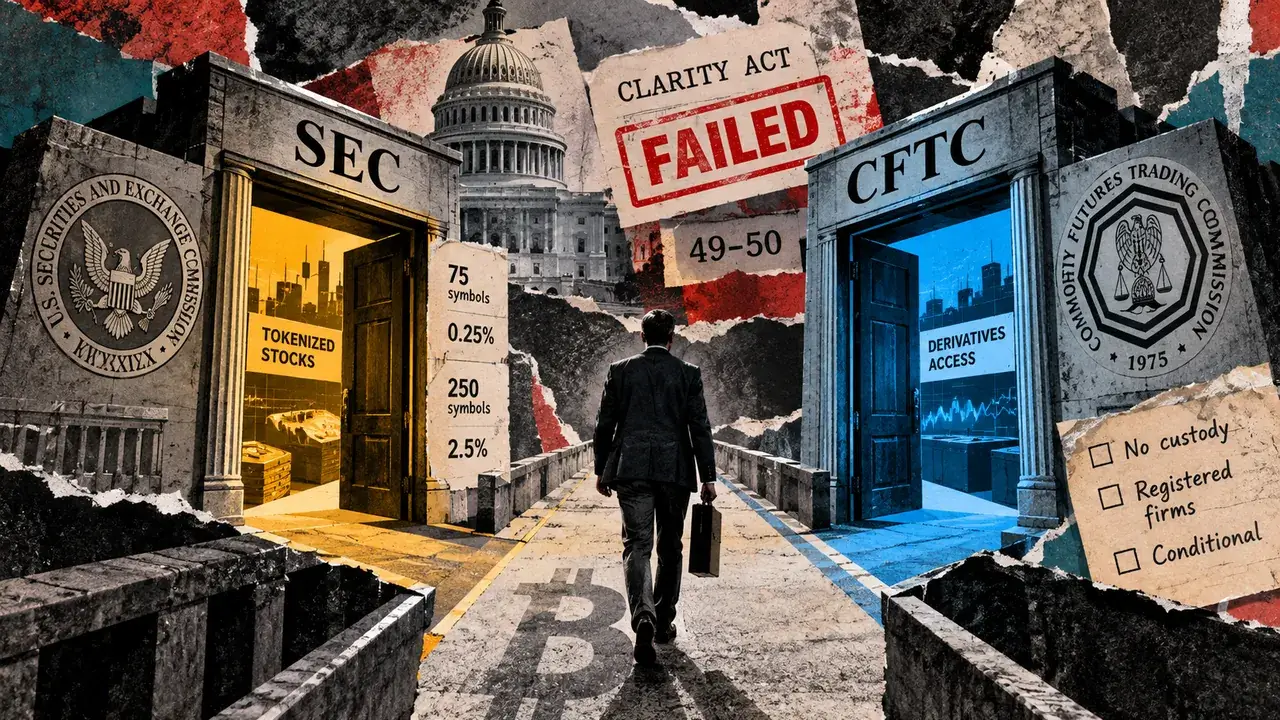
Tokenized stocks and wallet-linked derivatives can launch under new relief, while durable rights and jurisdiction remain unresolved.
 CryptoSlate•Liam 'Akiba' Wright18 Sept
The Hill’s fourth annual Notable Staffers project is a bipartisan list showcasing some of the most hard-working and influential Congressional staffers on Capitol Hill. More than 12,000 staffers in the House and Senate are the linchpins keeping Congress running year-in and year-out. They’re the unseen aides writing legislation on a host of policy matters, communicating…
The Hill18 Sept
Campaigning or control of Congress is expected to ramp up as some states open early voting The Trump administration has started sending a majority of undocumented children who came to the US alone and have new immigration court cases to Texas, where government facilities for them are unlicensed , their chances of getting a lawyer are low and advocates fear that “a deportation churn-out factory” awaits them, the Guardian has learned. Almost 80% of children in federal custody who arrived unaccompanied by a parent or legal guardian and who were placed in immigration court proceedings in July – and over 90% in August – have been funneled into shelter networks somewhere in Texas , a dramatic upswing from the months prior, according to analysis shared exclusively with the Guardian from researchers at the immigration data insights platform bklg.org. Continue reading...
 The Guardian•Taz Ali18 Sept