Iraqpage 2

Place · 219 articles
Share

Coverage, page 2

page 2 of 11

Hormuz Risk Opens $40-Plus Price Gap Between Crude Grades

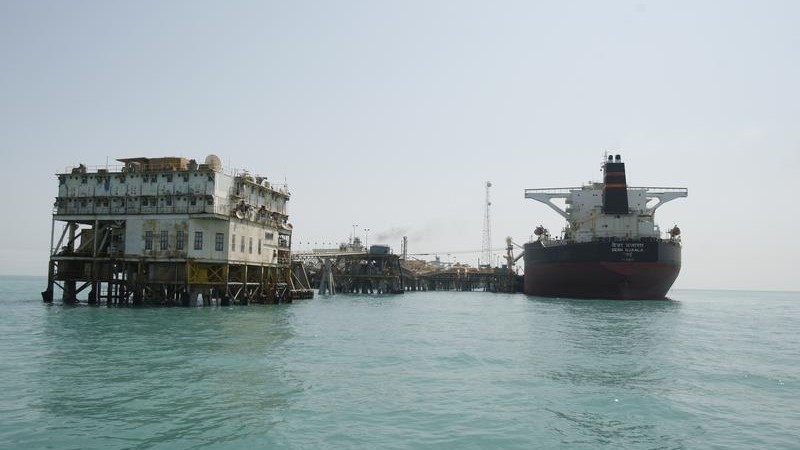
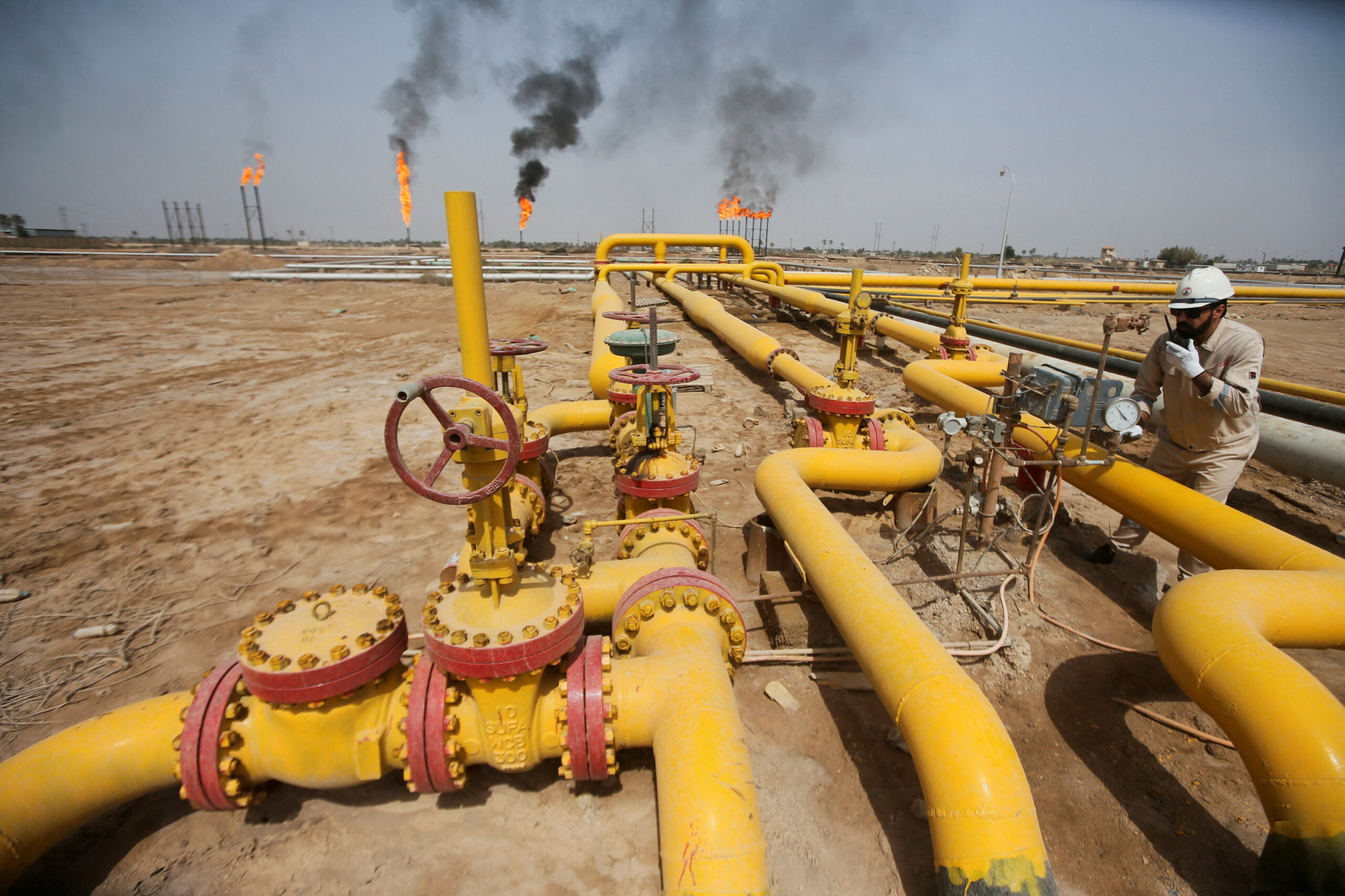
Back in late June, after the United States and Iran agreed to cease hostilities in the Persian Gulf for 60 days, oil prices took a dive. Two months later, Brent is trading at over $107 per barrel, and WTI is moving closer to $103, as a deep chasm opens up between the price for oil stuck in the Gulf and oil that can be moved with no threat of a drone or missile attack. Iraq, OPEC’s number-two producer, has suffered some of the most severe disruptions in its oil industry because of the war between the U.S. and Israel, and Iran. The country…

OilPrice.comOilPrice.comIrina Slav15 Sept

UNHCR Bulgaria Factsheet, February 2026

Countries: Bulgaria, Afghanistan, Iraq, Morocco, Syrian Arab Republic, Ukraine Source: UN High Commissioner for Refugees Please refer to the attached file. UNHCR provides protection and inclusion support to refugees from Ukraine who have fled to Bulgaria since the beginning of the full-scale war in Ukraine, of which some 84,190 are currently present in the country. UNHCR has expanded its support with assistance and protection and facilitating their socioeconomic inclusion through various programs aimed at improving access to employment and essential social services. UNHCR supports Bulgaria, being EU external border country to strengthen its asylum system ahead of the implementation of the EU Pact on Migration and Asylum.

ReliefWebReliefWebUN High Commissioner for Refugees15 Sept

Saudi Oil Pipeline Repairs Could Take Weeks After Drone Attack

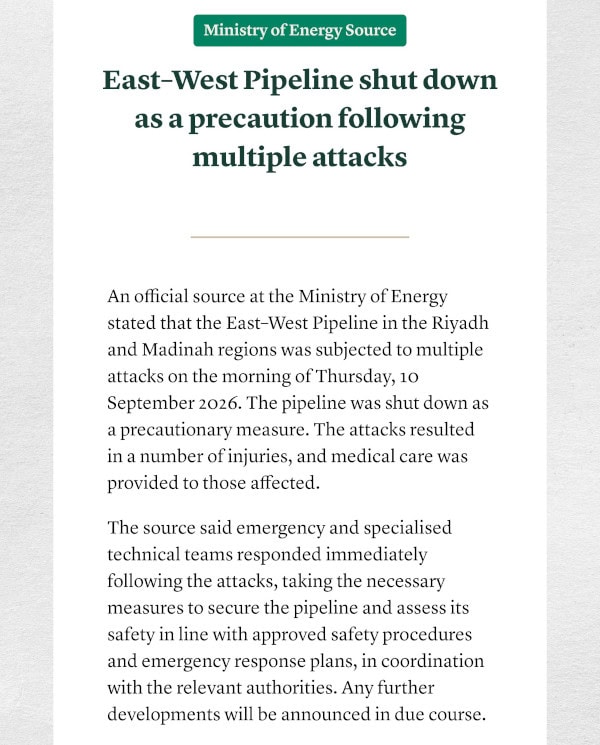
Last week’s drone attacks on Saudi Arabia’s key East-West oil pipeline have caused damage that could take weeks to repair, potentially significantly cutting the disrupted crude oil flows from the Middle East. Saudi Arabia was forced to temporarily shut down the East-West oil pipeline following drone attacks launched from the territory of Iraq close to the Iranian border on Thursday. The shutdown of the pipeline is a precautionary measure, after the attacks resulted in a number of injuries, the world’s top crude oil exporter…

OilPrice.comOilPrice.comTsvetana Paraskova15 Sept

Trump tries to jawbone oil lower

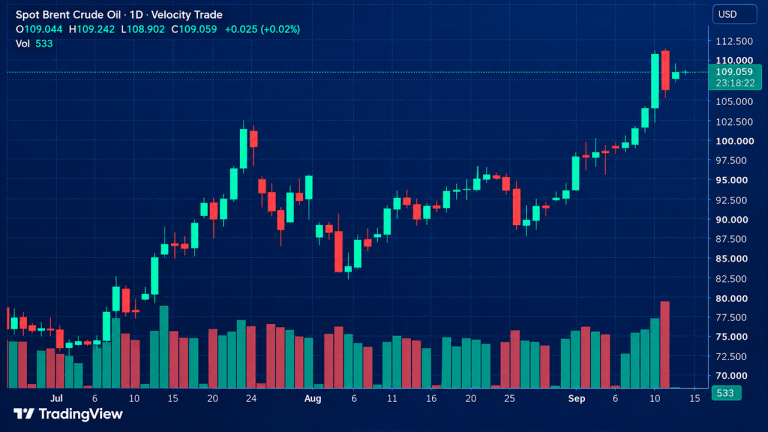
Moments ago, the US President tried to jawbone the oil market lower by suggesting in a social post that Iran "wants to make a deal, quickly and badly. I will determine whether or not the U.S.A. will choose to engage - The concept of which we are open to." However, I am not sure if there is any truth in that. Iran has repeatedly denied such reports and I wouldn't be surprised if we hear another denial this time around too. Crude prices were sharply higher earlier, resuming their rally after Saudi Arabia shut the East-West pipeline following drone attacks from Iraq at the weekend. The route is an important alternative to the Strait of Hormuz, carrying roughly 7 million barrels a day of exports. Meanwhile, Oman-led discussions with Iran and other Gulf states over a temporary shipping route through the Strait have been postponed. Against that backdrop, don't be surprised to see oil rebound off the lows again. Support is now seen around the $100.00 area on WTI, with $99.00 being the next important level. For now, the $102.80-$103.00 area has turned into resistance. Break that and $105 could be the next stop. By Fawad Razaqzada, FOREX.com analyst

TITradingView Ideas14 Sept

Syria in 2026: Between Transition and Recovery - A Secondary Data Review of Humanitarian Conditions and Operational Implications (August 2026)

Countries: Syrian Arab Republic, Egypt, Iraq, Jordan, Lebanon, Türkiye Source: Estonian Refugee Council Please refer to the attached file. Key Takeaways • Since December 2024, Syria has witnessed one of the largest and most rapid return movements of this century. More than 3.5 million refugees and IDPs have returned to their places of origin – a scale unimaginable only a few years ago. While the renewed possibility of return is encouraging, movements have far outpaced many communities’ absorption capacity. In many locations, returnees have found essential services missing and are having to live in damaged housing. As such, any future humanitarian programming should incorporate an area-based reintegration approach. • Available benchmarks show that income covers only a fraction of essential costs. In March, the minimum wage covered 28% of WFP’s MEB for a family of five and less than half (43%) of its food component. Independently, SCPR found that university educated public-sector and private-sector wages covered only 33.9% and 38.5% of the household abject-poverty line in April. These findings reinforce the need to verify household income and expenditure locally before setting transfer values and to review values regularly as prices and exchange conditions change. • Women-headed households, children, people with disabilities and families of missing persons face compounded protection concerns. Documentation and death-registration gaps restrict property rights and assistance; people with disabilities experience exclusion from work; economic stress increases GBV and harmful coping; and children are at a high risk for explosive-ordnance casualties, child labor and child marriages. Specialist legal assistance and robust referral system add-ons should be considered to ensure that assistance coverage goes beyond the minimum survival standards and accounts for specific vulnerabilities of affected groups. • Cash-delivery conditions improved somewhat in June and July as exchange-rate differences narrowed and the Central Bank expanded currency choice for beneficiaries of covered incoming remittances. However, local humanitarian transactions and procurement must still be conducted in Syrian pounds, and feasibility remains highly location specific. Financial service provider liquidity, currency availability, fees, agent coverage, documentation requirements, electricity, connectivity and cash-out safety should therefore be verified before selecting a delivery mechanism, with offline and non-cash alternatives retained. • Explosive-ordnance contamination and the prohibitive cost of land clearance constrain agricultural recovery in many return areas. Livelihood support should therefore extend beyond agriculture to viable non-farm microenterprises, particularly for womenheaded and returnee households. Productive-asset grants including support to purchase sewing machines, workshop tools, small-business stock, or equipment for small food retail activities is recommended, provided local assessment confirms demand and viability.

ReliefWebReliefWebEstonian Refugee Council14 Sept

Brent at $108: Gulf States Halt Hormuz Talks as Houthis Strike Saudi Airbase

Gulf states called off Monday's planned meeting with Iran on reopening the Strait of Hormuz the same day Yemen's Houthis fired dozens of missiles and drones at Saudi Arabia's King Khalid airbase in Khamis Mushait, calling it retaliation for more than 300 Saudi airstrikes on Yemen in five days. A Friday drone attack Riyadh blamed on Iran-backed fighters in Iraq knocked out Saudi Arabia's East-West pipeline, the kingdom's only route around the blockaded strait. The 7-million-barrel-a-day line feeds the Red Sea port of Yanbu, with traders telling…

OilPrice.comOilPrice.comCharles Kennedy14 Sept

First Thing: Oil prices surge as attacks on Saudi Arabia stoke supply fears

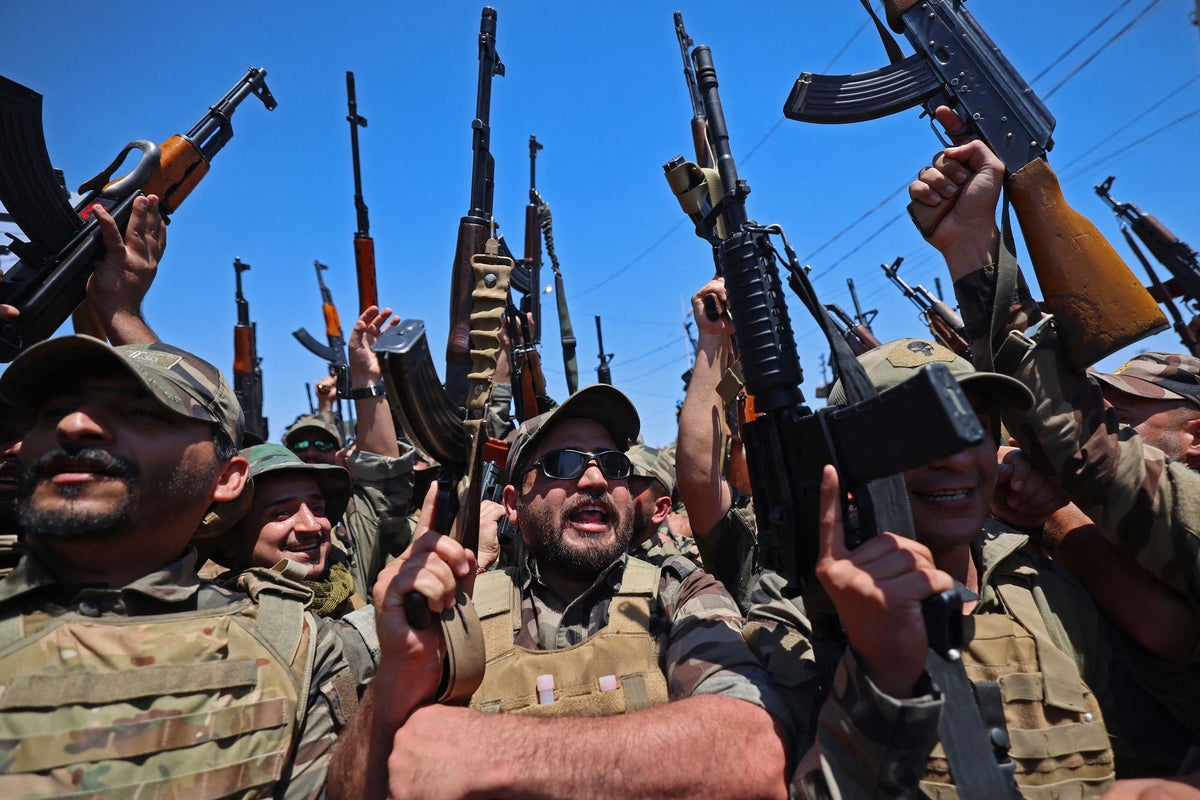
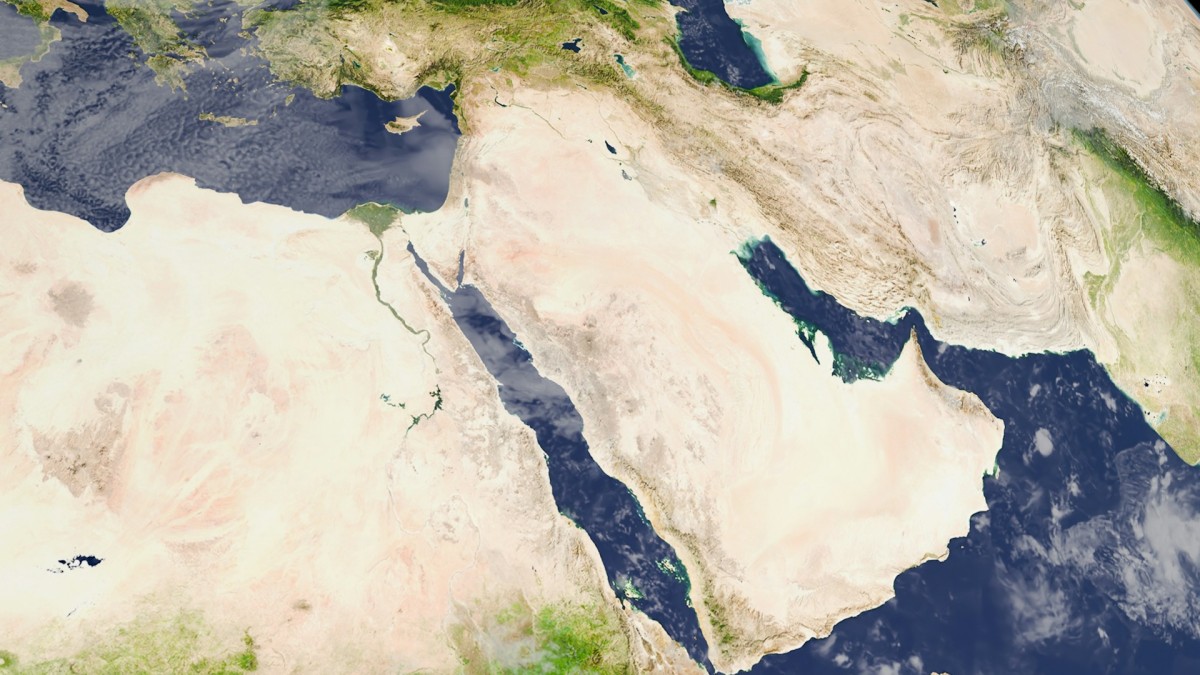
Strike on kingdom’s east-west pipeline could affect 4% of global oil supply. Plus, report reveals British monarchy’s role in financing slave trade Good morning. Oil prices have climbed above $108 a barrel after a series of drone attacks from Iraq’s territory forced Saudi Arabia to close its east-west crude pipeline. Saudi traders said the kingdom would run out of oil stocks for export if it did not reopen within days. Gas prices also climbed higher. Energy prices have surged this year, as the US-Israel war with Iran has disrupted oil and gas supply across the Middle East. The spike came as the Iran-aligned Houthi forces in Yemen launched several attacks against Saudi Arabia and captured the strategic island of Perim in the Bab al-Mandab strait on Sunday, expanding their control of the waterway. Where did the attack on Saudi Arabia come from? Iraq’s government confirmed the attacks were launched from its territory and ordered an investigation. Baghdad is under mounting pressure to stop militant groups – including those backed by Saudi Arabia’s regional rival Iran – launching attacks on Gulf countries from Iraqi soil. The US president, Donald Trump, said he believed Tehran was responsible. Why has Saudi Arabia been relying on its east-west pipeline? Riyadh has increased the use of the 745-mile pipeline since the start of the war on Iran in order to bypass the strait of Hormuz’s closure. The world’s biggest exporter has used the pipeline to reroute about 4m barrels a day – about 4% of global supply – but with the ‌pipeline out of service, the Red Sea port of Yanbu now has stocks to maintain exports for just five to seven days. What is the Anthropic CEO proposing? Robert Booth explains Amodei’s suggestion: first, each US AI company grants access to third-party evaluators; second, all companies in democratic countries establish common safety standards; and third, the world’s democratic AI powers coordinate with autocracies – notably China – to control the race. How has Barack Obama intervened over AI? The former US president made a direct appeal to Democrats to coalesce around a unified AI safety policy, arguing that waiting for voluntary compliance from tech firms was a recipe for governance failure. Continue reading...

The GuardianThe GuardianMartin Belam14 Sept

TNT’s Iraq War Drama ‘High Value Target: The Hunt for Saddam’ Is Dull and Deeply Disturbing: TV Review

Twenty-three years after the United States invaded Iraq, the American public now knows that despite his horrific reign and brutal dictatorship, Saddam Hussein never had any weapons of mass destruction. Based on former CIA analyst John Nixon’s 2016 memoir “Debriefing the President,” and adapted for television by Daniel Stiepleman and Jonathan Wakeham, TNT’s limited series, […]

VarietyVarietyAramide Tinubu13 Sept