
Nvidia agrees to acquire Hugging Face for nearly $13 billion
Nvidia's acquisition of Hugging Face could redefine AI development dynamics, potentially centralizing open-weight AI resources under its influence.
 CryptoBriefing•Editorial Team3 Sept
Nvidia's acquisition of Hugging Face could redefine AI development dynamics, potentially centralizing open-weight AI resources under its influence.
CryptoBriefing•Editorial Team3 Sept
Nvidia reaches $5.3 trillion market cap, accounting for 8% of the S&P 500 and exceeding multiple sectors while equaling 16.3% of U.S. GDP.
 The Daily Hodl•Daily Hodl Agent3 Sept
AI's integration into economic infrastructure could redefine global market dynamics, influencing tech investments and competitive landscapes.
CryptoBriefing•Estefano Gomez3 Sept
Broadcom's AI chip growth highlights a shift towards custom solutions, potentially reshaping market dynamics and challenging Nvidia's dominance.
CryptoBriefing•Editorial Team3 Sept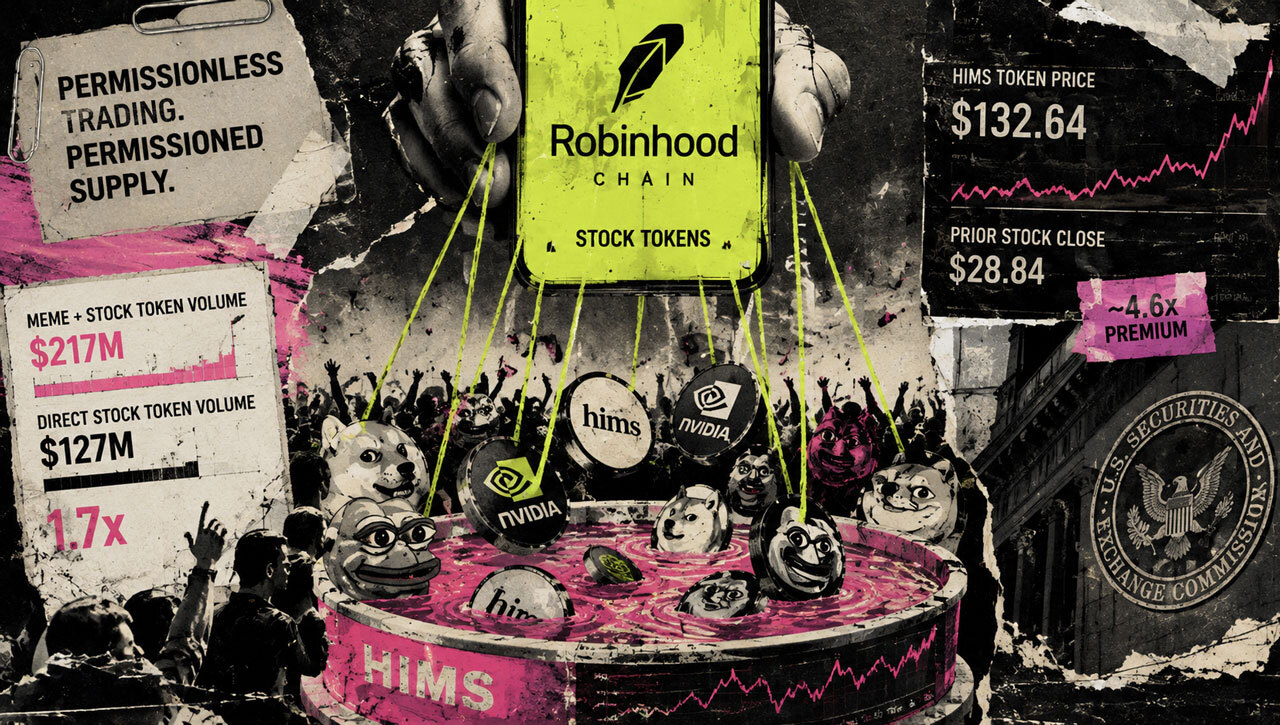
Memecoins paired against Robinhood's tokenized stocks generated $217 million of trading volume on Robinhood Chain on Sept. 2, according to data compiled by on-chain researcher Adam Tehc. The volume outpaced the $127 million that traded through direct stock token markets that same day. Traders are using tokenized Nvidia or Hims & Hers shares as the […]
 CryptoSlate•Gino Matos3 Sept
Nvidia insider selling hit $1.09 billion as director Mark Stevens filed to sell 5 million shares. NVDA still rose 3.21%.
 BeInCrypto•Phil Haunhorst3 Sept
Nvidia's dominance in the S&P 500 highlights concentration risks, potentially amplifying market volatility and influencing passive investment returns.
CryptoBriefing•Editorial Team2 Sept
A 25-company coalition including Nvidia, Microsoft, and Meta opposes US restrictions on open-weight AI models, arguing the push benefits closed
CryptoBriefing•Editorial Team2 Sept
Nvidia's influence on market indices highlights the growing impact of tech giants on financial markets, potentially increasing volatility.
CryptoBriefing•Editorial Team2 Sept
iPronics' innovation could revolutionize data center efficiency, reducing costs and energy use, while enhancing GPU utilization and scalability.
CryptoBriefing•Editorial Team2 Sept
AI's framing as critical infrastructure could drive global investment shifts, influencing national strategies and regulatory approaches.
CryptoBriefing•Editorial Team2 Sept
Expanding AI infrastructure could enhance global economic growth, solidify Nvidia's market position, and influence tech industry dynamics.
CryptoBriefing•Estefano Gomez2 Sept
Equinix's new AI marketplace could revolutionize enterprise AI deployment, enhancing global data accessibility and reducing vendor lock-in.
CryptoBriefing•Editorial Team2 Sept
As the war in Ukraine progressed, Russian strikes increasingly degraded Ukraine’s terrestrial communications infrastructure, steadily deepening Kyiv’s dependence on SpaceX’s Starlink. The satellite constellation became indispensable for crucial military functions, including command and control, drone operations, and artillery fire coordination, with no readily available European alternative should access be withdrawn.This reality exemplifies the idea that today, governments rely on critical infrastructure that is privately owned and globally embedded. But these interdependencies can be weaponized, and state-firm relations can become misaligned. Recent controversies over the ability of American and Chinese technology companies to restrict access to critical AI models, alongside NVIDIA’s
 War on the Rocks•Ivan Zaccagnini2 Sept
South Korea's AI investment reshapes global tech dynamics, enhancing Nvidia's position while highlighting SK Hynix's supportive role.
CryptoBriefing•Estefano Gomez2 Sept
The deal, part of MediaTek's record $3.9 billion bond offering, ties Nvidia's chip ecosystem to a Taiwanese rival building its own AI accelerator business.

Software optimization could disrupt Nvidia's dominance, potentially reshaping the GPU market by enhancing AMD's competitive edge and cost-effectiveness.
CryptoBriefing•Editorial Team1 Sept
Wafer's decision to remain independent could disrupt the AI hardware market by enhancing competition and reducing reliance on Nvidia's ecosystem.
CryptoBriefing•Editorial Team1 Sept
Nvidia's focus on physical AI could revolutionize industries, but geopolitical challenges and market dynamics may impact growth projections.
CryptoBriefing•Editorial Team1 Sept
The integration of AI in cybersecurity could significantly enhance threat detection and response times, reshaping industry standards.
CryptoBriefing•Editorial Team1 Sept