
BNB Chain

Platform · 174 articles
Share

All coverage

page 1 of 9

Ondo And Alpaca Add In-Kind Minting For Tokenized Stocks

TL;DR Ondo Finance has added in-kind minting and redemption for institutional Ondo Stocks users. Eligible institutions can contribute existing equity inventory rather than converting shares to cash first. The service currently supports tokenized positions on Ethereum and BNB Chain and is not a retail minting product. Ondo Finance is removing one of the more awkward steps in institutional stock tokenization: converting existing share inventory to cash before moving it onchain. Through an integration with Alpaca’s Instant Tokenization Network, eligible institutional users can now contribute existing equity inventory directly to mint Ondo Stocks positions. Shares Can Move Into The Tokenized System Without A Cash Detour The new in-kind flow changes the mechanics for institutions that already hold the underlying securities. Instead of selling shares, moving cash and then using that cash to create tokenized exposure, qualified users can deposit the existing inventory into the process. Ondo says the mechanism supports minting and redemption on Ethereum and BNB Chain. For large institutions, that can reduce settlement friction and make tokenized equities feel less like a separate market that needs to be funded from scratch. It also brings the workflow closer to the creation-and-redemption mechanics familiar from other institutional investment products. Retail Users Are Not The Target The service is restricted to KYC and AML-verified institutional participants. That means this is not a new button that lets ordinary retail users turn brokerage shares into blockchain tokens. The significance is more structural. Tokenized securities become easier to scale when the conversion process works with the inventory institutions already hold. Ondo and Alpaca are effectively trying to make the bridge between conventional equity custody and tokenized ownership less cumbersome. The product is now live for eligible institutional users on Ethereum and BNB Chain, with no cash-conversion step required for contributed inventory. This article was written by the News Desk and edited by Samuel Rae.

NewsBTCNewsBTCNewsBTC Editorial Team6h ago

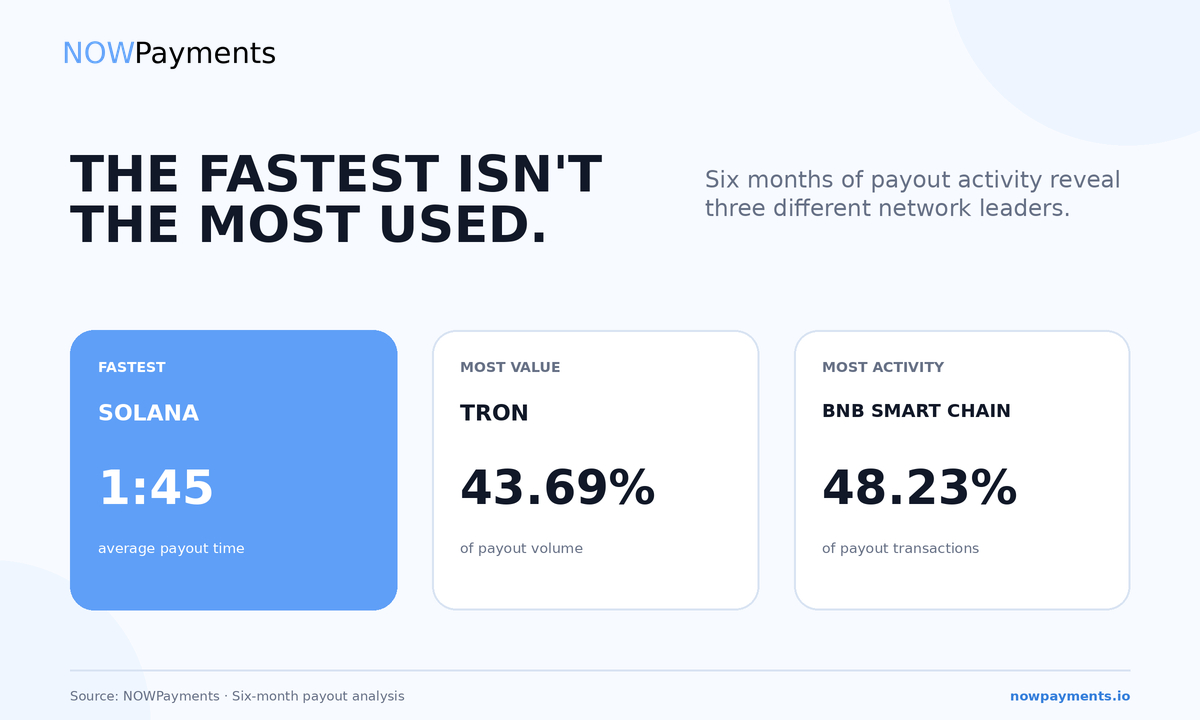
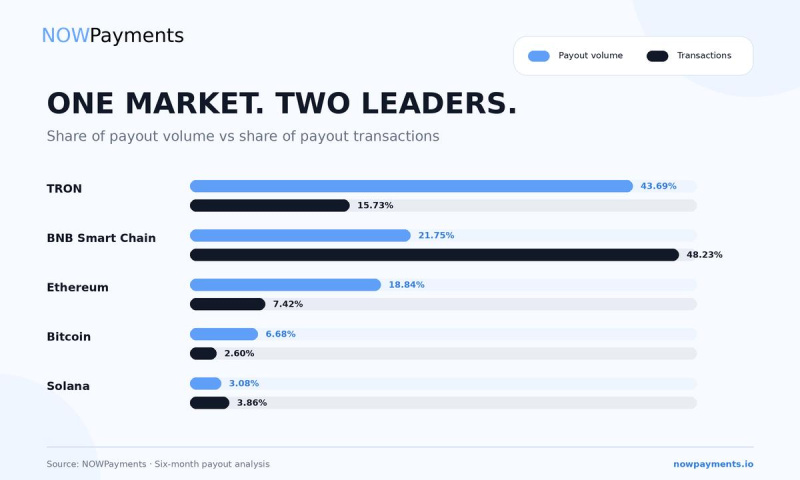
NOWPayments Releases Cross-Chain Payout Data Revealing Key Performance Benchmarks Across TRON, BNB Chain, and Solana

[PRESS RELEASE – Tallinn, Estonia, September 21st, 2026] NOWPayments today published new empirical data analyzing six months of enterprise payout activity, offering a comparative performance benchmark across TRON, BNB Smart Chain, Solana, Bitcoin, and Ethereum to help businesses select optimal blockchain rails based on speed, transaction volume, and cost efficiency. The dataset reveals distinct operational […]

CryptoPotatoCryptoPotatoChainwire21 Sept
  • neutral toward BNB Chain · 92%

ASTER — Textbook Accumulation Meets Fundamentals- Breakout Setup

ASTER/USDT is printing one of the cleaner textbook reversal structures on the daily chart, and it lines up almost perfectly with the token's first TGE anniversary (17 Sep 2025). Here is the sequence the market has walked through, step by step: 1. Exhaustion of the downtrend. From the November highs, price carved a series of lower lows and lower highs — a healthy, orderly markdown. This is the phase where late longs are flushed and supply is transferred to stronger hands. 2. Bullish divergence at the lows. As price pushed to fresh lows into February, the oscillator refused to confirm — momentum was rising while price was falling. That classic bullish divergence is typically the first tell that sellers are losing control. 3. Accumulation. Since February, price has traded sideways in a well-defined accumulation box between roughly 0.60 and 0.74. Volatility compressed, the moving averages coiled and flattened, and the range tightened — the signature of quiet distribution being absorbed before an expansion move. 4. On the brink of breakout. Price is now pressing the upper boundary of the box and has reclaimed the fast MAs. A daily close and hold above the entry trigger would confirm the range break and open the path toward the major resistance shelf. One honest caveat: a short-term bearish divergence has formed on the recent local high (visible on both price and the oscillator). That argues for patience — I want confirmation above the trigger rather than front-running the box. If the breakout fails and price loses the range, the structure is invalidated and the thesis is off the table until it rebuilds. FUNDAMENTAL BACKDROP The technical setup does not exist in a vacuum — the fundamental tape for ASTER is unusually constructive: What Aster is: a multi-chain perpetuals DEX (spot + perps across BNB Chain, Ethereum, Solana and Arbitrum) built from the 2024 merger of Astherus and APX Finance. It has positioned itself as a direct challenger to Hyperliquid, with hidden orders, MEV-resistant execution, stock/RWA perpetuals and yield-bearing collateral. It is backed by YZi Labs (formerly Binance Labs). Aggressive deflationary tokenomics. Since the June 2026 overhaul, up to 99% of daily platform fees are routed into ASTER buybacks for stakers, with a matching burn from reserves — a self-reinforcing loop where higher trading volume directly tightens supply. Cumulative burns have run into the hundreds of millions of tokens. Supply overhang removed. On 1 Sep 2026, the team extended the cliff on its 400M-token allocation (5% of supply) by a full year to 17 Sep 2027. Tokens that many feared would begin unlocking this month are now locked for another year — a materially cleaner near-term supply path than most peers carry. Product expansion. The Aster Chain L1, on-chain governance, staking, and RWA market growth continue to broaden the fee base — which, under the current model, feeds directly back into buyback pressure. Net read: strong deflationary mechanics plus a removed unlock overhang are exactly the kind of fundamental tailwinds that convert a technical accumulation into a sustained trend. TRADE PLAN Parameter Level Entry (on confirmed breakout) ~0.873 Take Profit 1 ~1.20 Take Profit 2 ~1.372 (major resistance) Stop Loss ~0.656 (below accumulation box) Execution notes: Trigger the long only on a decisive daily close and hold above ~0.873; avoid anticipating the box break given the local bearish divergence. Reclaiming and holding this level opens the door to the 1.20 shelf, with 1.372 as the extended target into major resistance. Scale out partials at TP1 and move stop to breakeven to lock in a risk-free runner toward TP2. Invalidation is clean: a breakdown and daily close below the box lows negates the setup. Not financial advice. This is a personal analysis shared for educational purposes — always do your own research and manage risk according to your own plan.

TITradingView Ideas17 Sept

Token Burns Still Make Crypto Traders Pay Attention — Revenue-Linked Burns Could Be the Bigger Upside Play. Where Does Wanted Network Fit?

Crypto traders have always loved a shrinking supply story. The logic is brutally simple: if demand holds while fewer tokens remain available, the setup can become more attractive. That is why burns, buybacks, and supply reduction mechanics still grab attention even after years of tokenomics experiments. The numbers can be dramatic. In July 2026, BNB Chain […]

CryptoPotatoCryptoPotatoFelix Mollen15 Sept