
CLARITY Act Fails Senate Vote, Circle Stock Falls 11%
The CLARITY Act fell short of 60 Senate votes on Tuesday. Circle stock dropped 11% as the crypto bill stalled.
 BeInCrypto•Lockridge Okoth15 Sept
The CLARITY Act fell short of 60 Senate votes on Tuesday. Circle stock dropped 11% as the crypto bill stalled.
BeInCrypto•Lockridge Okoth15 Sept
The failed procedural vote leaves the CLARITY Act facing an uncertain future after months of negotiations over crypto oversight and ethics provisions.
 Cointelegraph•Cointelegraph by Sam Bourgi15 Sept
Bitcoin price slipped below $76,000 before recovering toward $76,900, with weak momentum and dense liquidation zones leaving the price vulnerable ahead of the CLARITY Act vote and Federal Reserve decision. Bitcoin price rebounds after falling below $76,000 According to data…

Warren's opposition to the Crypto Clarity Act underscores the complex political landscape, potentially stalling regulatory clarity for digital assets.
 CryptoBriefing•Estefano Gomez15 Sept
Ripple CEO Brad Garlinghouse says crypto will ultimately prevail regardless of the Clarity Act’s fate, arguing that superior technology tends to win even as the landmark bill faces mounting pressure in the Senate.
 U.Today•Alex Dovbnya15 Sept
Sen. Elizabeth Warren says she remains determined to get a crypto bill signed into law — even if she doesn’t support the current Clarity Act.
 The Block•Sarah Wynn15 Sept
The Wyoming Republican says the final text hands Democrats more than 120 of their own demands, including sweeping new ethics rules, as the Senate holds a make-or-break cloture vote Tuesday afternoon.
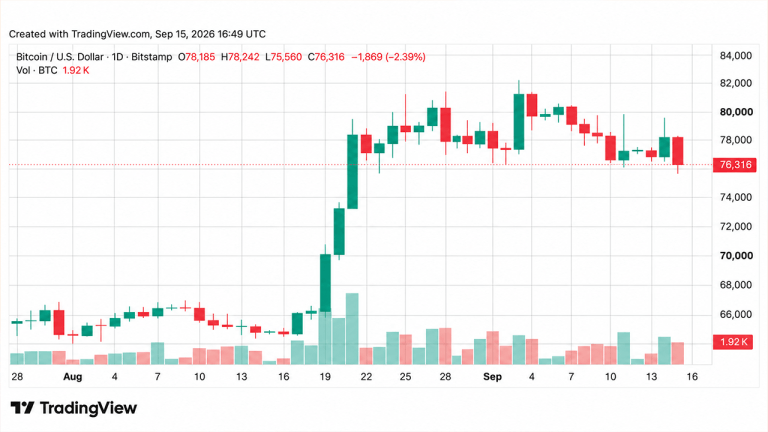
Bitcoin’s price dropped below $76,000, erasing its Monday gains and hitting a nearly four-week low of $75,560 after breaking past key $77,000 support. Market Reversal Bitcoin wiped out Monday’s gains, tumbling below $76,000 as Senate negotiations over the CLARITY Act remained deadlocked. The reversal came ahead of a crucial Federal Open Market Committee (FOMC) meeting, […]
 Bitcoin.com News•Terence Zimwara15 Sept
Bitcoin price action weakened over market nerves prior to the Senate CLARITY Act vote, while surging bond yields pressured risk assets across the board.
Cointelegraph•Cointelegraph by William Suberg15 Sept
Clarity act i dont thin i ll pass today, which will dump to price to 70 - 69 area giving us a buying chance. Looking forward to next year and 2028 too. I dont i ll be hikes rate aventhou odds are not in favour of that

Polymarket priced the odds of the bill becoming law this year at 12.5% on Tuesday morning, down from 29.5% on Monday afternoon, ahead of a cloture vote scheduled for 2:15 p.m. Ninety-five of the 124 largest non-stablecoin tokens fell as the Federal Reserve opened a two-day meeting with a
 The Defiant•The Defiant Team15 Sept
 CoinDesk•Nikhilesh De15 Sept
*Summary*: BTC is testing a key support zone between *$73,477 and $75,094* the red box. If support holds = next target is *$85,575* the green box. The chart shows a potential bullish W pattern. *cRSI 20*: At 28.79 and 37.80 = *Oversold zone*. This is a positive signal for a potential bounce. *Scenarios:* 1. *Bullish*: Holding above $75,094 with target $85,575 2. *Bearish*: Breaking $73,477 with next target $71,300 *Reason*: Market pressure due to waiting for the US CLARITY Act vote result
A Senate vote at 2:15 p.m. ET Tuesday could decide whether the CLARITY Act stays alive, but senators aren’t actually voting on whether to pass the crypto bill. They’re voting on whether to stop debating it. That requires 60 votes, meaning the Republican majority needs Democratic help before the Senate can even reach the ordinary […]
Bitcoin.com News•Jamie Redman15 Sept
Senate Republicans have rejected a late Democratic counteroffer and kept the CLARITY Act on course for a 60-vote procedural test at 2:15 p.m. ET on Sep. 15. According to Katie Warbinton, a spokesperson for Republican Senator Cynthia Lummis, Democrats “have…

The Senate vote and Fed decision could reshape crypto regulation and market dynamics, influencing institutional investment and asset volatility.
CryptoBriefing•Editorial Team15 Sept
Democrats are pushing for further concessions as Republicans insist their latest text is their final offer ahead of today’s 60-vote test.

Bitcoin just gave back its entire post-golden-cross rally in one red candle, with a make-or-break Senate vote landing this afternoon and the Fed staring down a rate hike.

Hours ahead of an initial vote on the Clarity Act, Senate Republicans are pushing back against a counterproposal from fellow Democrats.
The Block•Sarah Wynn15 Sept
The US risks falling behind in digital finance innovation, potentially ceding leadership to regions with clearer regulatory frameworks.
CryptoBriefing•Editorial Team15 Sept