
Trump crypto profits hit $1.4B as CLARITY Act faces ethics fight
Congress can't seem to ignore a billion dollars worth of conflict.
 AMBCrypto•Samyukhtha L KM10 Sept
Congress can't seem to ignore a billion dollars worth of conflict.
AMBCrypto•Samyukhtha L KM10 Sept
Court reform is a hot topic these days. Scholars , commentators , and politicians argue that the Supreme Court is aggrandizing its powers at the expense of Congress, undermining American democracy, and facilitating the Trump administration’s authoritarian overreach both with substantive rulings like the immunity decision and with its persistent interventions in favor of the president on the shadow docket – to name just a few of the critiques. Reform proposals include term limits (an idea that has long had cross-ideological support), increasing the number of justices (a version of which Rep. James Clyburn endorsed just this past weekend), and narrowing the court’s jurisdiction . Court reform opponents , on the other hand, often argue that reforming the court in response to disfavored opinions inappropriately politicizes and thus undermines an independent judiciary. There may be some truth to this argument. Restructuring the judiciary or dramatically changing the size or operation of the court in our politically polarized environment could, for example, lead to a political tit-for-tat where each party adds seats to the court (for example) whenever they can. Reformers should take into account what types and packages of reforms are more likely to produce stability . But it is a mistake to think about the work of the court as so removed from politics that reforms are inherently inappropriate. I start from the premise that how to interpret and apply the Constitution is an appropriate subject for democratic contestation. For example: Should we interpret the Constitution according to the “original public meaning,” which many originalists argue is the best way to identify what was actually ratified and therefore, they say, what has the strongest claim on democratic legitimacy? On the other hand, should it matter that such an inquiry, by definition, restricts the focus of the inquiry to a time when most people living in the United States could not vote or participate in public debate and might not even have been literate? Or what if the original public meaning is unclear? Does it matter at what level of generality we consider various constitutional provisions or to what extent we take into account how the drafters and ratifiers would have applied them? For example, if we view “equal protection of the law” as a statement of principle, then it is not hard to see why segregated schools are unconstitutional – even if few in 1868 thought that was how the 14th Amendment would be applied. Likewise, how should we decide whether that principle of equality reaches discrimination against women, discrimination on the basis of religion, or discrimination on the basis of sexual orientation and gender identity? What should we do when different provisions or aspects of the Constitution are in tension or conflict with each other? As Justice David Souter pointed out , the First Amendment is written in absolute terms. Yet the Constitution also contains a commitment to national security, albeit a less express one. Sometimes those commitments may be inconsistent. How should judges and justices resolve those dilemmas? These questions are worthy of public and political debate, which the Constitution itself contemplates and allows for. Why else, after all, are Supreme Court justices nominated by the president and confirmed by the Senate? As a result, the role of the court and the types of justices that will be appointed can be important campaign issues, and the nomination and confirmation process offers another opportunity for this public debate. (I’ve written elsewhere about how important confirmation hearings can be to the public’s understanding of what Supreme Court justices do and to different visions of the Constitution.) Indeed, I think that the national argument over Judge Robert Bork’s nomination, which engaged directly with his originalist philosophy, was democracy in action . So democratic input (with a small d) is built in. But a several factors have reduced its impact. One factor is the Constitution’s guarantee of life tenure for the justices. Life tenure means that the timing of justices’ deaths is crucial to the court’s make-up. And it encourages strategic retirements (see Justice Anthony Kennedy). All of that directly affects the number of justices a particular president gets to appoint. President Jimmy Carter appointed none in his single term. President Barack Obama appointed two over the course of two terms. President Donald Trump, in his first term alone, appointed three. The constitutional arrangement also rewards gamesmanship other than strategic retirements, as we saw after the deaths of Justice Antonin Scalia and Justice Ruth Bader Ginsburg. Then-Senate Majority Leader Mitch McConnell refused to allow the Senate to consider Obama’s nominee, Judge Merrick Garland, to replace Scalia because, he said, it was an election year. (The election, at the time of Scalia’s death, was eight months away.) Nevertheless, after Ginsburg’s unexpected death only weeks before the 2020 election, McConnell rushed through Trump’s nomination of Justice Amy Coney Barrett, with the confirmation vote shortly before Election Day. Readers of SCOTUSblog undoubtedly know all of that. But here’s another way of looking at it: We have a minoritarian court, in which its current make-up is further from the democratic input ordinarily provided by the nomination and confirmation process than perhaps ever before. As Kevin McMahon details in his book, “ A Supreme Court Unlike Any Other: The Deepening Divide Between the Justices And the People ,” five current justices were confirmed by the votes of senators who collectively represent millions fewer Americans than the senators who voted not to confirm. Using popular vote totals as a proxy, McMahon has shown that when Clarence Thomas was confirmed, for example, with a vote of 52-48, the senators who voted for his nomination collectively received nearly 3 million fewer votes than those who voted against it. Justice Samuel Alito, too, falls in this category, with a vote difference of 1.8 million. The three Trump justices – Justices Neil Gorsuch, Brett Kavanaugh, and Amy Coney Barrett – are even more minoritarian, as McMahon points out. For one thing, the president who nominated them himself lost the popular vote by more than 2.8 million votes. And in addition, the difference in popular vote totals for the senators voting for and against confirmation has grown dramatically. When Gorsuch was confirmed, for example, with a vote of 54-45, the senators who voted for his confirmation collectively received just under 56.7 million votes, while those who voted against it received 76.5 million, nearly 22 million more. (Another data point, courtesy of Daniel Immerwaher , reviewing Nikolas Bowie and Daphna Renan’s new book “ Supremacy: How Rule by the Courts Replaced Government by the People ”: “In the span of the Presidencies that yielded today’s Court, Republicans won the popular vote less than a third of the time but have appointed two-thirds of the current Justices.”) All of this is perfectly constitutional. But a justices’ nominations and confirmations are not the only ways the Constitution allows for small-d democratic input into the make-up and operation of the Supreme Court. Congress also has the power to add seats to the court; it has done so before. And Congress has the power to control at least some aspects of the court’s jurisdiction and workload. Indeed, the current arrangement, where the court has almost complete discretion over what cases it decides, is due to a series of 20th century laws , culminating in 1988 . (See these posts for longer, albeit not exhaustive, lists of congressional power related to the Supreme Court.) None of this is to advocate for the wisdom or the constitutionality of any particular reform proposal. It is instead to push back against the idea that changing the court necessarily politicizes it inappropriately. The Constitution contemplates and provides a number of mechanisms for democratic input and responses to the Supreme Court. As described, one of those mechanisms, nomination and confirmation, has arguably become a less effective way to provide that input than in the past. We should not ignore the others.
 SCOTUSblog•Carolyn Shapiro10 Sept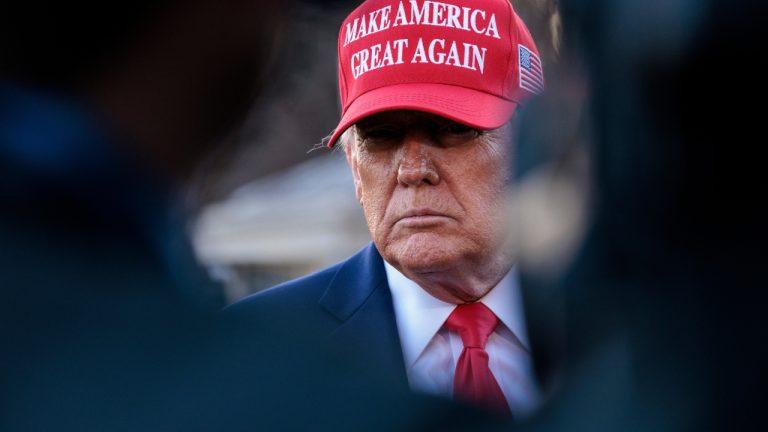
Bitcoin’s price held steady between $77,650 to $78,000 even as President Donald Trump offers $5,000 dividend checks to American adults if Republicans retain Congress in the midterm elections. Bitcoin Holds Flat Ahead of Key Inflation Data Bitcoin’s price was largely unchanged early Thursday, just hours after U.S. President Donald Trump floated the idea of $5,000 […]
 Bitcoin.com News•Terence Zimwara10 Sept
Twenty-five years after the attacks, twice as many people have died from illnesses linked to World Trade Center exposure as were killed on September 11 itself.
 The Hill•Ray Stanton, opinion contributor10 Sept
President Trump promised to send every adult citizen $5,000, but only if Republicans maintain control of Congress in the midterm election, drawing a strong response from House Democrats.
 NPR•Tamara Keith10 Sept
President Trump promised to send every adult citizen $5,000, but only if Republicans maintain control of Congress in the midterm election, drawing a strong response from House Democrats.
NPR•Tamara Keith10 Sept
U.S. President Donald Trump said Wednesday he would pay every American adult a $5,000 US "Trump dividend" if Republicans retain control of Congress in November's midterm elections, an extraordinary attempt to persuade voters to back his party.

US lawmakers answered an Anthropic researcher’s resignation with a fresh push to halt advanced artificial intelligence (AI) development, including a Senate bill that would ban superintelligence outright. Jacob Coxon quit on September 9 and said Anthropic and OpenAI are both gambling with human lives. Why the Anthropic Researcher’s Resignation Reached Capitol Hill More than 20
 BeInCrypto•Kamina Bashir10 Sept
Coinbase CEO Brian Armstrong has said the U.S. crypto industry could get clearer federal rules regardless of whether the CLARITY Act clears its key Senate test on Sept. 15. CNBC reported Wednesday that Armstrong expects either Congress or federal regulators…

President Trump pledged a $5,000 payout to U.S. adults on Wednesday, but only if Republicans hold on to their majority in Congress come November. “Here is my promise: If the Republicans win the House of Representatives and the United States Senate, both of them … because of our tremendous strength and success economically, I will…
The Hill•Mallory Wilson10 Sept
Trump administration to seek extra funding from Congress to ‘dismantle’ Los Tiguerones over narcotics trafficking The US has designated Ecuador’s Los Tiguerones gang, which stormed a television station during a live broadcast in 2024, as a terrorist organisation as the Trump administration expands its campaign against narcotics traffickers it says are destabilising Latin America. The US secretary of state, Marco Rubio, made the announcement in Quito, where he met Ecuadorian president Daniel Noboa, one of several rightwing allies of Donald Trump whom Rubio is courting as a security partner during a three-nation tour through Latin America that began on Tuesday. Continue reading...
 The Guardian•Andrew Roth and agencies9 Sept
Congress’s official ethics watchdog has cleared Rep. Ilhan Omar (D-Minn.) of misconduct related to inflated financial filings, according to the Minnesota Democrat’s office. The Office of Congressional Conduct (OCC) “delivered an overwhelming vote to dismiss any allegations against the Congresswoman,” an Omar spokesperson said Wednesday in a statement. “From day one, we have been clear:…
The Hill•Mike Lillis9 Sept
FBI Director Kash Patel is set to testify on Tuesday in front of Congress, according to members of the Senate Judiciary Committee. In a Wednesday post on the social platform X, the account for the Democrats on the panel said, “FBI Director Kash Patel to testify before the Senate Judiciary Committee on Tuesday, September 15.”…
The Hill•Tara Suter9 Sept
It’s hard to believe, but SCOTUSblog has now been around for nearly a quarter-century – old enough to run for Congress! SCOTUSblog was originally launched to help promote a then-three-person law firm. As a business-development strategy, the blog was not particularly successful, but it was a lot of fun, and other people seemed to find it useful. And, incredibly, over the years, SCOTUSblog became the definitive source for comprehensive and independent coverage of the Supreme Court. Last year, SCOTUSblog began a new chapter when it became part of The Dispatch family. As part of its acquisition of SCOTUSblog, The Dispatch’s co-founder and CEO, Steve Hayes, promised both to “let SCOTUSblog be SCOTUSblog” and to “invest in” the blog “to ensure that it remains the go-to authority on the Supreme Court.” Just over 15 months later, we couldn’t be happier with how The Dispatch’s bet on us is paying off. We’ve launched a daily newsletter, brought on more than 20 recurring columnists, revived the popular Stat Pack (and even introduced a new one), expanded our coverage of the court to include all of the argued cases and live blogs of high-profile arguments, and given the site a complete redesign – with plenty more to come. Today, we are excited to announce our next chapter: SCOTUSblog Plus. Subscribe to Plus Here’s why we’re launching Plus: First, the Supreme Court plays a central role in the direction of our country, deciding legal issues that shape our future and affect our daily lives. But it is an institution that is both relatively opaque and often misunderstood, which calls for especially careful coverage of it. Second, and relatedly, many of you have asked for even more analysis, reporting, and breakdown of arguments, orders, and decisions – including of the circuit and district courts. We hear you. Third, and to be blunt, running a blog like this one costs money. Your purchase of Plus will give us the resources to thrive in an increasingly difficult and competitive media environment. It will also give us the ability to continue our expansion and maintain SCOTUSblog as the best resource on the Supreme Court out there. But what exactly will you get with Plus? Our daily newsletter, SCOTUStoday : All of the day’s Supreme Court news and commentary, presented in a smart, approachable, and entertaining way, delivered every weekday to your inbox (starting on Sept. 22, this will no longer be available to non-Plus members Monday through Thursday) Explainers & SCOTUS FOCUS : Deep dives on the court, the issues that it’s confronting, and what its decisions actually mean Expert briefings & AMAs : Live insight behind the coverage, from those reporters and experts most familiar with the court. This includes chats with, among others, Sarah Isgur, Amy, Zach, and the extended SCOTUSblog universe Enhanced SCOTUS Statistics & complete Stat Packs : Right now, our statistics on Supreme Court coalitions, voting patterns, and much else come out with our Stat Packs twice a year. With SCOTUSblog Plus, you get all this information and more, updated contemporaneously with each court decision Text alerts : Decisions, orders, and arguments after they’re announced Our expanded Petitions to Watch: The cert petitions most likely to shape the docket, which have been re-organized and more fully explained Live-blog commenting: The ability to weigh in alongside experts and other SCOTUS watchers With even more features and products to come For the next 30 days, we’re offering a limited-time founding membership – at a lower price – for those who want to join us on the ground floor. In addition to the above, as a founding member you’ll also get exclusive access to our first AMA (and some very cool merch). Just to be absolutely clear: our core reporting isn’t going anywhere. Our analyses of court news and cases, along with the docket, calendar, and other coverage, will remain free. But we do hope you’ll help sustain SCOTUSblog by joining Plus. *** Since its inception, we’ve always thought of SCOTUSblog as more than simply a news site. For us, it’s a community of people who are deeply interested in – and just maybe a little obsessive about – the Supreme Court. We are so grateful to all of you for your support of SCOTUSblog and your participation in this special community, and we can’t wait to enter SCOTUSblog’s next phase with you. Subscribe to Plus
SCOTUSblog•Amy Howe, Zachary Shemtob9 Sept
Trump's push for the CLARITY Act could accelerate regulatory clarity in crypto, impacting market dynamics and raising ethical concerns.
 CryptoBriefing•Estefano Gomez9 Sept
A new Congressional Research Service report highlights the growing gap between the U.S. Air Force’s current fighter inventory, its legally mandated force structure, and the much larger planned fleet. The U.S. Air Force is currently operating below the fighter inventory minimum established by Congress, even as the service is seeking to dramatically increase the size […]
 The Aviationist•Stefano D'Urso8 Sept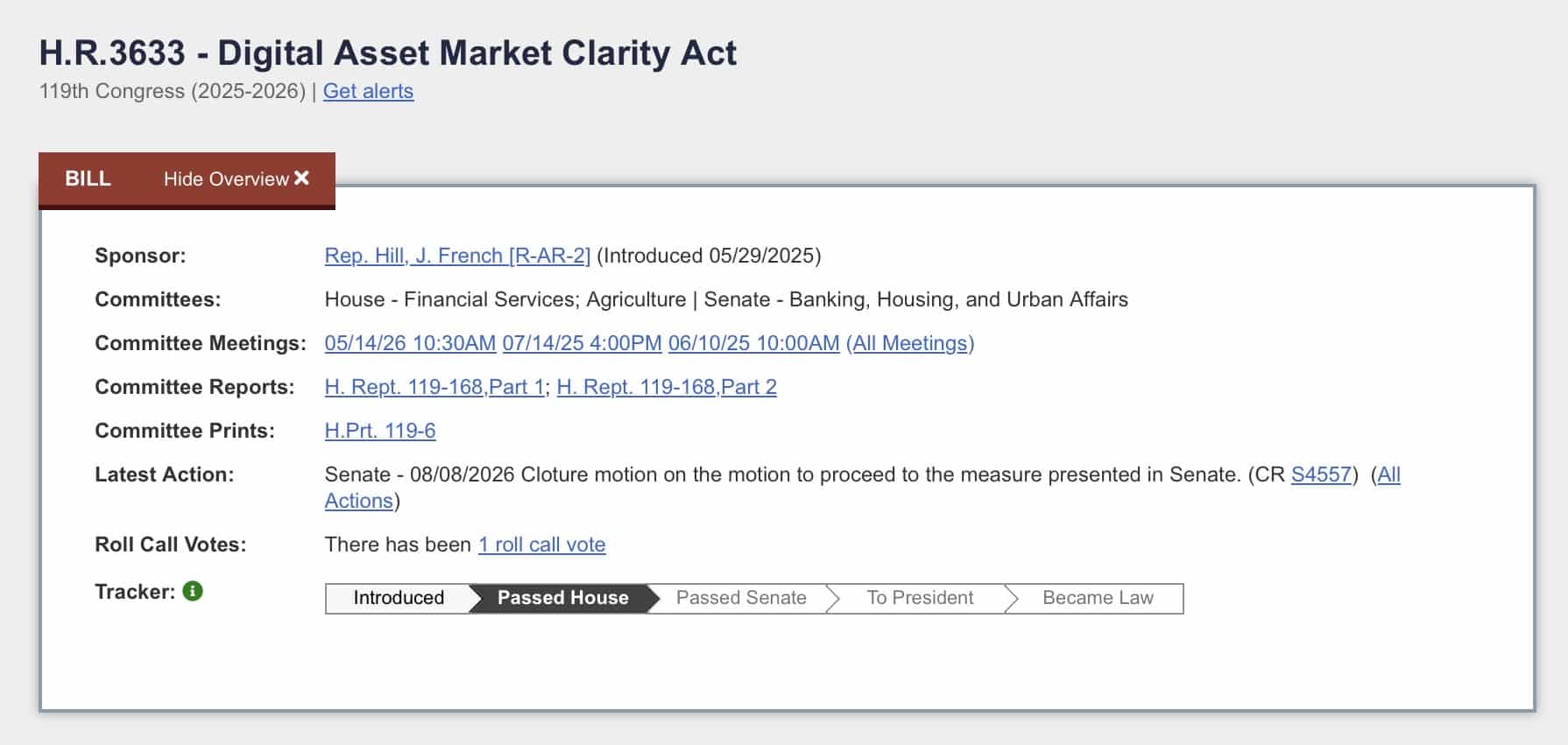
The CLARITY Act could face another realistic legislative opening only in 2030 if Congress fails to act, Sen. Cynthia Lummis says.
 Coinspeaker•Daniel Francis8 Sept
Eight days before the Senate’s Sept. 15 cloture vote, former federal prosecutor Mariotti says the message from lawmakers and staff in Washington is that the CLARITY Act is dead. What Mariotti Heard Mariotti, a former federal prosecutor, spent the week in Washington and subsequently posted his thoughts on his sojourn, claiming that members of Congress […]
Bitcoin.com News•Shiraz Jagati7 Sept
The Clarity Act's delay risks prolonging regulatory uncertainty in the U.S. crypto market, potentially hindering innovation and competitiveness.
CryptoBriefing•Editorial Team6 Sept
252 years ago today, the First Continental Congress was organized in Carpenter’s Hall, Philadelphia, after the British Navy implemented a blockade of Boston Harbor and the Parliament of Great Britain passed the punitive Intolerable Acts in response to the Boston Tea Party. The result of the Congress was the drawing up of the Continental Association, […]
 Good News Network•Good News Network5 Sept