The Federal Reserve

Organization · 69 articles
Share

All coverage

page 1 of 4

Fed’s Proposed Stablecoin Rules Put GENIUS Act’s Dollar Test to Work

The Federal Reserve is proposing a rulebook for bank-issued payment stablecoins that gets strikingly specific. Basically, every $1 of tokens must be backed by at least $1 of permitted reserves, customers generally must be redeemable within two business days, and an issuer that stays short of required capital could ultimately be forced to liquidate its […]

Bitcoin.com NewsBitcoin.com News•Jamie Redman17h ago
  • neutral toward Federal Reserve · 94%

Global bond sell-off deepens amid fears US economy may be running too hot – business live

Rolling coverage of the latest economic and financial news Financial markets are now much more confident that the US Federal Reserve will raise interest rates rates at least one more time this year. According to CME Fedwatch , there’s now a 55% chance that US rates are half a percentage point higher by the end of December – implying two quarter-point rate rises (or one beefy hike!). That’s on top of the Fed’s hike earlier this month. The main story is still the huge global bond selloff, with yesterday seeing the biggest jump in the 10yr Treasury yield (+15.2bps) since the market turmoil around Liberation Day in April 2025 . The main driver was a strong batch of PMIs, along with a rebound in oil prices, which both led to mounting speculation about faster rate hikes. Indeed, futures this morning are pricing a 71% chance of a Fed rate hike at the next meeting in October . With unemployment at 4.1% and growth running above trend, the US economy is showing signs of modest overheating. The Federal Reserve will therefore be firmly on notice. If the next inflation readings continue to print hot, policymakers may conclude that aggregate demand needs to be brought lower through the blunt tool of higher interest rates. In the US, flash PMI figures for September showed activity expanding at the fastest pace in more than five years . New orders grew at the fastest pace since April 2022, while manufacturing hiring was the strongest since February 2021. Massive AI investment and resilient consumer spending outweighed energy-price-led worries , though supplier delivery times stretched, according to the same data, while input costs remained elevated due to high energy prices and supply-chain pressures. 11am BST: CBI distributive trades survey of UK retailers 8.30am BST: Swiss National Bank’s interest rate decision 1.30pm BST: US jobless claims data 3pm BST: Bank of England’s Clare Lombardelli speech on “Macroeconomic Policy in a Heterogeneous and Imperfectly Rational World” Continue reading...

The GuardianThe Guardian•Graeme Wearden24 Sept

Why risk a smart contract exploit when safe US Treasuries pay better crypto yields?

The Federal Reserve raised its target range by 25 basis points to 3.75%-4.00% on Sept. 16, pushing the one-year Treasury yield to 4.45% the same day and pressuring crypto lending yields. That move lifts the return available to anyone willing to hold nothing riskier than government debt, setting a fresh benchmark for crypto lending yields […]

CryptoSlateCryptoSlate•Gino Matos18 Sept

Bitcoin Price Unlikely To Be Bothered by Interest Rate Hike: Grayscale

Bitcoin Magazine Bitcoin Price Unlikely To Be Bothered by Interest Rate Hike: Grayscale The Federal Reserve hiked interest rates on Wednesday — and may do so again this year — but bitcoin's price is unlikely to be hurt, Grayscale argued. This post Bitcoin Price Unlikely To Be Bothered by Interest Rate Hike: Grayscale first appeared on Bitcoin Magazine and is written by Mathew Di Salvo .

Bitcoin MagazineBitcoin Magazine•Mathew Di Salvo17 Sept
  • neutral toward Grayscale · 96%

transmission of monetary policy

The Fed Hiked. So Why Didn't Gold Stay Down? The Federal Reserve raised its policy rate by 25 basis points to 3.75%–4.00% on September 16, as the chart shows. Gold initially sold off sharply as higher rates, a stronger dollar and higher yields weighed on the non-yielding metal. But the pressure did not last. The key reason: the markets that transmit the Fed's policy signal into gold began moving the other way. The rate hike itself was largely anticipated Because an August inflation report came in hot at 3.4% and energy costs have been surging due to the U.S.-Iran war, investors and traders had already priced in a 90%+ probability of this hike. As a result, the execution didn't shock Wall Street, and major stock indexes initially held relatively flat before pulling back slightly due to the Fed's ongoing hawkish tone, so the announcement did not create a completely new shock to expectations. The more important question became what happened to the U.S. dollar, Treasury yields and inflation expectations afterward. By September 17, the dollar had weakened from its post-Fed high and the 10-year Treasury yield had fallen. At the same time, oil prices declined, reducing some of the immediate inflation pressure that had supported higher yields. Gold subsequently rebounded more than 2% from its post-Fed low. This is why the initial selloff failed to sustain: Fed hike → dollar/yields rise → gold sells off then: dollar/yields retreat + oil falls → pressure on gold eases → gold recovers. The Fed therefore did not become irrelevant to gold. The market simply stopped reinforcing the initial bearish transmission. A rate hike alone is not a complete gold thesis. Watch the U.S. dollar and real Treasury yields alongside the Fed decision. If they continue rising, the rate-hike pressure on gold can persist. If they reverse, gold can recover even with the Fed maintaining a tighter policy stance. The headline was the catalyst. The cross-market reaction determined whether the move lasted.

TITradingView Ideas17 Sept

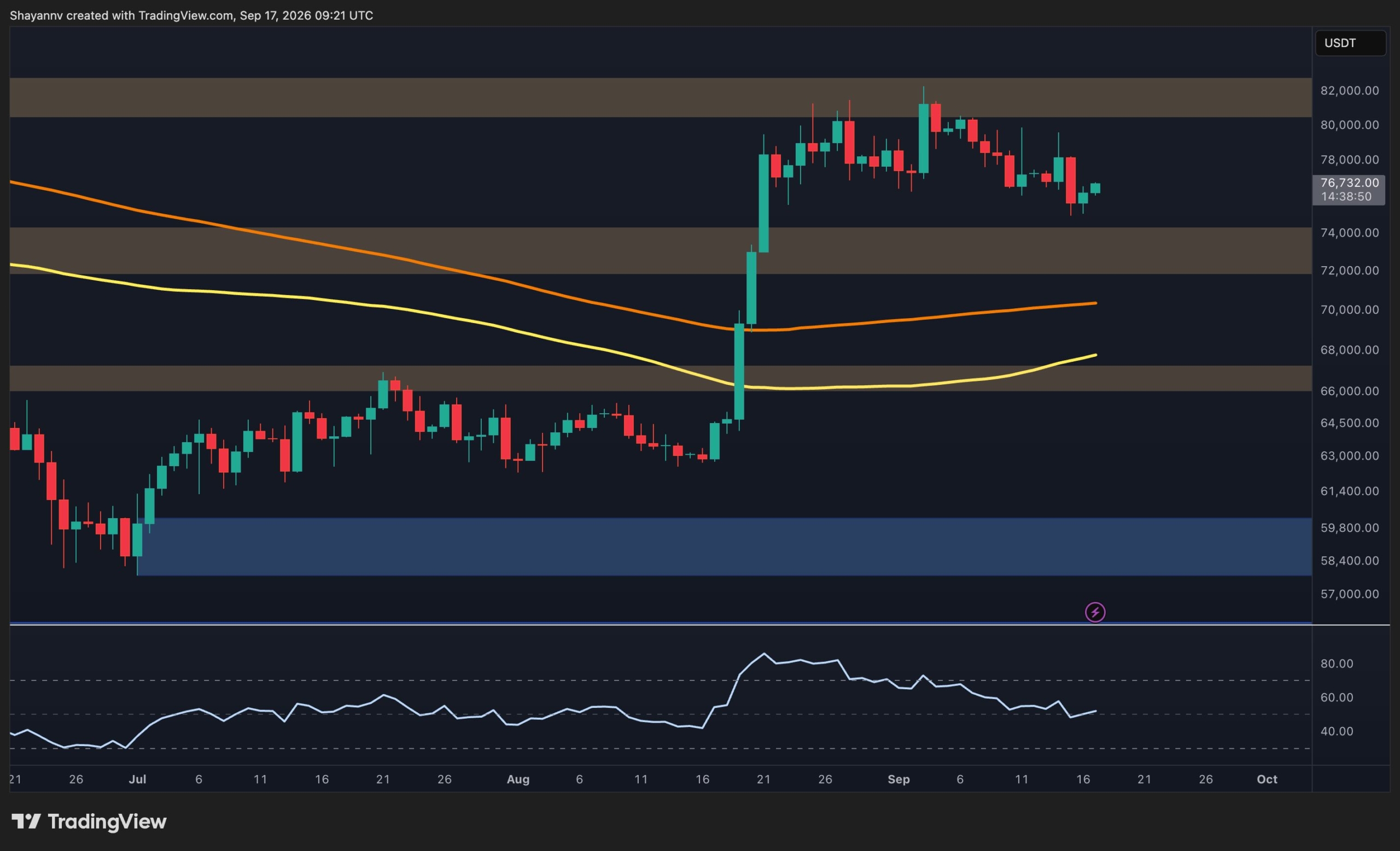
Bitcoin Price Prediction: Is BTC About to Break Above $80K or Crash Below $72K?

Bitcoin has absorbed a fresh macro shock without losing its broader post-breakout structure. The Federal Reserve raised its target rate by 25 basis points to 4.00% on Wednesday, a tightening move that also strengthened the dollar and pushed Treasury yields higher. Despite this traditionally challenging backdrop for risk assets, BTC continues to trade around $76.7K, […]

CryptoPotatoCryptoPotato•Shayan Markets17 Sept

Gold / U.S. Dollar (XAUUSD)

🟡 Gold / U.S. Dollar (XAUUSD) Could a Breakout from This Compression Define Gold’s Next Medium-Term Move? 📊🔥 Hello everyone and welcome back to all my TradingView followers! 👋📈 I hope you are all doing well and trading with patience, discipline and proper risk management. Today, we are looking at Gold versus the U.S. Dollar (XAUUSD), a market currently influenced by a combination of global uncertainty, USD strength, U.S. interest rates, Treasury yields and geopolitical risks. 🌍⚠️ 🌍 Fundamental View | Higher Rates, Stronger USD and Pressure on Gold 💵📈 Global markets remain highly volatile. On one side, geopolitical tensions and economic uncertainty continue to support demand for safe-haven assets. On the other side, the latest increase in U.S. interest rates and higher Treasury yields can create pressure on non-yielding assets such as gold. The Federal Reserve recently raised its policy rate by 25 basis points to a range of 3.75%–4.00%. The possibility of further restrictive policy has supported the U.S. dollar and increased the opportunity cost of holding gold. Reuters +1 The potential short-term mechanism is: Hawkish Fed → Stronger USD → Higher Bond Yields → Higher Opportunity Cost → Pressure on Gold 📉 However, gold is not driven by interest rates alone. Other important factors include: 🔹 Geopolitical tensions 🔹 Safe-haven demand 🔹 Central-bank purchases 🔹 Investment flows 🔹 Recession concerns 🔹 Sovereign debt and fiscal risks Therefore, the reaction to higher rates is not always one-directional. Still, in the short term, a stronger dollar and higher Treasury yields may remain important headwinds for gold. ⚠️ 📊 Technical Analysis | XAUUSD On the provided chart, gold has entered a compressed consolidation structure after a previous bearish move. This short-term compression is developing inside a broader 4H structure, and price is now approaching important technical decision zones. 👀 🔴 First Resistance Zone: 4368 – 4402 This is the key resistance area near the current price. Above this zone, the next important resistance is around: 🎯 4474 🟡 Main Support Zone: The major support area is approximately: 4260 – 4270 The smaller short-term consolidation area around 4310–4325 may also be relevant for intraday reactions. 🐂 Bullish Scenario | Confirmed Breakout for Medium-Term Longs 📈 If price breaks above the 4368–4402 resistance zone with strong momentum and confirms the breakout on the 4H timeframe, the structure could shift in favor of buyers. A more reliable bullish sequence would be: Breakout → Retest → Confirmation 🎯 After a confirmed breakout, the 4474 area could become the next important resistance and potential target. For a medium-term long setup, a temporary move above resistance may not be enough. Ideally, traders should look for: 🟢 A 4H candle close above resistance 🟢 Price acceptance above the breakout zone 🟢 A successful retest 🟢 Reduced selling pressure during the retest 🐻 Bearish Scenario | Breakdown of the Compression and Support 📉 If gold fails to break the resistance zone and selling pressure returns, the 4260–4270 support area becomes extremely important. A confirmed breakdown below this zone could indicate that the short-term bullish structure is weakening and that a deeper correction may develop. In that case, it may be more reasonable to wait for: Breakdown → Failed Retest → Continuation The bearish scenario could become stronger if the breakdown occurs alongside: 💵 A stronger U.S. dollar 📈 Higher Treasury yields 🏦 Expectations of tighter Fed policy 🌍 Increasing global risk aversion Under these conditions, fundamental and technical pressure could reinforce each other. 🧠 Final View Gold is currently approaching an important decision point. Fundamentally, higher U.S. interest rates and a stronger dollar may create short-term pressure on gold. However, geopolitical uncertainty and safe-haven demand can still provide support. Technically, price is trading inside a compressed structure, making the reaction to the key levels particularly important: 🔴 Break and confirmation above 4368–4402: higher potential for a move toward 4474. 🟢 Support holds around 4260–4270: further consolidation and another bullish attempt remain possible. 🐻 Confirmed support breakdown: the probability of a deeper correction increases. For now, the key is to wait for a confirmed breakout or breakdown, preferably supported by 4H price action, because volatile markets can produce false breakouts. ⚠️ 🗳️ What is your view? 🤔 Where do you think gold is heading next? 🟢 Bullish: Breakout above 4368–4402 and a move toward 4474 🔴 Bearish: Breakdown below 4260–4270 and a deeper correction 🟡 Neutral: Continued compression between support and resistance Share your opinion in the comments! 👇💬 ⚠️ Disclaimer | English: This analysis is for educational and informational purposes only and does not constitute financial or investment advice. Trading financial markets involves substantial risk, especially when leverage is used. Always conduct your own research and apply proper risk management before making any investment decision. 🏷️ Tags #Gold #XAUUSD #GoldTrading #GoldAnalysis #PreciousMetals #USD #USDollar #FederalReserve #Fed #InterestRates #TreasuryYields #BondYields #Inflation #SafeHaven #Geopolitics #Forex #Commodities #TechnicalAnalysis #FundamentalAnalysis #TradingView #MarketAnalysis #RiskManagement #Bullish #Bearish #Breakout #GoldPrice

TITradingView Ideas17 Sept

Gold: Fed vs. Treasury — Something Doesn’t Add Up

Gold: Fed vs. Treasury — Something Doesn’t Add Up Yesterday, the Federal Reserve raised interest rates at a time when the US Treasury Department is raising the alarm about higher yields that are breaking the historical high price level by rising further the US Debt. The decision of the FED to raise interest rates under these conditions remains strange, but this is just my personal opinion. The Federal Reserve and the US Treasury seem to be working against each other. The US Treasury started a $6 billion buy back program by rising the problem of high debt, but on the other hand, the Federal Reserve started to make this situation even worse. Crazy stuff. However, it seems that the Federal Reserve's decision could not lower gold below 4235. The price started to recover again and is already in the same positions as it was yesterday. There may be some ups and downs, but considering that gold could not stay below the previous low, the chances are that it will rise as we had our scenario. Manage risk well because the current situation is not good. I have never seen the US take such actions when the Federal Reserve and the US Treasury are asking for different things. You can find more details on the chart. Thank you! 🍀 ⚠️PS: Do your own analysis and use your own strategy to join the trade. ❤️ If this analysis helps your trading day, please support it with a like or comment ❤️

TITradingView Ideas17 Sept

Can the Australian Dollar Survive Fed Hikes?

Macroeconomic Divergence The Federal Reserve raised its target range to 3.75% to 4.00% on September 16, 2026. The vote was unanimous at 12-0. This was the first US rate increase since July 2023. Updated projections signal another hike may follow this year. The move narrowed Australia’s yield advantage without erasing it. The RBA cash rate sits at 4.35%, still above the new US range. The Reserve Bank hiked three times earlier in 2026, then held in August. Markets now price roughly a 78% chance of a move to 4.60% on September 29. AUD/USD fell anyway. The pair traded near 0.7093 after the decision, below the 0.7100 handle. It closed under its 50-day average for the first time in six weeks. The September high was near 0.7250. Australian core inflation remains persistent. Trimmed mean inflation held at 3.6% in the year to July. Headline CPI eased to 3.5% from 3.8% in June. Both sit above the RBA’s 2% to 3% target band. Rising global energy costs tied to Middle East tensions are feeding domestic prices. The IMF’s February 2026 Article IV review welcomed the RBA’s rate increase. Directors backed a data-dependent stance and urged continued vigilance. They stopped short of prescribing a hawkish bias. Geopolitics and Geostrategy Australia supplies vital rare earth minerals to the United States. These resources power critical defense technologies and clean energy hardware. Lynas signed a binding letter of intent with the US Department of War in March 2026. The deal allocates about $96 million over four years for rare earth oxides. The October 2025 bilateral framework covers projects valued at $8.5 billion. Indo-Pacific friction reinforces Australia’s strategic economic value. However, global turmoil keeps the US dollar positioned as the ultimate safe haven. The dollar index pushed above 100 after the Fed decision. Capital flows toward American assets during heightened international instability. Industry Trends and Business Models Mining giants like BHP and Rio Tinto drive Australia’s export revenue. BHP ships iron ore, copper, coal, uranium and gold. It does not produce lithium. Rio Tinto carries the lithium exposure of the two. Its Q2 2026 output reached 14,600 tonnes of lithium carbonate equivalent, up 20% year on year. Mining companies invoice commodity transactions globally in US dollars. Strong dollar revenues boost balance sheets, but volatile demand creates risk. Firms are adopting greener business models to meet global decarbonization standards. Corporate Leadership and Culture Executive leadership teams in Sydney and Melbourne prioritize agile operations. Strong corporate culture fosters continuous innovation and cost management. Australian leaders invest heavily in sustainable infrastructure and clean extraction methods. Resilient management keeps Australian firms competitive on the global stage. Healthy corporate profits attract steady foreign direct investment into Australia. Technology, High-Tech, and Patent Analysis Australian mining operators pioneer autonomous vehicles and AI-driven exploration. Patent filings show rapid growth in advanced battery storage technologies. US venture capital actively funds Australian climate tech and energy startups. These technology transfers generate strong cross-border capital transactions. Australian companies simultaneously import advanced American enterprise software. Cybersecurity Imperatives Cyberattacks pose severe risks to critical Australian export infrastructure. A major port breach could temporarily halt critical commodity shipments. Such disruptions would immediately weaken the Australian dollar in FX markets. Australian and American defense teams cooperate closely on cyber intelligence sharing. Robust cybersecurity preserves market confidence and protects foreign trade balances. Science and Pharmaceutical Links Australia leads key clinical trials and scientific biotechnology research. Firms like CSL export specialized therapies to American healthcare markets. Revenues earned in USD boost domestic research and development budgets. A weaker Australian dollar cuts both ways here. It lifts the local value of USD export receipts. It also raises the cost of importing scientific instruments from the US. This biotech synergy supports Australia’s long-term current account health. Strategic Outlook The Australian dollar faces headwinds from narrowing yield differentials. Yet robust commodity demand and high-tech innovation provide structural support. Central bank policy decisions will dictate short-term exchange rate swings. The September 29 RBA meeting is the next domestic catalyst. Investors must monitor geopolitics, corporate innovation, and cybersecurity trends. Comprehensive cross-sector analysis remains essential for mastering AUD/USD movements.

TITradingView Ideas17 Sept

ETHUSDT: Price Under Pressure, Sellers Control

ETHUSDT is trading around 2,418 USDT and remains within a descending channel. The current rebound lacks the strength to alter the market structure, as the price stays below the EMA89 (near 2,449) and overhead resistance continues to exert selling pressure. The 2,450–2,490 zone serves as a critical resistance area. If ETH rallies to this level but faces rejection—specifically below the EMA cluster and the channel's upper boundary—I lean towards a scenario where the price retreats to 2,380 before extending toward the primary target near 2,320 USDT. Macroeconomic factors and capital flows currently support a bearish outlook. The Federal Reserve recently raised interest rates by 25 bps and signaled the possibility of further hikes this year, driving the USD to a seven-week high and causing short-term yields to surge. Ethereum faces additional pressure following the failure of the CLARITY Act in the Senate; FXStreet reported a roughly 3.4% drop in ETH, alongside the largest single-day outflow from US spot Ethereum funds since January. The bearish scenario would be invalidated if ETH breaks out of the channel and establishes firm support above the 2,490–2,500 range.

TITradingView Ideas17 Sept