Asiapage 5

Place · 361 articles
Share

Coverage, page 5

page 5 of 19

Airbus sees no softening in demand despite geopolitical headwinds

HONG KONG: Airbus has not seen any softening in aircraft demand ‌or deliveries due to geopolitical or supply chain headwinds, its Asia-Pacific president said on Tuesday. "We continue to see strong demand," Airbus Asia-Pacific President Anand Stanley said during a briefing in Hong Kong on its 2026-2045 market forecast ⁠focused on the Asia-Pacific region. "Not only that, we continue to see a strong readiness to take deliveries and a strong uptick in deliveries across the board, and ‌this is not just in Asia-Pacific, but we also see that we are continuing to do our deliveries ‌in the Middle East," he said. Airbus forecasts about ‌42,000 new aircraft will be required globally over the ‌next 20 years, ‌and about 45% of those will be delivered to the fast-growing Asia-Pacific region. Francois Cabaret, Airbus' head ‌of global market forecast, said at the event ⁠that Chinese airlines face a huge catch-up in renewing their fleets. Before the COVID-19 pandemic, Chinese airlines were taking about 400 ⁠deliveries a ⁠year, but the collective number from Airbus, Boeing and Chinese planemaker COMAC had since fallen to less than half of ⁠that, Cabaret said. Airbus data shows China, its single largest market for commercial jets, will need 8,830 new passenger aircraft over the next 20 years, India will need 3,480, and the rest of Asia-Pacific will require ‌6,880. The forecast also highlighted diverging growth within Asia. India remains the world's fastest-growing air travel market, with Airbus raising its domestic traffic growth forecast to 9.3% from 8.9%, while cutting China's to 4.7% from 5.4%.

MBMobile BusinessReuters15 Sept
  • neutral toward Airbus · 94%

Panama canal traffic to be cut again as drought from El Niño worsens

Latest daily reductions will further choke one of the world’s most important shipping lanes The Panama canal plans to again cut maritime traffic due to worsening drought caused by the El Niño climate phenomenon, further choking up one of the world’s most important shipping lanes. The canal handles 5% of global maritime trade and about 40% of US container traffic; it is favoured by shippers because it usually reduces cost and transit times, especially for companies trading between China, Asia and the US. Continue reading...

The GuardianThe GuardianMark Saunokonoko with Agence France-Presse15 Sept

THE KOG REPORT - Update

End of day update from us here at KOG: Couldn't have started the week better than that! Early session bias level broke, the indicator said short, the red boxes aligned with the liquidity, two targets hit before London and another two during New York. Not just Gold, 7 hits across the board giving us a full house again for the day. As you can see, we've bounced the ideal level below on the hourly chart so here we've now added the hot spots for the Asia session. We have support at the 4285 level which will need to break to go lower, otherwise, the decent entry was from the retracement level and that would have been protected and managed. If we can support that lower level, we should see an attempt at the 4325-30 regions which is the level to watch in my opinion. Breach or reject? The levels are on the chart, let's see how it plays out. Bullish above 4360 with target above 4383 Bearish below 4330 with target below 4296✅ As always, trade safe. KOG

TITradingView Ideas14 Sept

First Solar (FSLR)

First Solar (FSLR): Pullback Creates an Attractive Entry Point FSLR has fallen from its June high of $320.95 to around $210, while the company has maintained its 2026 guidance. First Solar (FSLR) Entry price in report: $210 Current price (September 11, 2026): $206.62 Target: $255 Stop-loss: $185 Horizon: November 9, 2026 Investment thesis First Solar maintained its 2026 guidance after Q2 and continues expanding manufacturing capacity in the United States. The company also has a substantial contracted backlog extending through 2030, providing relatively strong visibility into future shipments and revenue. Its competitive position remains differentiated by its cadmium telluride thin-film technology. Unlike most global solar manufacturers, First Solar is not dependent on the crystalline-silicon supply chain, a large part of which is concentrated in Asia. This technological difference has become increasingly important amid the expansion of U.S. manufacturing and stronger trade protection. Q2 results remained strong. Revenue was approximately $1.06 billion, while net income rose to $423 million from $342 million a year earlier. EPS increased to $3.92 from $3.18, and adjusted EBITDA reached $644 million. First Solar maintained its full-year 2026 outlook for revenue of $4.9–5.2 billion and adjusted EBITDA of $2.6–2.8 billion. The main issue remains the pace of new bookings. Backlog declined to 45.1 GW as of June 30, but after Q2 the company reported around 1.9 GW of new U.S. bookings, with more than 2 GW subject to conditions and roughly another 2 GW under active negotiations. At around $210, FSLR trades at approximately 7.7x 2026 EV/EBITDA. The $255 target corresponds to roughly 9.5x 2026 EV/EBITDA and 7.8x 2027 EV/EBITDA. Key catalyst: Q3 earnings expected in late October. The market will be watching new bookings and confirmation of full-year guidance. Main risks: weaker new-order growth, changes in government support, international capacity utilization, and competition from lower-cost silicon modules. Report recommendation: BUY

TITradingView Ideas14 Sept

Expectations vs Reality: Oil and the Dollar

The disconnect between Wall Street expectations and how policies actually played out created the macro whiplash seen across both charts: ]The Trade: What Markets Priced In Late 2024 The Drill Baby Drill Assumption: Consensus expected a supply flood from deregulation and quick federal leasing, crushing crude prices into the dirt around 50 to 60 dollars sustained. The Unstoppable King Dollar: Traders bet broad tariffs and deregulation would spark a roaring domestic boom, forcing the Fed to freeze rate cuts while blowing out foreign competitors, sending DXY vertical. The Reality: What Actually Happened in 2025 and 2026 Sanctions and Geopolitics Trumped Deregulation: Slapping sanctions back onto Russian flows, tightening squeeze points on Venezuelan barrels, and escalating Middle East friction choked physical supply far faster than domestic drillers could ever add rigs. Plus, US producers kept capital discipline rather than reckless overdrilling. Supply tightened, and oil ripped. Aggressive Tariffs Acted as a Drag, Not Pure Dollar Fuel: The sweeping, shifting tariff regime and trade frictions with Canada, Europe, and Asia created massive supply chain uncertainty and weighed on US domestic growth earlier in the year. The Deficit and De Dollarization Friction: Ballooning national debt and unpredictable trade posture pushed several trading partners toward non dollar settlements, taking the steam out of that late 2024 dollar rally and allowing DXY to bleed down toward 98. The Currency Stance Itself: Markets initially forgot that the administration historically expressed frustration with an overly strong dollar making US exports uncompetitive. Wall Street positioned for a low energy, super dollar boom. Instead, physical supply dictated oil, and domestic growth drag capped the greenback until energy inflation recently forced the bond market to wake back up. Touching on the Daily: DXY Looking Noticeably Stronger Now that oil has held near triple digits, the inflation lag is catching up and driving bond yields higher. That is putting a real floor under the dollar. On the daily chart(not shown), TVC:DXY is showing clear signs of bottoming. The red selling pressure on momentum indicators is gone, RSI is curling upward from oversold territory, and price is directly testing the downward trendline near the 100 level. While crude takes a slight breather at the top of its channel, the daily dollar setup looks ready to push. If DXY clears the 100 resistance mark, the feedback loop is back in play: high oil sparks inflation, yields rise, and the dollar follows crude higher. TGtg!

TITradingView Ideas14 Sept

The Hotspot | South Korea pushes for football season to make winter switch after unbearable summer

Why fainting fans and perspiring players are a worry for the Asian league seeking to follow Japan and align with Europe South Korean football is trying to find the goldilocks time to play the K-League. Winters have long been too cold and, increasingly, summers are too hot. This may be the Land of the Morning Calm but, for much of the time, the weather can be pretty extreme. Last week a survey revealed that more than 70% of 29 respondent coaches in Asia’s oldest professional league support a shift from the traditional March to November schedule to one that matches the European format, which starts in late August and has a winter break. Continue reading...

The GuardianThe GuardianJohn Duerden14 Sept

AI-linked stocks fall after tech bosses call for slowdown in ‘reckless’ development

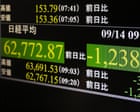
Shares in tech firms tumble across Asia with Nasdaq also likely to dip later after Anthropic, OpenAI and SpaceX leaders back call Business news – live updates AI-linked stocks tumbled on Monday after the bosses of Anthropic, OpenAI and SpaceX called for a slowdown in “reckless” development citing fears the technology could soon run out of control. Shares in SoftBank, a Japanese investor that is a big backer of OpenAI, slumped 13%, while the South Korean Kospi stock index, which relies heavily on chip makers that supply AI companies, dropped by 3%. Continue reading...

The GuardianThe GuardianLauren Almeida14 Sept