G
Green forest fire notification in Indonesia
On 09/09/2026, a forest fire started in Indonesia, until 14/09/2026.
On 09/09/2026, a forest fire started in Indonesia, until 14/09/2026.

Countries: Philippines, Cambodia, Indonesia, Thailand, Viet Nam Source: ASEAN Coordinating Centre for Humanitarian Assistance Please refer to the attached Infographic. REGIONAL SUMMARY: During the thirty-seventh week of 2026, a total of thirteen disaster events were reported across ASEAN, including droughts, floods, landslides, and storms in Indonesia, as reported by Badan Nasional Penanggulangan Bencana ( BNPB ); Thailand, as reported by Department of Disaster Prevention and Mitigation ( DDPM ); and Viet Nam, as reported by the Viet Nam Disaster and Dyke Management Authority ( VDDMA ). In addition to these events, disaster situations continued to be reported across the region. These included ongoing Anak Krakatau volcanic activity, which affected conditions in Lampung and western parts of Java island, including Banten, Jakarta, and West Java. Disaster situations also continued to develop due to the combined effects of Southwest Monsoon and Tropical Cyclones GAENARI and KUJIRA. HIGHLIGHT: In Indonesia, according to BNPB , Mount Anak Krakatau, located in Sunda Strait between Lampung and Banten, has remained at Level III (Siaga) since 2 July. A continuous eruption began on 4 Sep at 2307H UTC+7. As of 12 Sep at 1045H UTC+7, BNPB reported that several areas across Lampung Province (Lampung Selatan, Tanggamus, Pringsewu, Pesisir Barat, and Pesawaran), Banten Province (Serang, Pandeglang, Cilegon, Lebak, and Serang City), Jakarta, and parts of West Java had been affected, with approximately 161K families affected. Due to the dispersion of volcanic ash, all flights from Jakarta’s Soekarno-Hatta International Airport and Halim Perdanakusuma Airport were reportedly temporarily suspended from 6 September 2026 and resumed operations on 8 September at 0000H UTC+7. Meanwhile, in the Philippines, combined effects of Enhanced Southwest Monsoon and tropical cyclones GAENARI and KUJIRA continued to affect Regions I, II, III, IVA, IVB, V, VI, IX, CAR, and NCR. According NDRRMC report as of 14 Sep at 0700H UTC+7, approximately 9.6M people (2.8M families) had been affected, with 44 fatalities, 18 injuries, and 5 people reported missing. Around 157K people remained displaced, including 76K people temporarily sheltering in 748 evacuation centres. Authorities continued to intensify monitoring, coordinate response efforts, and mobilise resources to provide assistance and support to affected communities. HYDRO-METEO-CLIMATOLOGICAL: During the past week, data from the ASEAN Specialised Meteorological Centre ( ASMC ) indicated medium to high seven-day average rainfall across areas north of Equator including Brunei Darussalam, Cambodia, Indonesia (northern parts of Sumatra, Kalimantan, and Papua), Lao PDR, Malaysia, Myanmar, Philippines, Thailand, and Viet Nam. As of this report, INVEST 90W, located approximately 3,000 km east of the Philippines, is being monitored for potential development into a significant tropical cyclone ( DMRS , JTWC ). GEOPHYSICAL: Five (5) significant earthquakes (M>5.0) were recorded by Indonesia’s Badan Meteorologi, Klimatologi, dan Geofisika ( BMKG ). Mount Ibu (alert level II), Ili Lewotolok (alert level II), Semeru (alert level III), and Anak Krakatau (alert level III) in Indonesia, and Taal (alert level 1), Mayon (alert level 2), Bulusan (alert level 1), and Kanlaon (alert level 2) volcanoes in the Philippines reported recent volcanic activity according to Pusat Vulkanologi dan Mitigasi Bencana Geologi ( PVMBG ) and the Philippines Institute of Volcanology and Seismology ( PHIVOLCS ). OUTLOOK: According to the ASEAN Specialised Meteorological Centre ( ASMC ), for the coming week, drier-than-usual conditions are expected over most of the southern ASEAN region, while wetter-than-usual conditions are forecast over parts of southern Mainland Southeast Asia and the northwestern Maritime Continent. In addition, warmer-than-usual conditions are expected across most of the ASEAN region. For regional assessment of extreme, there is a small increase in chance of very heavy rainfall conditions to occurs over parts of central and eastern Mainland Southeast Asia. Meanwhile, extremely hot conditions are very likely across much of the equatorial band between 5°N and 5°S, with moderate chances also expected over central and northern Myanmar and the southern Philippines. The El Niño – Southern Oscillation (ENSO) monitoring system state is “El Niño Conditions”. Strong El Niño conditions are predicted until at least the end of 2026. El Niño at this time of the year, typically brings drier conditions for much of the Maritime Continent, and to a lesser extent, some parts of Mainland Southeast Asia. Sources: ASEAN Disaster Monitoring & Response System (DMRS); ASEAN Disaster Information Network (ADINet); ASEAN Specialised Meteorological Centre (ASMC); ASEAN Earthquake Information Centre (AEIC); Joint Typhoon Warning Centre (JTWC); Indonesia: BNPB, BMKG, PVMBG; Philippines: NDRRMC, PAGASA, PHIVOLCS; Thailand: DDPM; Viet Nam: VDDMA; Various news agencies.
 ReliefWeb•ASEAN Coordinating Centre for Humanitarian Assistance14 Sept
On 9/14/2026 10:58:03 AM, an earthquake occurred in Indonesia potentially affecting 330 thousand in MMI III. The earthquake had Magnitude 5.6M, Depth:162.179km.
On 06/09/2026, a forest fire started in Indonesia, until 14/09/2026.
On 07/09/2026, a forest fire started in Indonesia, until 14/09/2026.
On 9/14/2026 9:27:38 AM, an earthquake occurred in South Of Java, Indonesia potentially affecting [unknown]. The earthquake had Magnitude 5.5M, Depth:10km.

Hundreds of Indonesian rescuers including the coast guard and the navy raced on Monday to board a passenger ship that capsized in the Java Sea over the weekend as they searched for 129 people still missing, officials said, with the confirmed death toll at six.

Indonesia intensified its search operation on 14 September for 129 people still missing after the Virgo Transport 8 ferry capsized in rough seas in the Java Sea the previous day. By then, 108 survivors had been rescued and six bodies recovered.
 Euronews14 Sept
A surge in Indonesia's wood pellet and chip production is driving a new wave of deforestation, threatening the vast archipelago's remaining tropical forests, vital biodiversity hot spots and the land of Indigenous peoples, according to new satellite analysis from environmental nongovernmental organizations.
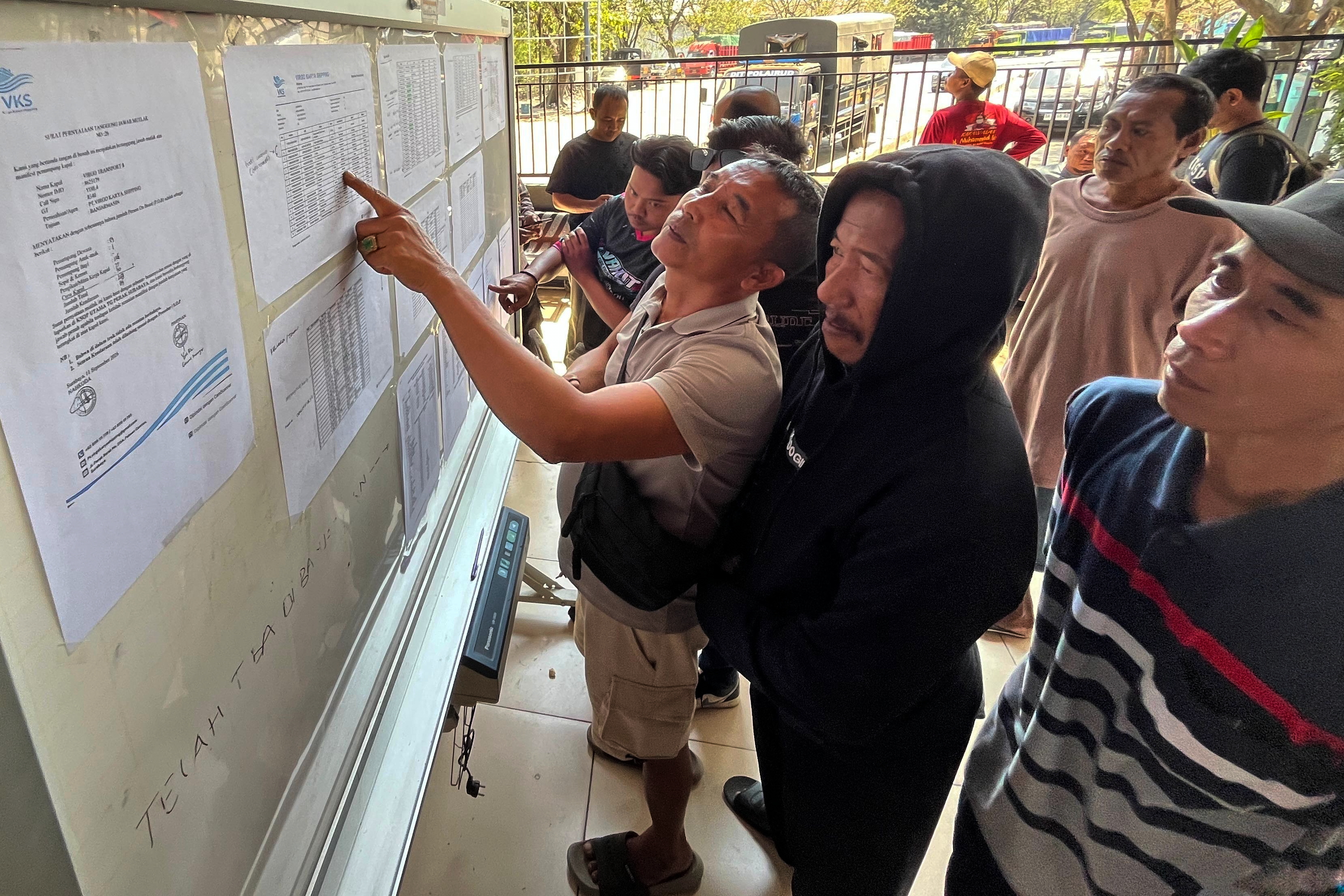
Indonesian authorities intensified on Monday a search for people missing after a ferry overturned in bad weather in the Java Sea. At least six passengers were killed and 129 people are still missing.
 NPR•The Associated Press14 Sept
Indonesian rescue teams on Monday deployed specialised underwater teams and navy-operated underwater drones as the search for more than 120 people missing in the Virgo Transport 8 ferry capsizing intensified.

Officials say more than 600 rescuers battle stormy seas in search for missing people.
 Al Jazeera14 Sept
At least six people were killed and more than 100 rescued after the vessel sank in the Java Sea on Sunday, the authorities said.
 The New York Times•Yan Zhuang and Muktita Suhartono14 Sept
Fighting for the two seats at the world championships.
 Dot Esports•Jeremiah Sevilla14 Sept
Country: Indonesia Source: World Food Programme Please refer to the attached Map.
ReliefWeb•World Food Programme14 Sept
Country: Indonesia Source: World Food Programme Please refer to the attached Map.
ReliefWeb•World Food Programme14 Sept
An Australian man and two children have been found dead in Kuta in Bali, Indonesia.
 The Sydney Morning Herald14 Sept
On 01/09/2026, a forest fire started in Indonesia, until 13/09/2026.

Search continues as some survivors brought ashore after Indonesia ferry overturning
The Sydney Morning Herald13 Sept
A search is underway for at least 129 people after a ferry capsized off the coast of Indonesia.
The Sydney Morning Herald13 Sept