
India to supply Nepal electricity after floods wrecked hydropower projects
India to provide Nepal with 654 megawatts of electricity daily to meet urgent needs after devastating glacial floods.
 Al Jazeera14 Sept
India to provide Nepal with 654 megawatts of electricity daily to meet urgent needs after devastating glacial floods.
Al Jazeera14 Sept
Countries: China, Nepal Source: European Commission's Directorate-General for European Civil Protection and Humanitarian Aid Operations Please refer to the attached Map.
 ReliefWeb•European Commission's Directorate-General for European Civil Protection and Humanitarian Aid Operations14 Sept
Countries: Nepal, China Source: European Commission's Directorate-General for European Civil Protection and Humanitarian Aid Operations Please refer to the attached Map.
ReliefWeb•European Commission's Directorate-General for European Civil Protection and Humanitarian Aid Operations14 Sept
The himalayan flash flood that devastated northern Nepal on August 26 was an unprecedented disaster. The death toll continues to rise, with nearly 1,400 people now confirmed dead and 5,130 still missing, including around 600 foreign nationals from 35 countries.
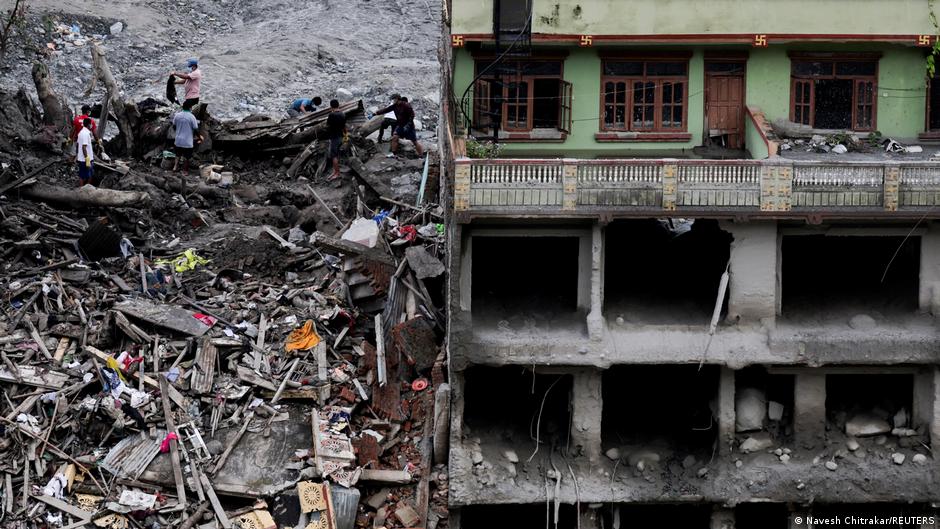
The Himalayan nation is moving from rescue operations to recovery, facing a $4.8 billion reconstruction bill amid renewed calls for climate justice.
 Deutsche Welle14 Sept
Countries: World, Chad, Grenada, Malawi, Myanmar, Nepal, Niger, Papua New Guinea, Philippines, Saint Vincent and the Grenadines, Viet Nam Source: Germanwatch Please refer to the attached file.
ReliefWeb•Germanwatch14 Sept
Countries: World, Chad, Grenada, Malawi, Myanmar, Nepal, Niger, Papua New Guinea, Philippines, Saint Vincent and the Grenadines, Viet Nam Source: Germanwatch Please refer to the attached files. The Climate Risk Index (CRI) ranks countries by the human and economic toll of extreme weather. The latest edition highlights increasing losses and the urgent need for stronger climate resilience and action. The Climate Risk Index (CRI), published since 2006, is one of the longest running annual climate impact-related indices. The CRI analyses climate-related extreme weather events’ degree of effect on countries. In doing so, it measures the consequences of realised risks on countries. This retrospective index ranks countries by their economic and human impacts (fatalities, as well as total affected), with the most affected country ranked highest. The CRI visualises such events’ degree of effect at one year before the index’s publication and over the preceding 30 years. The index contextualises international climate policy debates and processes with a view to the climate risk countries are facing. It simplifies the aggregation and understanding of climate-related extreme weather events’ impacts across different regions and time periods. The most strongly affected countries rank highest and should view the CRI results as a warning sign that they are at risk of frequent events or rare and unusual extreme events. CRI 2026 ranking and results: highlights Scorching heat, heavy rainfalls, raging wildfires, deadly floods, and devastating storms: The manifestations of extreme weather events have become too common in a new reality worldwide. The CRI 2026 sheds light on inaction’s growing cost. It reveals the mounting human and economic toll. From 1995 to 2024, more than 832,000 lives were lost and direct economic losses of nearly USD 4.5 trillion (inflation-adjusted) were recorded, driven by more than 9,700 extreme weather events . The frequency and intensity of climate-related disasters continue to rise, and these figures underscore the urgent need for climate action. Methodology The CRI methodology involves analysing extreme weather events’ impacts via three hazard categories: hydrological, meteorological, and climatological. The index visualises these events’ impact on countries both one year prior to publication and over the preceding 30-year period. It draws on data from the EM-DAT international disaster database, World Bank, and International Monetary Fund (IMF). The index considers absolute and relative impacts, using six key indicators: economic loss, fatalities, and affected people – each in absolute and relative terms. CRI 2026 key messages The Climate Risk Index (CRI) ranking indicates that, in 1995–2024, Dominica , Myanmar, and Honduras were the countries most affected by extreme weather events’ impacts. St. Vincent and the Grenadines , Grenada, and Chad were the most affected by extreme weather events’ impacts in 2024. From 1995 to 2024, more than 832,000 people died worldwide and direct economic losses of over USD 4.5 trillion (inflation-adjusted) directly resulted from more than 9,700 extreme weather events. Floods, storms, heat waves, and drought were the most prominent impacts short- and long-term. From 1995 to 2024, heat waves (33%) and storms (33%) caused the most fatalities. Floods accounted for almost half of those affected (48%). Storms caused, by far, the greatest economic losses (58% or USD 2.64 trillion inflation-adjusted). The most affected countries in the long-term index, for 1995–2024, can be divided into those: (1) most affected by highly unusual extreme events ( e.g. Dominica, Myanmar, Honduras, and Libya )and (2) affected by recurring extreme events ( e.g. Haiti, the Philippines, Nicaragua, and India ). Climate science clearly shows that climate change raises the risk for both categories and strongly indicates that it contributes to transforming unusually extreme events into ongoing threats, creating a new normal. The CRI indicates that all countries are affected, but those in the Global South are particularly impacted. In both the short- and long-term indices, extreme weather events’ impacts particularly affected poorer Global South countries. In 2024, eight of the 10 most affected were in the low-income and lower-middle-income group. [1] Between 1995 and 2024, six of the 10 most affected were lower-middle-income, including one Small Island Developing State and three Least Developed Countries. These countries’ coping capacities are substantially lower than others’. None of the 10 most affected over the previous 30 years were in the high-income group, and only one for 2024. The CRI ranking is based on the best publicly available historical dataset (at the time of publication) on extreme weather events’ impacts. These events and their impacts are often underreported, especially those in Global South countries, because of data quality and coverage challenges, and data gaps. This can lead to the ranking less accurately capturing all experienced impacts for all countries. Human-induced climate change affects the frequency and intensity of extreme weather events and leads to widespread adverse climate impacts. El Niño influenced many extreme events at the beginning of 2024. However, attribution science found that climate change helped fuel these events even more than El Niño. [2] Climate science also found that, in 2024, human-caused climate change added 41 days of dangerous heat for billions of people worldwide, greatly impacting vulnerable populations and driving other extreme weather events, such as intensified hurricanes and wildfires. The summer of 2024 was the hottest on record, with two billion people experiencing 30+ risky heat days. [3] COP 30 should find effective ways to close the global ambition gaps, as the CRI 2026 results illustrate: Global emissions must be reduced immediately, adaptation efforts must be accelerated, effective solutions to address loss and damage must be implemented, and adequate climate finance must be provided . Courts this past year have confirmed this urgency. An International Court of Justice advisory opinion clarified that states have binding legal duties to prevent and address the harmful effects of climate change – including stronger mitigation, adaptation, and loss and damage actions – by providing climate finance. [1] For a definition of income groups, see World Bank (2024). World Bank Country and Lending Groups, 2024 . [2] World Weather Attribution (2024). When Risks Become Reality: Extreme Weather In 2024 . [3] Climate Central (2024). People Exposed to Climate Change: June-August 2024 .
ReliefWeb•Germanwatch14 Sept
Abinash Bikram Shah’s “Elephants in the Fog” has been sold to distributors across 10 territories, Best Friend Forever has revealed, as the Cannes Un Certain Regard Jury Prize winner plays at the Toronto Film Festival with Nepal’s Oscars international feature submission also confirmed. New deals put the film with MetFilm Distribution in the U.K., Filmin […]
 Variety•Naman Ramachandran13 Sept
For 10 days, Nepali hydropower worker Sanjay Sah survived in darkness inside a flooded tunnel, drinking muddy water and losing all sense of time as he desperately prayed for rescue.

Survivors tell the stories of the people and places buried under the mud after a disaster in Nepal.
 The New York Times•Mujib Mashal, Binod Ghimire and Lam Yik Fei13 Sept
Mujib Mashal, our South Asia bureau chief, travels to points along a river in Nepal that turned into a deadly torrent, killing more than 1,300 people and leaving over 5,000 more missing as entire, towns bridges and roads were swept away.
The New York Times•Mujib Mashal, Rebecca Suner, Leila Medina, Rafaela Balster, James Surdam and Lam Yik Fei13 Sept
A catastrophic flood in Nepal that left thousands missing began with a collapse of ice and rock high in the mountains—a warning that disaster planning must prepare for chains of hazards, not isolated events, experts say.

A string of major disasters in 2026 have had devastating consequences. Earthquakes in Venezuela and Colombia and floods and mudslides in Nepal have killed tens of thousands of people and injured many more. Countless people remain missing, and hundreds of thousands of homes are damaged, with some entire neighborhoods destroyed.

The massive and deadly floods on the Nepal–Tibet border are a stark reminder of why the world needs to constantly update its understanding of the fragile ecosystem in the Himalayas.

Country: Nepal Sources: Emergency Telecommunications Cluster, Logistics Cluster, World Food Programme Please refer to the attached file. This Situation Report provides an update on the humanitarian situation following the flash floods that struck Nepal on 26 August 2026. Since the activation of the Logistics & Telecommunications Cluster (LTC) 1 on 02 September, the LTC Telecoms Area has supported humanitarian partners through telecommunications coordination, assessments, connectivity services and information management. The report highlights the latest situation, telecommunications impacts and LTC Telecoms activities. Summary Points • Following the activation of the Logistics and Telecommunications Cluster (LTC) on 02 September, a Telecoms Coordinator arrived in Kathmandu on 05 September for an initial two-week mission. The deployment is supporting the identification and prioritization of telecommunications requirements at common humanitarian operational locations, strengthening coordination with government and response partners. • The Government has requested support to deploy sustainable backup-power solutions for telecommunications towers, prioritizing inaccessible sites where disrupted fuel supply routes had rendered generator-dependent operations unsustainable and placed continuity of critical connectivity at risk. • The LTC Telecoms Coordinator is developing a twomonth response plan outlining priority telecommunications requirements, coordination actions and potential support activities.
ReliefWeb•World Food Programme11 Sept
Country: Nepal Source: Direct Relief Medical aid touches down in Kathmandu on Saturday as local organizations cross mountain roads to reach communities in need. By Lara Cooper Fourteen tons of requested medical aid arrived in Kathmandu, Nepal, over the weekend to support communities impacted by last month’s flash floods. More than 1,300 people were killed when catastrophic flooding swept through entire communities in northern Nepal and southern Tibet on August 26. More than 5,000 people are still missing, and more than 13,000 people have been rescued. Medical aid from Direct Relief was pre-positioned in the country before the floods, allowing emergency response teams to deploy immediately and begin providing care . Additional requested support arrived in the country on Sept. 6 and will be distributed in coordination with Nepal’s Ministry of Health and Population. The shipment contains items to address medical needs , including antibiotics, IV fluids, medications for chronic disease management, water purification supplies, and personal protective equipment. Direct Relief is also working with local organizations to distribute medical support and provide services to the last mile of the response, to communities where access remains limited or cut off due to infrastructure damage. One Heart Worldwide, the Shanti Foundation, Mountain Heart Nepal, and Dhulikhel Hospital all reported last week how they’ve been reaching communities, in spite of major access challenges. More than 40 bridges have been washed away, leaving many communities with limited road access, particularly in Rasuwa district. That district’s road connection to Nuwakot district to the south, which borders Kathmandu, the country’s capital, has been severed. Crews are working to clear roads in order to install temporary bridges, and air support to remote areas continues. Roads that are still open have been challenging due to ongoing rains. “It’s been a real race against time, because access is very difficult,” according to Gordon Willcock, Direct Relief’s Regional Director of Asia Pacific Programs. Willcock was in Kathmandu to receive the recent infusion of medical aid and met with local organizations responding, including One Heart World Wide. Surya Bhatta of One Heart Worldwide described the organization’s recent trip into affected areas to bring medical aid after “six or seven hours of off-roading from mountain to mountain,” he said. The organization was able to deliver requested medications to Trishuli Hospital in Nuwakot, as well as bring counselors to Rasuwa to provide psychological first aid to people in holding centers that have been displaced by the floods. The organization shared a video of a delivery truck making its way through thick mud on the road from Galchi Dhading, the only road north, on the way to deliver aid to Trishuli Hospital in Nuwakot. “The main highway that people used to travel is all gone now,” said Jagdishwor Upadhyay, also of One Heart Worldwide. An alternate route through Nuwakot “is a rural road,” not a regular highway, he said, and rains have caused even more degradation to the road. When the group arrived, Upadhyay said a counselor was able to connect with a woman who was six months pregnant. She lost her family members, as well as her life savings, and her home, he recounted. She was staying at the holding center, and One Heart Worldwide was able to connect her with nutrition, hygiene products, and also clothing. “It’s a really small thing, but it means a lot,” he said. One Heart Worldwide shared a video of people crossing the Trishuli River via zipline. Rains have continued in the area, and the river could be seen running below. Another Direct Relief partner organization, the Shanti Foundation , reported last week that they had arrived in the Trishuli flood-affected areas in Tukuche, Nuwakot, which lies along the road to Rasuwa. “We are traveling to Rasuwa via the Dhading Road,” she reported, and local leaders reported that more than 600 people in the area had been swept away by the floods. The organization is providing support to women and children impacted by the disaster. Mountain Heart Nepal reported last week that “we are focusing our response on Rasuwa, where little assistance has reached because of the difficult and treacherous road conditions. Much of the relief effort has understandably been concentrated in the more accessible parts of Nuwakot.” “We are delivering essential medicines and medical supplies to Jibjibe Primary Hospital and affected communities around Kalikasthan. We also moved oxygen concentrators from [Siddhasthali] hospital to Rasuwa, as the local hospital was struggling to care for patients with COPD and asthma due to a lack of oxygen cylinders and limited options for refilling them.”
ReliefWeb•Direct Relief11 Sept
Two weeks after the devastating flash floods, the number of dead and missing continues to rise. At Kathmandu’s public hospital, as well as outside the military base in Bidur, hundreds of photographs of missing people have been put up. Hundreds of families come forward, hoping for news – good or bad – of one or more loved ones. A race against time is underway: helping survivors, finding those still alive and identifying the victims. Rescue teams have been carrying out repeated helicopter flights, as air access is now the only way to reach remote areas cut off from the rest of the world. Civil society has also mobilised, particularly Nepal’s Generation Z. From Kathmandu to Betrawati, FRANCE 24's reporters Alban Alvarez and Fantine Dantzer accompanied a humanitarian convoy along one of the country’s most treacherous roads.
Country: Nepal Source: Food and Agriculture Organization of the United Nations In this interview, Beth Bechdol, FAO Deputy Director-General, outlines the impact of the floods on rural communities and the urgent path towards agricultural recovery 10/09/2026 Rome – The devastating flash floods that swept through Nepal’s Bhote Koshi–Trishuli river corridor on 26 August 2026 have taken a heavy toll on communities, killing over 1000 people, forcing many to flee their homes and causing extensive damage to agriculture and rural livelihoods. Preliminary assessments indicate that around 1,800 hectares of crops—mostly paddy—were damaged, while thousands of livestock were killed. Farmland, fisheries, food stocks and agricultural infrastructure were also affected, threatening the food security and incomes of farming families well beyond the immediate emergency. The Food and Agriculture Organization of the United Nations (FAO) is supporting the Government of Nepal’s response, including through emergency veterinary support and assessments of damage to agriculture and rural livelihoods. In this interview, FAO Deputy Director-General Beth Bechdol discusses the impact of the floods on farmers and livestock producers, the most urgent agricultural needs and why restoring production ahead of the next planting season will be critical to recovery. Q1. What has been the impact of the floods on people’s livelihoods? BB: First of all, the human toll of the recent floods has been devastating. More than 1,000 people have lost their lives, thousands more remain unaccounted for, and entire communities have been affected. But this disaster has also washed away the means by which many families feed themselves and earn an income. Crops have been buried under mud and sediment. Fishponds have been swept away, and roads, bridges and markets have been damaged, disrupting the movement of food, animal feed, milk and other agricultural inputs. FAO’s preliminary assessment indicates that around 1,800 hectares of crops have been damaged, mostly paddy fields, with production losses approaching 7,700 tonnes. For farming families, these losses are about much more than the current harvest. Losing a crop can mean losing next season’s production and next month’s income. Q2. How have the floods affected livestock and poultry? BB: This is also an important livestock-producing area. Across 11 affected municipalities, there were more than 350,000 head of cattle, buffalo, sheep and goats, as well as 1.6 million poultry. Thousands of animals have now been reported lost, and we estimate that 5 to 10 percent of the livestock and poultry population in these communities may have been completely lost. For a farming family, losing an animal is not only about losing food today. It can also mean losing an important source of income and future production. That is why agricultural recovery needs to be considered as part of the response, and it has to begin early. Q3. What are the most urgent needs for farmers and livestock producers? BB: Farmers will need seeds, while livestock will need feed and veterinary care. There is also an increased risk of animal disease following flooding like this. So vaccination, treatment and disease surveillance will also be important. At the same time, we are working with the Government to understand the full extent of the damage to crops, livestock, fisheries, farmland and agricultural infrastructure. We are using field assessments, as well as satellite and remote-sensing technology. We need to know not only where the flood went, but what it took with it—and what farmers need to produce again. Q4: Why is the next planting season so important? BB: There are really two clocks running at the same time. The first is the immediate emergency: providing safe water, food, shelter and sanitation, and reaching communities that have been cut off from one another. Forty-one bridges have reportedly been destroyed, and damaged roads continue to impede access and constrain the delivery of humanitarian services. But the second clock is agriculture. Planting season does not wait for a recovery plan. We also have a significant challenge with the land itself. Our satellite imagery shows cropland buried under mud and sediment, along with erosion and major sediment build-up. This will mean bigger challenges for long-term agricultural recovery. Recovery is not simply about replacing seeds. We need to determine which fields can be brought back into production, restore soils where needed, repair drainage and irrigation systems, and help farmers prepare for the next crop. If farmers miss the next planting season, the impact of this flood will last far longer. Q5: What is FAO doing to support agricultural recovery in Nepal? BB: Within about 24 hours, FAO had deployed emergency teams, including veterinarians, to affected areas. We provided veterinary medicines to treat injured animals, and we are doing our best to assess the risks of animal disease and the urgent need for feed. At the same time, FAO is leading the agricultural loss-and-damage assessment requested by the Government, so that it can build an informed and targeted recovery plan. These immediate actions feed directly into FAO’s longer-term recovery work. FAO brings something very specific and very important to the response: we work on the front end to rapidly boost food production as part of the emergency response and simultaneously focus on opportunities for agricultural recovery. That could mean restoring damaged irrigation systems or getting seeds and tools to a family before the planting window closes. It could mean providing feed and veterinary services so that a surviving animal stays alive and productive. Or it might mean helping restore fisheries and local markets. For us, the goal is not simply to replace or fix what was lost. It is to restore the ability of families to produce food and earn an income. When a farmer can produce again, a family begins to recover—and a community becomes less dependent on emergency assistance. Contact Irina Utkina FAO(+39) 06 570 52542 irina.utkina@fao.org FAO News and Media (+39) 06 570 53625 FAO-Newsroom@fao.org
ReliefWeb•Food and Agriculture Organization of the United Nations11 Sept
Country: Nepal Source: Famine Early Warning System Network Please refer to the attached file. Key Messages In the worst flood-affected areas of Rasuwa District, outcomes aligned with Stressed! (IPC Phase 2!) are expected through at least January 2027, supported by food assistance. Some households not receiving assistance are likely to face outcomes aligned with Crisis (IPC Phase 3). The August 26 flash flood and debris flow destroyed homes, food stocks, livestock, cropland, markets, and infrastructure, leaving many households dependent on assistance. Recovery is expected to be slow due to continued physical access constraints, damaged infrastructure, and limited income-earning opportunities. In Rasuwa District, prolonged disruption to livelihood activities, trade, and tourism is expected to constrain income and therefore food access through at least January 2027. The flood severely damaged the main highway, hydropower infrastructure, and key infrastructure supporting trade links with China. Households typically rely on income from tourism, transport, trade, customs and hydropower activities, which are expected to remain limited. Across most of Nepal, outcomes aligned with Minimal (IPC Phase 1) and Stressed (IPC Phase 2) are expected through January 2027. In late September/October acute food insecurity is expected to improve with Minimal (IPC Phase 1) becoming more widespread. Rice planting exceeded last year despite below-average June to September monsoon rains across much of the country. Food access is expected to improve with the arrival of maize and rice harvests. However, localized flood and landslide damage, and staple food prices that remain above the five-year average, are expected to constrain food access for some poor households. Some poor households in the northwestern mountain areas of Karnali and Sudurpaschim provinces are expected to face outcomes aligned with Crisis (IPC Phase 3). Reduced income from yarshagumba sales, declining seasonal labor opportunities, and the lingering impacts of previous floods and earthquakes are expected to limit household purchasing power. Meeting their food needs will be most difficult for households displaced by recent landslides and those with limited productive assets.
ReliefWeb•Famine Early Warning System Network11 Sept
Buddha Air has increased flights between Bharatpur and Kathmandu following damage to sections of Nepal’s Prithvi Highway, resulting in a demand for air travel as passengers seek alternatives to disrupted road transport. The airline that normally operates five daily flights on the route has since doubled its daily operations to about nine to 11 flights […]
 Travel Radar•Manahil Chaudhary10 Sept