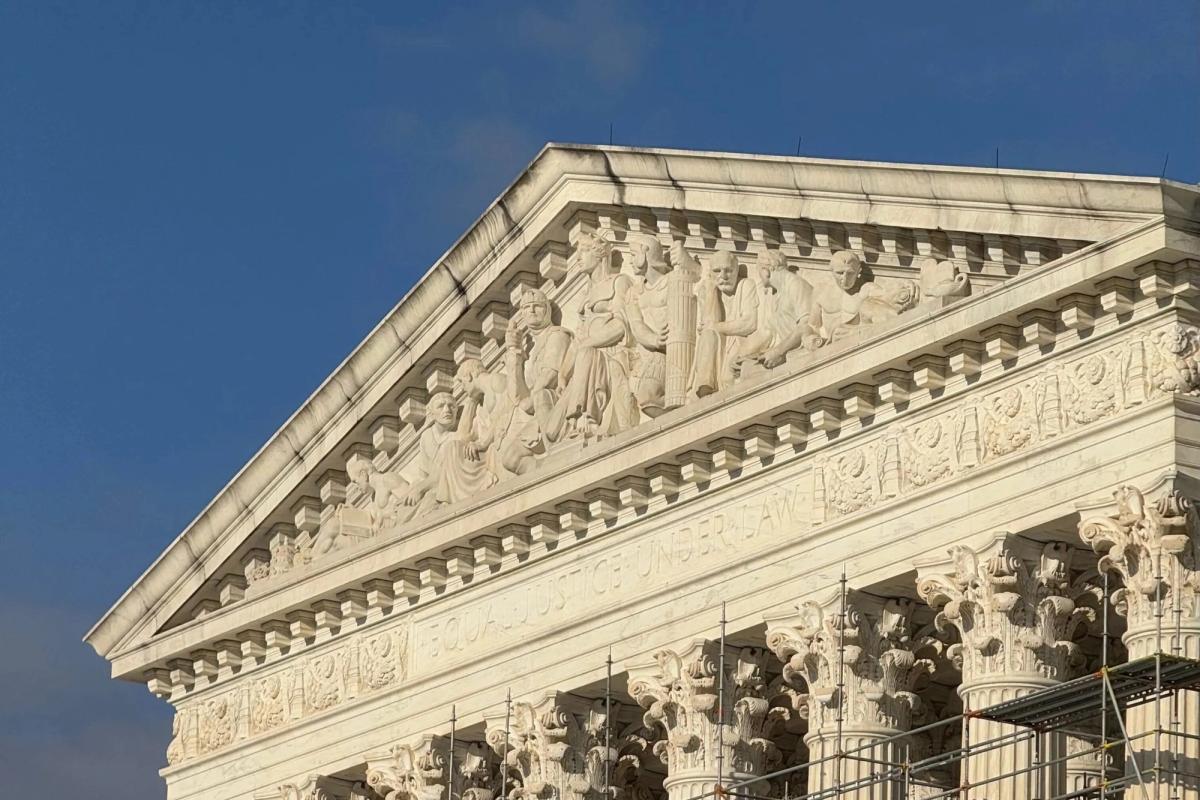
Trump blasts Supreme Court on social media
Plus, what Attorney General Todd Blanche said about the administration’s next moves on mail-in voting.
 SCOTUSblog•Kelsey Dallas, Amy Howe29m ago
Plus, what Attorney General Todd Blanche said about the administration’s next moves on mail-in voting.
SCOTUSblog•Kelsey Dallas, Amy Howe29m ago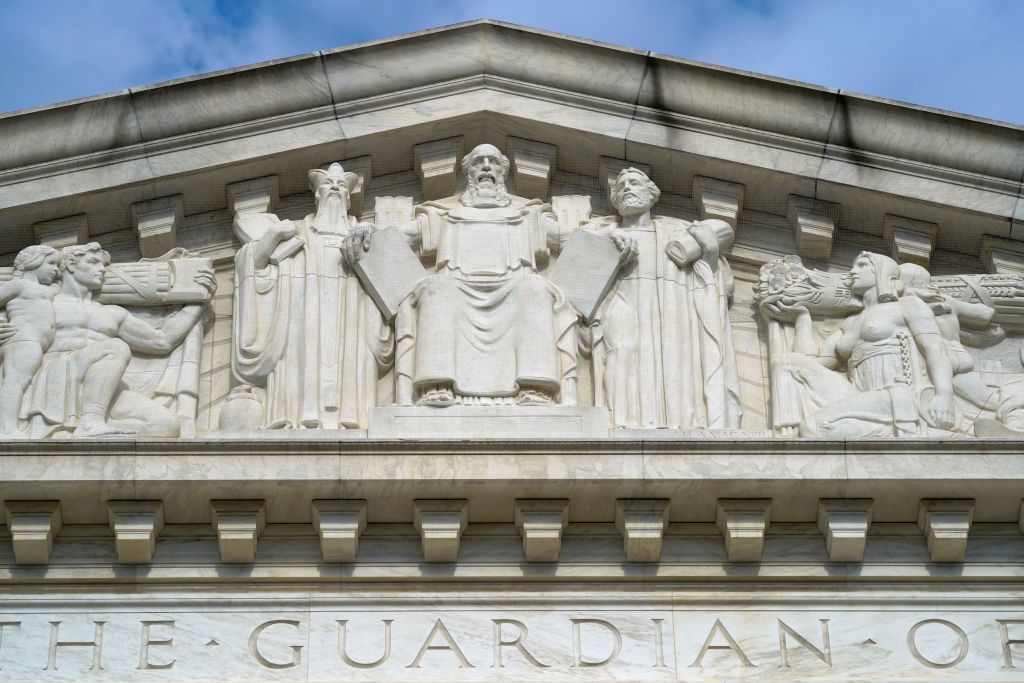
Lawyers for the League of Women Voters and the Electronic Privacy Information Center on Tuesday urged the Supreme Court to leave in place a ruling by a federal judge in Washington, D.C., that bars the federal government from using a centralized database to verify voters’ citizenship. Nikhel Sus, the lawyer representing the two groups, told the justices that, in violation of federal law, “the government has recklessly created an error-laden master citizenship database that endangers millions of Americans’ privacy and voting rights.” The filing came less than 24 hours after the Supreme Court rejected the federal government’s request to be allowed to implement portions of a U.S. Postal Service rule on mail-in ballots – which, like the database at the center of this case, the Trump administration said was necessary to combat election fraud. The dispute has its roots in a March 25 executive order that (among other things) instructed the Department of Homeland Security and the Social Security Administration to establish systems that would allow state and local governments to verify voters’ citizenship and immigration status. Those agencies then overhauled the Department of Homeland Security’s Systematic Alien Verification for Entitlements database, known as the SAVE system, to include the records of U.S.-born citizens, to give it access to Social Security numbers, and to allow users to conduct multiple searches simultaneously. The League of Women Voters and the Electronic Privacy Information Center went to federal court in Washington, where they challenged the changes to the SAVE system. On June 22, U.S. District Judge Sparkle Sooknanan blocked the government from using the modified system, agreeing with the challengers that it violates federal privacy laws, the Social Security Act, and the federal laws governing administrative agencies. Sooknanan wrote that “the federal government has knowingly trampled on the privacy rights of American citizens in a manner that threatens the sacred right to vote.” Moreover, she continued, “states have partnered with the federal government to access the database and are actively removing United States citizens from voter rolls based on inaccurate information.” By a vote of 2-1, the U.S. Court of Appeals for the District of Columbia Circuit on Sept. 4 rejected the government’s request to put Sooknanan’s order on hold while the appeal moves forward, but it ordered the appeal to be fast-tracked. The court instructed the litigants to propose a briefing schedule by Sept. 14, but the litigants later agreed that the briefing schedule should be postponed until the Supreme Court acts on the Trump administration’s request. U.S. Solicitor General D. John Sauer then came to the Supreme Court on Sept. 8, asking the justices to pause Sooknanan’s ruling while the government’s appeal moves forward. He called Sooknanan’s decision an “indefensible order that threatens the integrity of upcoming elections by vacating the federal government’s authority to internally use Social Security data when fulfilling its duty to respond to requests by States to verify the citizenship of individuals for voting and other purposes.” Moreover, he added, Sooknanan did not have the power to enter her order because the challengers do not have a legal right to sue, known as standing. Among other things, he wrote, the federal government is not the source of any injury that the challengers and their members might suffer, because the SAVE system “merely notifies the States whether the federal government can confirm citizenship.” In their filing on Tuesday afternoon, the groups pushed back against the government’s argument that they lack standing because the states, rather than the federal government, would be the source of any injury to them. That contention cannot be squared with the Supreme Court’s own cases, Sus wrote, which have “repeatedly recognized that a plaintiff has standing if ‘”third parties will likely react” to the government [action] “in predictable ways” that will likely cause . . . the plaintiff’s injury.’” “‘It is hardly surprising,” Sus continued,” “that additional voter verification and potential voter disenfranchisement is “the predictable effect of” the federal government incorrectly informing a state that an individual may be ineligible to vote.’ Indeed,” he concluded, “the government concedes this is the intended effect.” The groups also told the justices that the federal government was reading too much into a provision of federal immigration law – which, Sauer had argued, trumps any other federal law, like the Social Security Act or the Privacy Act, that might prevent DHS from obtaining or disclosing information. Accepting that interpretation, Sus countered, “would give DHS unlimited power to vacuum up millions of Americans’ sensitive information from SSA (or any other agency) and disclose it in bulk to states however it wants.” If Congress had intended to give DHS that “extraordinary power,” Sus suggested, “it would have done so clearly and expressly.” But not only has it not done so, Sus emphasized, but “several bills that would expressly authorize the SAVE modifications have failed in Congress.” Finally, the groups said, there is no real harm to the government if it cannot move forward with the modified system while the litigation continues. The pre-2025 SAVE system will remain in place, they stressed, and government agencies can continue “to use SAVE for individualized citizenship checks as they did for decades prior to 2025.” Moreover, they added, “[t]he government also lacks a substantial interest in operating a citizenship database it admits is error-prone and unreliable.”
SCOTUSblog•Amy Howe16h ago
This is the eighth and final piece in a series on what I believe the court can, and should, do better. *** Every year, each justice hires four law clerks. Under the current practice, the justices will hire young lawyers with sterling credentials who secured two or three prior clerkships from “feeder” judges. Often, interviews are scheduled while applicants are still in law school, and before they have even started their first clerkship. Justices have built elaborate screening networks with former clerks, as applicants have to traverse multiple rounds of interviews. The justices would acknowledge that for every clerk that is hired, there are many more equally qualified candidates. Getting the job is like winning the gold medal at the Olympics – you are the best of the best but conditions have to be just right. During the term, the clerks are privy to most things that happen at the court. The information they learn makes them extremely valuable. Accordingly, clerks are handsomely rewarded. Some law firms pay signing bonuses in excess of $700,000, even as former clerks are barred from practicing before the court for two years. Invariably, these former clerks often become the biggest boosters for their justice and the court itself. I have been critical of this law clerk cartel. Far too much power is granted to people with so little experience. As a thought experiment, I proposed how Congress could phase out Supreme Court law clerks altogether. This plan is extremely unlikely. But perhaps the justices can constrain their own process. Justice Ketanji Brown Jackson has taken some important first steps . For starters, she only considers applicants who have already completed an appellate clerkship. This step eliminates the unusual phenomenon in which law students are applying for Supreme Court clerkships before actually completing, or even starting, their first clerkship. Moreover, Jackson limits the application process to the submitted materials. There are no backdoors or secret paths to the clerkship. The notice states clearly that “[n]o information will be considered outside of the formal application process.” And references are barred from contacting the justice: “Neither applicants nor their references, recommenders, or other advocates should contact Justice Jackson or her current or former staff regarding a pending or prospective application.” If there are any doubts, the penalty is stated clearly: “Failure to follow this instruction may disqualify an application from further consideration.” Good for KBJ. Perhaps as the newest member of the court, she is still able to assert control over the hiring process before it explodes beyond her control. Other justices could have followed her lead, but they apparently have not. I would adopt all of Jackson’s preconditions and go several steps further. First, the justice should ask all of their clerks, following their clerkship, to work for two years in government service, for a non-profit, or some other public interest work. Implicit in this commitment is a postponement, or even rejection, of the gratuitous signing bonus. The justice would make clear that they are looking to hire clerks with an eye towards public interest. Moreover, these clerks will likely get far more practical experience following their clerkships outside of the private sector, where they can do far more good. Second, I have proposed that the justices should spend part of their time working in the courthouses across the country. Their law clerks should join them. This project is mostly about keeping the judges grounded, but I do think there is value in keeping the law clerk’s feet planted on the ground. Working in a marble palace can distort any sense of reality. Perhaps law clerks could spend part of the year in the home chambers and part of the year at the Supreme Court. Or some law clerks could spend all of their time in either location. Or perhaps a justice could go to D.C. without any law clerks. The third proposal will perhaps be the most draconian: the clerks should be barred from talking about cases with anyone in other chambers. Books and exposés about the Supreme Court recount how law clerks will often engage in shuttle diplomacy between the chambers. Documents about the so-called “Shadow Papers” may have leaked from someone who kept clerkship records from 2016. The law clerks become part of the deliberations. This approach may be useful and convenient for the justices, but I think it can distort the power structure. The clerks should be reminded that the justices are in charge, and they are just helpers. If the clerks are unable to talk with other chambers, then perhaps the justices would be forced to talk to each other more. And that is a very good thing. *** This concludes my eight-part series on unilateral Supreme Court reform. The first installment proposed eliminating the summer recess. The second installment urged the justices to hold regular press conferences. The third installment called on the justices to hold oral argument outside of Washington, D.C. The fourth installment considered how the chief justice could share much of his power. The fifth installment would restore the practice of the justices riding circuit. The sixth installment would enhance the Supreme Court minority’s procedural powers. And the seventh installment proposed empowering the Supreme Court’s supermajority on substantive matters. My sincere hope is that this series will generate discourse and debate. Unlike most proposals for court reform, these ideas should garner bipartisan support. None of them purport to change how many justices there are and how they decide cases. All of these proposals would maintain the independence of the court. Indeed, many of these ideas could be adopted by the justices unilaterally. Ultimately, the justices should not be bystanders in debates about SCOTUS reform. If the justices take the initiative to adopt reforms on their own, the impetus for external reform will decline. These changes would not only be good for the court but society as a whole.
SCOTUSblog•Josh Blackman23h ago
As many SCOTUSblog readers are likely aware, there are some blockbuster criminal law cases set for the Supreme Court’s upcoming term. Bans on AR-15 and similar semi-automatic rifles. Whether juries in criminal cases must always be 12 persons . Whether seizing a plane for the unlawful transport of a six-pack of beer is an unconstitutional “excessive fine.” In fact, 11 of the 25 cases already granted for review are, by my calculation, criminal law and related ( what I call the court’s “CLAR” cases ). They won’t all be headline-grabbers, but 40% of the court’s docket is a very healthy chunk. And the court will surely grant some more after its Sept. 28 “long conference.” I provide more details on the 11 already granted below. But first: The court can and should take more criminal cases Before discussing the merits of the current 11 CLAR cert grants, I want to point out that the court could do much more. Last month the Congressional Research Service put out a 68-page report on “Circuit Splits from 2025.” That little-reported document details almost 100 cases in which lower courts have disagreed (just in 2025?) on significant federal points of law. The Supreme Court has statutory jurisdiction to address such lower court “splits,” whether from federal or state courts. The Supreme Court’s Rules 10(a) and (b) expressly note that lower court “splits” on federal questions – that is, cases from different courts that disagree on some important point of federal statutory or constitutional law – are a reason for the court to grant review. And granting Supreme Court review on lower court splits makes sense, as national uniformity on federal issues is a major, and one of the oldest , reasons for having (as Article III of the Constitution begins) “one supreme Court.” What’s more, I have to believe that the CRS report did not come out of the blue but was prepared with the knowledge of (and perhaps even encouragement from?) folks in the solicitor general’s office . By far, the largest category of unresolved such “circuit splits” listed by CRS is criminal law and procedure, with 28 cases – three times larger than the next category, civil procedure. The report provides case citations for all 28 of these (at least one from every circuit except the U.S. Court of Appeals for the 5th Circuit). Just a few examples of important questions that need settling: Is embezzlement a continuing offense that extends the statute of limitations? Is car-jacking a violent felony when the state statute also reaches extortion? Is criminal forfeiture limited to property a defendant has actually acquired (here a cert petition may be pending)? What intent is required for a civil rights violation on a county road ? To make an oft-repeated point, the Supreme Court used to decide as many as 150 cases per term. But during the 2025-26 term the justices heard argument after full briefing in only 58. According to a Federalist Society report that has often been repeated , in 2012 Chief Justice John Roberts said that the court could hear “100 cases without any stress or strain, but the cases just aren’t there,” and he “emphasized that circuit splits are far and away the most important consideration.” The capacity of the justices to handle more cases is not an issue – more grants of review to provide national uniformity in criminal cases ought to be a priority. Criminal-law-and-related cases already set for the 2026-27 term The court has issued argument calendars for the last three months of 2026. As detailed below, there are two CLAR cases set for argument in the October sitting and three for the November sitting. The blockbuster AR-15 and criminal forfeiture cases will not be heard until Dec. 1 and 2. The case where I expect the court will rule , non-textually but universally, that serious criminal case juries must always have 12 and not six jurors is still unscheduled and so will not be argued until 2027. Below are my relatively brief descriptions and observations on the 11 CLAR cases set for argument so far in the coming term. The hyperlink for each takes you to the SCOTUSblog page for the case, where you can then find links to all the filings and other information about it. I address the three “biggest” cases first, and then the other eight in order of their scheduled oral arguments. Keep in mind that more criminal cases are likely to be granted after Sept. 28. Semiautomatic rifles, 12-person juries, and excessive fines Viramontes v. Cook County ( Dec. 2 , consolidated with Grant v. Higgins ): Like another nine states, Connecticut and Cook County, Illinois, have laws that ban possession of what they call “assault weapons.” The term is defined to include semi-automatic rifles like the AR-15 (and the Second Amendment Foundation petitioners do not challenge fully “automatic or burst fire” weapon bans). The question whether legislatures may ban semi-automatic weapons has been brewing for years, and last term Justice Brett Kavanaugh wrote that the court would “soon” address it. The solicitor general has now asked to join the oral argument over whether such “ categorical” bans are consistent with the Second Amendment. The case will attract huge media attention and the one hour scheduled for oral argument is likely to go much longer. Because these consolidated cases will attract much attention from other columnists, I won’t go into much detail. The U.S. Courts of Appeal for the 7th and 2nd Circuits both denied the firearm owners’ challenges, finding procedural flaws in each case. But the question – narrow, in the sense that even if the court reverses, a remand for specific application will be necessary – remains: Does the Second Amendment allow bans at all on semiautomatic rifles? I will add only the following textualist thought, about a small-but-radical change between the language of District of Columbia v. Heller and now. The 2008 Heller decision, which changed precedent to find a Second Amendment right to own handguns for self-defense, was decided 5-4. To me (and others ) it is clear that Justice Antonin Scalia had to include various qualifiers in his opinion, or he would have lost one or two of his five votes and Heller would have come out differently. Part III of the opinion was clearly added to capture, or keep, the narrow but earth-shattering majority, and ought to be viewed as the binding judgement of the court. Specifically, in addition to listing various “longstanding prohibitions on the possession of firearms” left undisturbed, part III said we “recognize another important limitation on the right to keep and carry arms. ... the sorts of weapons protected were those ‘in common use at the time ’ ” (quoting United States v.Miller , a 1939 precedent upholding bans on machine guns). I add emphasis on “at the time,” because the Viramontes briefing all but ignores what the court said was this “important limitation.” As the solicitor general’s brief notes, “the AR-15 rifle was developed in 1956,” And the first semiautomatic rifle of any kind was sold in 1903 . Thus, while they may be the “most commonly owned rifle[] in America” today (albeit by less than 10% of all Americans), semi-automatic rifles were undisputedly not in common use “at the time” the Second Amendment was adopted in 1791. Indeed, as the SG’s brief also explains, it is the modern technological developments in the AR-15 that makes it popular today. (This is also why they are commonly used in mass-shootings.) Rather, the solicitor general’s Viramontes brief subtly changes the language, saying (on page 21) that the proper Second Amendment test is whether AR-15s “ are in common use” today (again, my emphasis). This radically departs from the doctrinal limits that were essential to cementing the Heller result. In his 2025 dissent from denial of certiorari, Kavanaugh (joined by Justice Samuel Alito) adopted this same semantic transfiguration of Heller (changing “were” to “are”) – an error (or strategy) presaged in Kavanaugh’s 2011 Circuit judge dissent when Heller was remanded in 2011. Many folks will be listening on Dec. 2 to see whether a majority of justices will agree that Heller did not actually mean what it appeared to say. Kian v. Florida ( unscheduled ): Unlike Viramontes , Kian will be, I think, easy for the court, even if non-textual. So easy, it appears to me, that the parties and the court have agreed that an appendix presenting the underlying record is unnecessary. Whether the Sixth Amendment ’s right to a “jury” trial for all criminal prosecutions requires a 12, rather than six, person jury, has been pushed by Justice Neil Gorsuch for years: in his view, when the framers wrote “jury” they understood this to mean it consisted of 12 members. Amicus professor Akhil Amar agrees, saying that “[a] proper criminal jury means twelve good persons, nothing less. In 1791 and 1868, the number twelve was implicit in the word ‘jury’.” To rule for Kian, the court will have to overturn a divided 1970 precedent ( Williams v. Florida ) that upheld Florida’s six-person jury practice, over Justice Thurgood Marshall’s dissent that a jury of 12 is required. Williams reviewed the Sixth Amendment’s history and concluded that “precisely 12” was an “accidental feature” of juries at the time. But decades earlier, the court had seemed to hold that 12 persons are required. Then Gorsuch’s opinion in 2020’s Ramos v. Louisiana overruled a similar jury trial precedent allowing non-unanimous criminal conviction verdicts. As Alito suggested in his Ramos dissent , that decision seems to lead directly to a similar implied rule: that a criminal trial “jury” means, constitutionally if also implicitly, 12 persons. The case for overruling Williams has been around for years, and I think it will pose little difficulty for a majority in Kian . Former Solicitor General Seth Waxman (confession: also my former law-practice colleague) will argue for Kian, and it should be lively whenever it occurs. A more difficult question – whether Kian should be applied retroactively as a “new rule” to challenge former six-person-jury convictions – may be discussed and even decided, but it’s unnecessary to resolve the question presented here. Jouppi v. Alaska ( Dec. 1 ): One of my frequent, if nonsensical, classroom bon mots is that “facts make the law, not the other way around.” The soundbite facts of Jouppi are that Jouppi’s plane was taken by the state as a criminal forfeiture for illegally transporting a six-pack of beer. As my friends on Advisory Opinions note in their fun discussion of the case, there are other facts that might reduce one’s sympathy (such as nine gallons of beer in the back of the plane and that Jouppi’s passenger ran a bar in the area), but still this case looks like a “libertarian’s dream[].” And although Gorsuch has resisted the libertarian label , he seems to become a dispositive “wild card court” justice for the “little guy” when the government looks like a bully . All this suggests a ruling for Jouppi – but the question presented is more general: whether the Eighth Amendment’s no “excessive fines” provision should be applied “purely in the abstract” or by reference to a defendant’s specific wrongdoing. This distinction grows out of a 5-4 decision, 1998’s United States v. Bajakajian , which found a $357,144 fine for a currency reporting failure to be unconstitutionally excessive. Justice Clarence Thomas wrote that a fine is constitutionally excessive if “grossly disproportional to the gravity of a defendant’s offense.” His language there appears to have left room for argument now: did the justices mean the defendant’s offense specifically, or the gravity of that type of offense in general? There is a serious split here , among state as well as federal courts, and last term’s excessive fines case ( Pung v. Isabella County ) did not address it. Oral argument will likely be full of hypotheticals as to how any resulting constitutional test might be applied, even if the justices end up putting aside, perhaps with a grin or two, the forfeiture of Jouppi’s $95,000 plane for transporting a six-pack of beer as excessive under any test. All that said, forfeiture of instrumentalities of crime, things used to facilitate the crime itself, has long been a feature of criminal law. And deciding on the scope of forfeiture is generally thought of as more a legislative than a judicial task. The framers of the Constitution put only “excessive,” not all, forfeitures out of bounds, and left little guidance for precise application of the concept. Because Jouppi will provide significant guidance for thousands of criminal forfeiture actions, which not incidentally bring in billions of dollars for all levels of government, it will be one of the most significant criminal law decisions in the coming term. Another seven criminal-law-and-related cases next term Space considerations and the attention span of even knowledgeable readers for this sort of thing counsels shorter descriptions here. The descriptions are my own, not necessarily the court’s. Argument dates and the criminal law topic are bolded. One case is set for argument in October, five in November, and one is still not scheduled. Beaird v. United States ( Oct. 13 ): Is there a more nuanced way to describe the deferential standard for official commentary published by the U.S. Sentencing Commission to explain the federal Sentencing Guidelines ? Must federal courts follow the Commentary even if it conflicts with an unambiguous Guideline? The solicitor general ended up supporting a ruling for the defendant here, so Anthony J. Dick, a former clerk to Alito, has been appointed to defend the 5th Circuit’s prior rulings on the question whether the strict deferential standard for Commentary announced by a 9-0 1993 decision ( Stinson v. United States ) is still correct. When it granted cert in this case, the court wrote its own short question for the parties to address, But its brevity – is Stinson still correct? – is deceptively simple . Maxwell v. Dinis ( Nov. 2 ): Is a claim that a prisoner is entitled to release to a halfway house cognizable in a federal habeas corpus action? This case is a rare pro se prisoner petition granted for review. Once a response to the petition was requested by the court, a high-powered law firm arranged to represent him ( Masha Hansford , who has previously argued nine cases as an assistant to the solicitor general). Another former clerk to Alito, Brian W. Barnes , has been appointed to defend the 5th Circuit’s ruling that release to a halfway house is not a release from custody subject to habeas relief, because the solicitor general said that position is “inconsistent” with prior Supreme Court cases. Younge v. Fulton County ( Nov. 2 ): This is a civil procedure case involving the firing of a supervising prosecutor in a county district attorney’s office. May a civil defendant assert an affirmative defense well past the civil procedure Rule 16 deadline to support a summary judgement motion? Unlike other circuits, the U.S. Court of Appeals for the 11th Circuit has said yes if the plaintiff is not “prejudiced” by it. Guerrero v. Johnson ( Nov. 4 ): This is a state death penalty case involving a claim of “intellectual disability,” a topic which has recently engaged the court. Here, a threshold issue is presented: is a “ new rule ” of constitutional law available for retroactive application in a habeas petition, if it could have been raised in a prior petition even though it was viewed as meritless at that time? The new-rule-doctrine is complicated ; the question is what does a rule that was “previously unavailable” mean, as used in the habeas statute that governs state criminal convictions. The 5th Circuit ruled that it means “previously unavailable” (with a dissent from Judge James Ho to a 9-7 denial of rehearing en banc). The U.S. solicitor general has agreed in an amicus brief that the 5th Circuit’s interpretation is “unsound” – we’ll see if the SG asks to also participate at oral argument, since the habeas statute applicable to federal convictions has the same “previously unavailable” language. Nielsen v. Watanabe ( Nov. 9 ): The real question here is will the court overrule Bivens v. Six Unknown Federal Narcotics Agents , a 6-3 decision issued in June 1971? Bivens was perhaps the last hurrah of the liberal Warren court – four months later both Justices Lewis F. Powell and William H. Rehnquist were confirmed to replace famed liberal Hugo Black and moderate John Marshall Harlan II . Bivens allowed a private cause of action for damages under the Fourth Amendment against federal agents who violate constitutional rights. That idea was extended in 1980 to Eighth Amendment claims for deliberate indifference to a prisoner’s medical issues, in Carlson v. Green . This case ( Nielsen ) involves a similar, but of course not identical, Eighth Amendment claim, and the U.S. Court of Appeals for the 9th Circuit – traditionally a red flag for conservative critics – upheld Nielsen’s claim (despite 10 en banc dissenters). Bivens has been criticized , but also applauded , since the day it was decided. The court has rejected similar constitutional damages claims consistently since Carlson , and in 2022 Gorsuch called Bivens a “misstep” that the court should step away from. Francis Nielsen is a federal prison paramedic who allegedly told an injured prisoner to “stop being a cry baby” and failed to treat his injury, leading instead to two months of solitary confinement without medical treatment for what turned out to be severe injuries. The 9th Circuit ruled that Watanabe’s claim against Nielsen and others could go forward on a Bivens / Carlson theory. Nielsen, who is represented by former Assistant to the Solicitor General Jeffrey A. Lamken , argues directly that Bivens should be overruled. As amicus, the solicitor general has asked to participate in oral argument, and suggests that the court might want to wait for a case decided under the Fourth Amendment like Bivens to consider overruling it. On Nov. 9, Bivens will likely be vigorously defended by the three liberal justices. A legal regime in which a person who is intentionally injured by a federal agent’s violation of a constitutional right and has no remedy for damages is undoubtedly in tension with the famous Marbury v. Madison idea that every violation of a right deserves a remedy . But the anti- Bivens handwriting seems to be starkly on the wall . Two cases presenting statutory “plain language” as well as circuit splits that the solicitor general agreed the court should resolve Wassily v. Blanch ( Nov. 30 ): This is another important immigration case, after five others decided by the court this past year. Are persons who were once “granted asylum” but whose asylum status was later terminated for serious criminal convictions categorically ineligible for adjustment to lawful permanent resident status? The statute says that “any alien granted asylum” may apply for such status, but the solicitor general argues that the 2nd Circuit was correct to rule that the statute is intended to apply only to persons who are presently in asylum status. Montoya Palacios v. Liggins ( not yet scheduled ): Can a successful habeas corpus action used to challenge immigration detention be eligible for an award of attorneys’ fees and costs under the Equal Justice Act ? Habeas actions are filed as civil, not criminal, cases, and the statute says that “any civil action” other than those “sounding in tort” can qualify. But the solicitor general argues that habeas actions have been viewed differently than other civil actions in the past, and it’s true that Schlanger v. Seamans , decided in 1971, said that habeas cases are “not automatically subject to all the rules governing ordinary civil actions.” At the same time, that decision referred to “rules,” not “statutes.” Merits briefing has been extended into December so further analysis awaits.
SCOTUSblog•Rory Little23h agoPlus, a closer look at Clarence Gideon from Gideon v. Wainwright.
SCOTUSblog•Kelsey Dallas, Blake Fox15 Sept
The Supreme Court on Monday declined to allow the U.S. Postal Service to carry out parts of a new rule on mail-in voting. In a brief, unsigned order , the justices left in place a ruling by a federal judge in Boston that bars the USPS from implementing aspects of the rule. Justice Brett Kavanaugh penned a one-paragraph concurrence in which he agreed with the decision to deny the government’s request. He suggested that, in his view, the Postal Service might have the power to issue the rule. But even if it does, he continued, election officials “do not have sufficient time to reasonably implement the rule before” the November elections. Justice Samuel Alito dissented from the court’s ruling, in an opinion joined by Justice Clarence Thomas. He argued that some of the challengers in the dispute do not have a legal right to sue, known as standing, “while the remainder are pursuing a claim that this Court has recently called a ‘Hail Mary pass’ that ‘rarely succeeds.’” The court’s order comes less than two months before the midterm elections in November. At least two states – North Carolina and Alabama – have already begun to send out ballots by mail. As part of his administration’s broader effort to combat alleged voter fraud, President Donald Trump in March signed an executive order that directed federal agencies to take a series of steps on mail-in voting. For example, it required the Department of Homeland Security to send each state a list of the adult U.S. citizens in that state at least 60 days before a federal election and instructed the U.S. attorney general to investigate and prosecute state officials who allow people who are not eligible to vote to cast ballots. A group of 23 states, led by California, and the District of Columbia went to federal court in Massachusetts to challenge the government’s efforts to implement the executive order. They argued that the order clashes with provisions in the Constitution that give states the power to determine voter eligibility and to set the “Times, Places, and Manner” of holding congressional elections. U.S. District Judge Indira Talwani agreed. In an order on June 25, she temporarily prohibited the federal government from implementing parts of Trump’s executive order on or before the upcoming November elections in California, the states joining the lawsuit, or D.C. On Aug. 24, the Supreme Court put Talwani’s order on hold, allowing the Trump administration to begin implementing the executive order. The majority explained that the states’ challenge had come too soon because the order had not yet been carried out – and, therefore, the states had not suffered the kind of injury that would allow their lawsuit to go forward. Three days later, Talwani issued a new order that prohibited the Trump administration, for 14 days, from requiring states to comply with several provisions of a new rule issued by the U.S. Postal Service to implement Trump’s executive order – for example, imposing requirements for the design of the envelopes used to mail ballots and for the submission of voter data into a USPS portal. The Trump administration returned to the Supreme Court on Sept. 3, asking the justices to pause Talwani’s second order. U.S. Solicitor General D. John Sauer withdrew that request three days later, after Talwani issued a preliminary injunction , which replaced her Aug. 27 temporary restraining order and barred the Trump administration from requiring states to comply with provisions of the USPS rule indefinitely while the litigation continues. Sauer instead filed a new request with the Supreme Court, seeking to block Talwani’s preliminary injunction. He argued that Talwani’s “continuing prejudgment of the rule is baseless,” and her rationale is “simplistic,” and he rejected any suggestion “that the Postal Service is trying to federalize the rules for mail-in voting.” Instead, he wrote, “the Postal Service’s final rule imposes only modest envelope-design and addressee-information requirements for federal-election ballots sent via U.S. Mail.” Without a stay of Talwani’s order, Sauer continued, states will be able to mail out ballots that do not comply with the new rule. California and the other states countered that “USPS’ unprecedented experiment with our Nation’s most cherished franchise—the right to vote—is unlawful.” And they suggested that the effects of a stay could lead to “chaos,” with some states unable to comply with the rule by the November elections, “meaning that millions of voters would be unable to vote by mail and some would not be able to vote at all.” Moreover, they added, “even if state and local officials were somehow able to implement the new rule perfectly, there is a high risk of technical breakdown, ineptitude, and delay on the part of USPS.” A “friend of the court” brief filed by state and local election officials – including Republican secretaries of state from Kentucky, North and South Dakota, Georgia, New Hampshire, and Kansas – echoed this caution. They told the court that “[a]ttempting to implement the Rule now will almost certainly lead to mistakes, delays, and confusion for both voters and election officials.” A brief filed on Wednesday by the League of Women Voters and other civic groups, which had filed their own challenge to one part of the rule, also urged the court to leave Talwani’s preliminary injunction in place. The groups told the justices that “Congress charged the Postal Service with delivering the mail nationwide, subject to a scheme of narrow exceptions for specified categories of material that Congress itself—not USPS—has deemed ‘nonmailable’ and subject to rules of general application such as sufficient postage. Mail ballots fall outside those congressionally prescribed exceptions.” In an order issued on Monday night, the court indicated that the “Government is unlikely to succeed on the merits of its challenge to” Talwani’s order – a key factor in determining whether to grant the relief that the government was seeking. “And the equitable factors applicable for obtaining emergency relief from this Court” – such as whether the government will be permanently harmed if Talwani’s order is not put on hold – “do not favor a stay,” the court added. In dissent, Alito contended that the Trump administration “has made the showings necessary for a stay.” First, he reasoned, the civic groups challenging the rule had relied on “cryptic filings” to assert their right to sue. But they must “make specific allegations establishing that at least one identified member had suffered or would suffer harm,” Alito stated, and provide that member’s name. As for the states, Alito continued, the dispute boils down to “whether the Postal Service has statutory authority to promulgate the rule.” In this case, Alito asserted, the challengers must meet a high bar, but they cannot do so, because the USPS “has broad authority to regulate the mail.” Alito agreed with the Trump administration that it would suffer permanent harm if Talwani’s order is not put on hold while the litigation continues, because it would not be able to implement the rule in time for the November elections even if her injunction is ultimately reversed. “[T]he Government,” Alito emphasized, “has a strong interest in enforcing the rule.” By contrast, although Alito made clear that he took “th[e] problem” of “the practical effects of implementing the rule close to the midterm elections” “very seriously,” he concluded that “it is not enough to convince me to deny the application.” Some states, he noted, support the rule and say that they can comply with it during the November elections. Moreover, he suggested, the challengers and the courts “bear a substantial share of the blame” for the delay in the implementation of the rule.
SCOTUSblog•Amy Howe15 Sept
This is the fifth of seven introductory articles on the relevance for constitutional law and the Supreme Court of the “born free and equal” clauses, which appeared in the Declaration of Independence and in six out of 12 state constitutions when the federal Bill of Rights was ratified in 1791, in 24 out of 37 state constitutions when the 14th Amendment was ratified in 1868, and is in 37 out of 50 state constitutions today. The “born free and equal” clause of the Massachusetts Constitution of 1780, for example, provided that : Article I. All men are born free and equal, and have certain natural, essential, and unalienable rights; among which may be reckoned the right of enjoying and defending their lives and liberties; that of acquiring, possessing, and protecting property; in fine, that of seeking and obtaining their safety and happiness. In my initial articles, I showed that the “born free and equal” idea is deeply rooted in American history and tradition as that phrase is used in such correctly decided cases as Washington v. Glucksberg (rejecting a right to assisted suicide), McDonald v. City of Chicago (recognizing that the Second Amendment’s right to own a handgun for self-protection extends to the states), and Dobbs v. Jackson Women’s Health Organization (overturning Roe v. Wade ). In the second and third article, I argued that while the 14th Amendment does not give rise to a “right to privacy,” it does through the privileges or immunities clause constitutionalize the “born free and equal” clauses, subject to rational basis review, which justifies the outcome, although not the opinions in 1965’s Griswold v. Connecticut (holding that states may not criminalize the use of contraceptives by married couples) and in 2003’s Lawrence v. Texas (holding that states may not criminalize same-sex “sodomy”). And in my fourth article , I examined the application of the “born free and equal” clauses to yet another famous “right to privacy” case: 2015’s decision in Obergefell v. Hodges , which correctly found a national constitutional right to same-sex civil marriages. Today I turn to one of the most atrocious rulings in Supreme Court history: the 1927 case of Buck v. Bell , in which the court, 8-1, upheld a model eugenics statute. Specifically, a Virginia act allowed the compulsory sterilization, for the supposed “protection and health of the state,” of anyone who was deemed by a “social worker” to have genes resulting in feeblemindedness, unfitness, or an intellectual disability. Only a perfunctory hearing was allowed to those who were compulsorily sterilized. This statute did not come out of nowhere. Rather, such eugenics laws were first championed in 1883 by the social Darwinist Sir Francis Galton, a second cousin of Charles Darwin who chillingly believed that there were many different human “races” on the earth and that those races of human beings were competing for what psychologist and philosopher Herbert Spencer called “the survival of the fittest.” Galton, who was fascinated by the concept of animal breeding of dogs and racehorses, dreamed of applying this to human beings so as to promote the most intelligent, physically strong, and beautiful or handsome of them. (Darwin himself had hinted at such an idea in “The Origin of Species,” and mentioned it in his 1871 book “ The Descent of Man .”) Support for eugenics laws became an orthodox staple of the creed of the Progressive Era. In one letter, President Theodore Roosevelt stated that: Society has no business to permit degenerates to reproduce their kind … Any group of farmers who permitted their best stock not to breed, and let all the increase come from the worst stock, would be treated as fit inmates for an asylum … Some day we will realize that the prime duty, the inescapable duty of the good citizens of the right type is to leave his or her blood behind him in the world; and that we have no business to permit the perpetuation of citizens of the wrong type. The great problem of civilization is to secure a relative increase of the valuable as compared with the less valuable or noxious elements in the population … The problem cannot be met unless we give full consideration to the immense influence of heredity. Woodrow Wilson, the other major Progressive politician of the first part of the 20th century, signed a eugenics bill into law as governor of New Jersey. Other famous eugenicists included William Howard Taft ; Margaret Sanger (the founder of Planned Parenthood); and Winston Churchill. Indeed, as home secretary from 1910 to 1911, Churchill argued for eugenic government intervention regarding people categorized at the time as “feeble-minded” or “insane.” In addition, major early philanthropic foundations like the Carnegie Institution and the Rockefeller Foundation provided extensive financial grants to eugenics organizations, such as the Eugenics Record Office at Cold Spring Harbor Laboratory, under the direction of leaders and trustees who subscribed to the pseudoscience of the era. This extended to the universities as well. James Rowland Angell , who was president of Yale from 1921 t0 1937, and Charles William Eliot , who was president of Harvard from 1869 to 1909, were outspoken and virulent eugenics supporters. (Elliott served as a vice president to the first International Eugenics Congress held in London in 1912.) The court itself perhaps most prominently embraced this movement in Buck v. Bell . In upholding Virginia’s compulsory sterilization law, Justice Oliver Wendell Holmes, Jr. wrote for the majority that: It is better for all the world, if instead of waiting to execute degenerate offspring for crime, or to let them starve for their imbecility, society can prevent those who are manifestly unfit from continuing their kind. The principle that sustains compulsory vaccination is broad enough to cover cutting the Fallopian tubes . ... Three generations of imbeciles are enough. In the wake of the Supreme Court’s ruling, 70,000 Americans were compulsorily sterilized, and 32 states ended up adopting compulsory sterilization statutes like Virginia’s. Nazi jurists and race hygienists studied U.S. sterilization statutes, such as California’s eugenics programs, as well as the Buck v. Bell decision. These laws inspired Adolf Hitler’s Nazi government to pass a German eugenics law in July 1933 entitled a “Law for the Prevention of Offspring with Hereditary Diseases” a few months after the Nazis came to power. Ultimately, 400,000 people were sterilized by the German law. The same racist ideology that led to these compulsory sterilizations in Hitler’s Nazi Germany undoubtedly helped fuel the ideas behind the Holocaust. Such ideas could not be in greater contrast to the Lockean principle that “All men are born free and equal.” That idea was thriving in the 1780’s when the Constitution was adopted; it was thriving during Reconstruction and in President Abraham Lincoln’s Gettysburg Address; but by 1912 it had effectively died out. The “born free and equal” idea only reemerged in 1948 as an Article I right in the Universal Declaration of Human Rights after the horrors of the Nazis and the Holocaust began coming to light. *** Buck v. Bell was egregiously wrong not only as a matter of morals, but under the “birthright equality” principle that underlies the citizenship clause of the 14th Amendment. Citizens, as I explained in my prior articles, are born equal (i.e., they are born to be neither slaves nor lords). The citizenship clause grants equal rights unto the feeble-minded and the geniuses of this world alike. The right to have children, like the right to marry (the purpose of which is often to have children) is obviously deeply rooted in American history and tradition. The Preamble of our Constitution states that one of the six purposes of that document is: “To secure the Blessings of Liberty to ourselves and our Posterity ”. It goes without saying, I think, that a government which is compulsorily sterilizing its citizens based on a social worker’s finding of feeblemindedness is not securing the “Blessings of Liberty to ourselves and our Posterity .” The landmark 1823 decision of Corfield v. Coryell , which I have previously said is the 14th Amendment’s version of the “born free and equal” clauses, stated that: The inquiry is, what are the privileges and immunities of citizens in the several states? … They may … be all comprehended under the following general heads: Protection by the government; the enjoyment of life and liberty, with the right to acquire and possess property of every kind, and to pursue and obtain happiness and safety; subject nevertheless to such restraints as the government may justly prescribe for the general good of the whole [people]. As noted, Americans cannot “enjoy … life and liberty” or “pursue and obtain happiness and safety” if they face the risk of compulsorily sterilization. But can such laws then be justified under Coryell ’s rational basis test (in bold), i.e., that such laws are “just” and are enacted for the “general good of the whole [people]?” Certainly not. A government that could compulsorily sterilize the feeble-minded would also be able to compulsorily sterilize any population that has fallen out of favor, whether Jewish or Black people, Native Americans, or Latinos. Nor, even if such a policy for the “feebleminded” was justified, could it be properly implemented (as was true in Buck’s very own case ). The Supreme Court distinguished but did not overrule Buck v. Bell in 1942’s Skinner v. Oklahoma after it became terribly apparent what eugenics led to. Someday, the Supreme Court should formally overrule this terrible precedent. In the meantime, Harvard Law School should cancel its annual, prestigious “Oliver Wendell Holmes Lecture.” Three generations of Holmes Lectures are enough.
SCOTUSblog•Steven Gow Calabresi14 Sept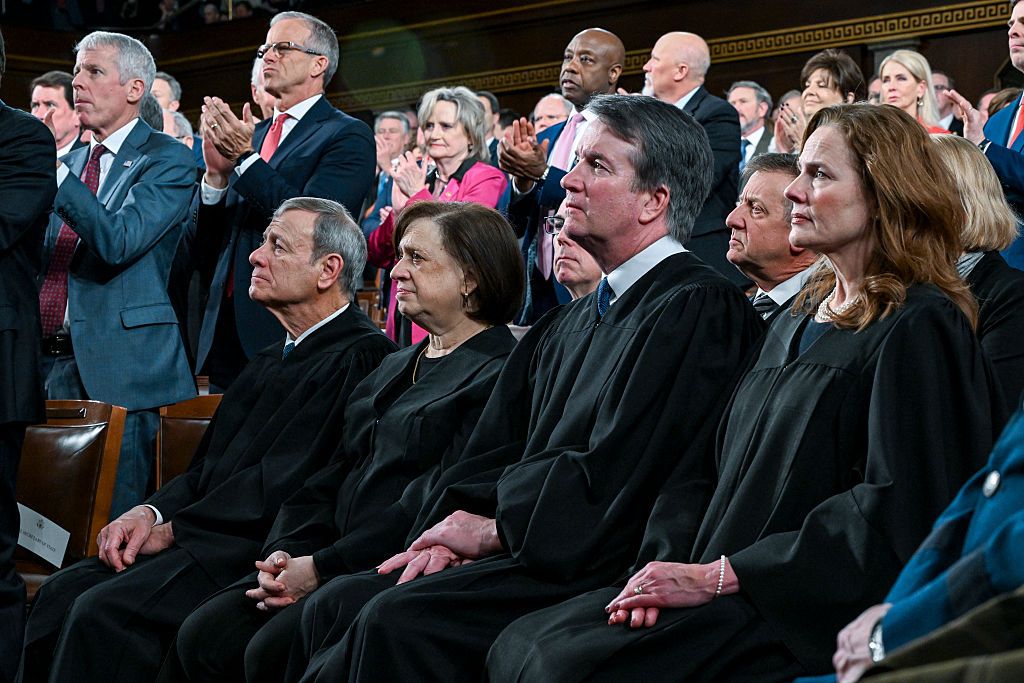
Upon introducing Amy Coney Barrett as his nominee to the Supreme Court in September 2020, President Donald Trump praised her as “ a woman of unparalleled achievement, towering intellect, sterling credentials, and unyielding loyalty to the Constitution .” This view of her did not last. In April, after Barrett voted against Trump’s tariffs and in anticipation of a ruling striking down his executive order on birthright citizenship , the president posted to Truth Social that “certain ‘Republican’ Justices have just gone weak, stupid, and bad.” Barrett and Justice Neil Gorsuch, Trump wrote, “were appointed by me, and yet have hurt our Country so badly!” Trump is certainly not the first president to have “presidential buyer’s remorse,” as Harvard Law School professor Jon Hanson called it . President Dwight Eisenhower, for one, chose Earl Warren as chief justice in 1953 because, among other things (including having promised him a seat on the court a year earlier in exchange for Warren’s political support) the California governor’s philosophy “ pleased ” him. Within a decade, however, Eisenhower supposedly called Warren’s appointment “the biggest damn fool mistake I ever made.” (There is some debate as to whether he actually said this.) Judge Laurence Silberman of the U.S. Court of Appeals for the District of Columbia Circuit spoke of a potential cause for the phenomenon of ideological drift in a 1992 speech to the Federalist Society . There, he argued that The New York Times’ legal reporters existed mainly to “put activist heat on recently appointed Supreme Court justices,” who might then move leftward to “curry favor with or avoid criticism from the Washington press corps.” “Tom Sowell,” a prominent conservative economist and social theorist, Silberman continued, “described this technique as the ‘Greenhouse Effect.’” Sowell coined the eponymous term in a column after Linda Greenhouse, the Times’ longtime Supreme Court correspondent (“[p]erhaps the most influential journalist who denigrates conservative judges and lionizes those on the left,” from Sowell’s point of view). According to Sowell , this phrase describes “the susceptibility of judges to such journalistic influence in general.” “The idea” of the “Greenhouse effect” “is that once confirmed, justices become desperate to be invited to the right cocktail parties and conform their views to those of the liberal intelligentsia,” as Slate reporter Dalhia Lithwick has characterized it. Whether due to the Greenhouse effect or not, historically there has been significant frustration over judicial “drifting”: In the words of Silberman, “those of us who had been involved in judicial selection had watched with great disappointment as jurists seemed to change on the bench – or, as the press would say, ‘grow.’” Perhaps exhibit A in modern times is Justice David Souter. John Sununu, who served as the governor of New Hampshire before becoming the chief of staff to President George H.W. Bush, “ assured ” conservatives in 1990 that the former New Hampshire Supreme Court associate justice would be “a home run,” even though Souter was a relative unknown who had spent just three months on the U.S. Court of Appeals for the 1st Circuit. Two years later, Souter joined Justices Anthony Kennedy and Sandra Day O’Connor in Planned Parenthood v. Casey to reaffirm the “essential holding” of Roe v. Wade . Over time , he came to align with Justice John Paul Stevens (another Republican appointee) as one of the most liberal justices on the court. Since then, it has become a mantra for some in the conservative legal movement to have “ no more Souters ”; that is, to rigorously guard against the type of jurist who would drift leftward. So has this effort proven successful? And what does success look like here? The “drifters” A history of modern justices drifting to the left appears to be more than just anecdata. University of Virginia political scientist Larry Sabato estimated in 2005 that roughly a quarter of the justices confirmed over the preceding half-century turned out more moderate or liberal than expected. In 2007 , political scientists Lee Epstein, Andrew Martin, Kevin Quinn, and Jeffrey Segal used justices’ ideological scores (known as Martin-Quinn scores , which “estimate each justice’s ideological position by modeling voting coalitions in non-unanimous cases”) to show that nearly every justice since 1937 had ideologically drifted during his or her tenure, and that presidents could expect their appointees to vote as predicted only for their first few terms. President Richard Nixon, for example, selected Justice Harry Blackmun on the understanding that he was a rock-solid conservative – only for him to pen Roe v. Wade three years later. Stevens, who was nominated by President Gerald Ford, eventually proved the court’s most consistent liberal, coming to lead the left wing of the court. And Kennedy, once hailed as “ Bork without the beard ,” authored the court’s majority opinions in both Lawrence v. Texas and Obergefell v. Hodges , which held, respectively, that a Texas law criminalizing same-sex sexual conduct violated the due process clause and that the 14th Amendment gave same-sex couples an equal right to marry. Even arch-conservative Chief Justice William Rehnquist moved leftward over time, especially after his appointment as chief. Other than the Greenhouse effect, several explanations have been offered for such drifts. Georgetown law professor Mark Tushnet argued that Justice Antonin Scalia’s “acerbic comments on his colleagues’ work” may have occasionally driven Kennedy into the arms of his liberal colleagues. Souter himself said he knew little about federal constitutional law when confirmed and formed his views on the job, coming to see himself as sticking to the precedents of the Warren and Burger courts while his conservative colleagues departed from these. Along those lines, Hanson and Drexel law professor Adam Benforado have argued that the job changes people , as a justice who must decide real cases with real parties may not rely on the same intuitions that got him or her nominated. As Judge Richard Posner of the U.S. Court of Appeals for the 7th Circuit once put it based on his own experience, being a judge “is bound to moderate one’s views.” The pipeline In the face of such drift, one criticism (at least on the right) has been that Republican presidents and their staff have done a markedly poor job vetting their picks. There may be some truth to this claim, but it’s not entirely convincing. President Ronald Reagan’s Justice Department ran what a leading historian of judicial selection called the “most systematic philosophical screening” of judges in American history – this process produced Rehnquist as chief justice and Scalia, but also the more moderate O’Connor and Kennedy. Law professor Michael Dorf has written that for every Republican nominee since Nixon (and up to 2007, when his paper was published), one variable – prior service in the federal executive branch – is an important predictor of whether a justice would “evolve.” Chief Justice Warren Burger and John Roberts, as well as Rehnquist, Scalia, and Justices Clarence Thomas and Samuel Alito had such experience (and therefore remained ideologically “solid,” with perhaps the exception of Roberts), while Blackmun, Powell, Stevens, O’Connor, Kennedy, and Souter had no such experience. According to Dorf, this phenomenon may stem from committed conservatives seeking out and working for the Justice Department in Republican administrations, while presidents have reached for somewhat unknown outsiders when they wanted to avoid a confirmation fight. Others (in line with the Greenhouse effect) have focused more on what happens to the justices once they join the court, arguing that people respond less to public opinion than they do to the elite networks around them; as such, the argument goes, organizations must instead focus on “ situational influences ” that affect a judge’s behavior. One study tried to measure the effect using ideological scores for every Republican appointee from 1982 through 2021, and found that Republican appointees without a Federalist Society affiliation, for example, drifted left by about 0.07 points per year on the Martin-Quinn scale, while affiliated justices drifted right by about 0.05. Today’s court The current administration has taken ideological drift quite seriously. When the time came for Trump to nominate a Supreme Court justice to Scalia’s seat in 2017 , he had already “worked closely with conservative legal groups like the Heritage Foundation and the Federalist Society to compile a list of potential nominees, which he released before the election,” according to SCOTUSblog's contemporaneous coverage . Various other media outlets reported that Leonard Leo, then executive vice president of the Federalist Society, at Trump’s request , “drew up the lists of potential justices that Donald Trump released during the 2016 campaign,” and “advised Trump on the nominations of Neil Gorsuch, Brett Kavanaugh and Amy Coney Barrett.” In 2018 , the lawyers advising Trump on Kennedy’s replacement reportedly “huddled on the fourth floor of the Eisenhower Executive Office Building for days to review the writings and opinions of the leading candidates … [and] continued sharpening the briefing and vetting materials.” The same year , Trump remarked that “[w]e’re going to have great judges, conservative, all picked by the Federalist Society.” So how has this pipeline fared? Like many other things, it depends on who you ask and what metrics you use. Trump’s first nomination to the Supreme Court, Gorsuch, measures as relatively conservative – his Martin-Quinn score places him as the third-most conservative justice on the current court, behind Thomas and Alito. Yet it’s a bit more complicated than that: Gorsuch is also the court’s most frequent bridge to the liberals in dissent, joining them in eight of his 46 dissents since Justice Ketanji Brown Jackson arrived on the court. And in the tariffs case, Gorsuch signed onto Roberts’ majority opinion in full (and wrote an even broader concurrence), striking down the president’s signature economic initiative and thereby incurring Trump’s wrath. Kavanaugh is perceived to be less conservative than Gorsuch by some measures , and more so by others , specifically when it comes to the interim docket (again, it’s what metric you use!). In merits cases, Kavanaugh often aligns with Roberts, of whom the contemporary right is no fan, yet he was also the only member of the court’s center-right to side with the president in the tariffs case, writing the principal dissent and (whether he wanted it or not) garnering the president’s praise . As for Barrett, she sits closest to the center according to several metrics . On the current court, she has also “ drifted ” the most leftward, according to an analysis by Adam Feldman; a separate study found that her share of conservative votes in divided cases fell from 65% in the 2020 term to 57% in the 2023-24 term. During the 2025-26 term, she also voted against two of the president’s most prominent executive orders (in both the tariffs and birthright cases), unlike Kavanaugh and Gorsuch. For this, she has generated a great deal of anger from the right. Is “drift” even a fair standard? Of course, whether Barrett has drifted depends on what “drift” means. Despite some prominent “defections,” she has joined her conservative colleagues in the majority of contentious cases on the merits and interim dockets. But, perhaps most importantly, a justice’s judicial philosophy and the outcomes the party that nominated her support can be two different things. Barrett would argue that she is applying an originalist methodology regardless of where it leads, whether in Trump’s favor or to the president’s detriment. And, indeed, if a political movement’s constituency measures justices’ votes simply by their outcomes – as opposed to the reasoning used to get there – a pipeline’s success may look to that constituency like failure. While this might displease the partisans among us, some would argue that’s exactly the point of judicial independence.
SCOTUSblog•Nora Collins14 SeptPlus, former crypto mogul Sam Bankman-Fried wants SCOTUS to take up his case.
SCOTUSblog•Kelsey Dallas, Nora Collins14 Sept
The Supreme Court on Friday dismissed a case that had been scheduled for argument in October after U.S. Solicitor General D. John Sauer notified the court that the case is now moot and the challenger agreed that it should be removed from the oral argument docket. In Genalo v. Black , the justices had been set to consider at what point, if any, certain noncitizens have a right to a bond hearing during a lengthy detention and what the government must show to justify continued detention if such a hearing is indeed required. In his letter to Scott Harris, the clerk of the court, Sauer said the Justice Department aims to bring the issue back to court soon in a new petition for review. When Sauer asked the court to take up Genalo v. Black , the case involved two men detained under Section 1226(c) of the Immigration and Nationality Act, which requires the detention of noncitizens, including green card holders, who have committed certain crimes and who are awaiting removal proceedings. Highlighting that Section 1226(c) “expressly prohibits” the release of such individuals “except on ‘narrow, witness-protection’ grounds,” Sauer urged the justices to review the U.S. Court of Appeals for the 2nd Circuit’s decision that the men’s detention had stretched on for so long that they were entitled to a bond hearing under the Fifth Amendment’s due process clause. Sauer pointed to Jennings v. Rodriguez , in which the Supreme Court held in 2018 that Section 1226(c) itself did not require periodic bond hearings and considered – but did not resolve – the question of whether, amid a lengthy detention, due process would eventually require such hearings. Sauer urged the court to grant review in Genalo v. Black and answer that lingering question. While the federal government’s petition for review was pending, one of the men involved, Carol Williams Black, left the United States and filed a declaration with the court stating that he had no intention of returning. The parties agreed that his claim was moot. When the court granted the petition on June 15, it clarified that the case would focus only on the other man, who is identified as Keisy G.M. and had been detained by immigration officials for 21 months after being convicted of assault. However, the court acknowledged that questions remained about whether the case still presented a live controversy, asking the litigants to brief whether G.M.’s claim was also moot (as his lawyers had asserted in his brief opposing review). At that point in the case, the mootness question stemmed from the fact that G.M. had been released from custody in 2022. But in late August, the question took on new significance, when New York Gov. Kathy Hochul granted G.M. a pardon with respect to his assault conviction. “As a result, G.M. is no longer deportable” and no longer “subject to mandatory detention under” Section 1226(c), ACLU National Legal Director Cecillia Wang wrote in G.M.’s merits-stage brief , urging the court to determine that the case was moot. In his Friday letter to the court, Sauer also pointed to the pardon, explaining that the government “agrees with G.M. that his habeas case is now moot.” Sauer and Wang filed a joint stipulation to dismiss on Friday, as well. Later on Friday, the court dismissed the case, which had been scheduled for argument on Tuesday, Oct. 13. The dismissal leaves only one argument currently scheduled for that day and only six total arguments in the October sitting.
SCOTUSblog•Kelsey Dallas12 Sept
Welcome to SCOTUSblog’s recurring series in which we interview experts on different supreme courts around the world and how they compare with our own. Today’s column focuses on Germany’s Federal Constitutional Court. To help me understand the court that can apparently “do no wrong,” I corresponded with Professors Susanne Baer and Christoph Möllers . First of all, I understand that Germany has several supreme courts. What is the difference between the Federal Court of Justice, for example, and the Federal Constitutional Court? SB: In Germany, there are supreme courts for different major fields of law (civil, labour, criminal, administrative, social security, and tax law), while the Federal Constitutional Court decides constitutional questions only, including judicial review of legislation, administration, and the courts. Since Germany is a federal state, there are also constitutional courts in each state. CM: The FCC is a specialized constitutional court which has the mandate to apply just constitutional law, not statutory rules. The Federal Court of Justice is one (of five!) supreme courts for statutory law, in this case for criminal and civil law. Focusing on the Federal Constitutional Court, how many justices are on this body? SB: There are 16 justices, in two “senates,” or panels, with most smaller cases decided by chambers of three justices each (“kammern”). How are these justices selected? SB: Half of them are selected by the national Parliament (“Bundestag”), the other half by the federal second chamber of state governments (“Bundesrat”), with a 2/3 majority requirement, usually forcing the governing party to get votes from the opposition. The result has been an informal scheme that gives the power to propose candidates to the (larger) parties represented, with the conservative CDU/CSU [Christian Democratic Unity of Germany/Christian Social Union in Bavaria] and the liberal FDP [Free Democratic Party] on one side, the progressive social democrats SPD [Social Democratic Party] and the Greens on the other side, but both in need to agree across the aisle on “their” candidates. Do the justices serve terms – and if so, of what length? SB: The legislature defines the length of term and has amended the law over time. To date, justices serve for 12 years, or until age 68. Is this court an appellate body? Or are its cases mostly matters of original jurisdiction? SB: Citizens may lodge a constitutional complaint, which they do around 10,000 times a year. This is not a regular appeal, but the FCC nonetheless controls lower courts so that they do not act in utter disregard of the Constitution [also known as the Basic Law] (“Grundgesetz”). Also, the government, parliament, and federal states as well as political parties and their members have access to the court. Procedures and jurisdiction are listed in the Constitution and specified in the code of procedure for the court (“BVerfGG”). CM: Technically, the court is not an appellate court, it has only original jurisdiction, but de facto most of the cases are constitutional complaints (“Verfassungsbeschwerden”) against court decisions brought by citizens. My understanding is that – based on its very nature – the Federal Constitutional Court has the power of judicial review. What other powers does it have? SB: The FCC controls all powers bound by the constitution, as defined in Article 1, section 3 of the Basic Law : the legislature, the executive, and the regular courts. Cases may be brought by individuals or by lower courts that deem a law to be unconstitutional, or by other state organs. In addition, the court decides whether a political party that aggressively attacks the very foundations of the constitutional order must be prohibited, a rare request that may only be brought by parliament, the federal chamber, or the government. The court would also handle requests to remove the president. CM: It has the power to adjudicate constitutional conflicts between the federal and the state level, between parliament and government, the power to ban a political party, and the power to answer concrete constitutional questions brought by an ordinary court to the FCC. Are cases decided by a simple majority? SB: In a panel of eight, five votes would be enough, but the culture of the court is to seek consensus. The court usually speaks as one but may also emphasize that the decision was agreed upon by all justices, or that there was a split vote, like 6-2, on a particular matter. How is the opinion writer assigned? SB: By law. There is a president of the court, as well as a vice president, as heads of each respective senate, but cases are assigned to a reporting justice based on regulations published beforehand and renewed every other year. The reporting justice prepares the file, assisted by four clerks, usually career judges or state prosecutors “on loan” by the states for a few years, and drafts the opinion after intense deliberations. The opinion is then circulated for revision and consented upon line by line in the final “reading deliberation.” CM: There is a general distribution of competences (an “organization plan”) that regulates in advance who will be the reporting justice for a given topic. Generally, there is no opinion writer. Unanimous decisions are delivered per curiam, others by the majority. Is there a tradition of concurrences or dissents on the court? SB: There is the right, but the tradition is consensus. CM: There are dissents, but they are rather rare (and getting even more rare, lately). The overwhelming majority of cases are decided unanimously. What were some major issues recently decided by the Federal Constitutional Court? SB: The court gets cases from all walks of life and concerning all the issues on the agenda. However, major decisions take at least two years, some much longer. In recent years, the FCC decided many EU cases, in that it called for more control of the European Central Bank (“EZB”) by the European Court of Justice , because the EU is a law-based entity. It also clarified is own role as a national court responsible for fundamental rights next to, and not below, the ECJ. Regarding domestic politics, the court held that a federal budget scheme was unconstitutional (“Schuldenbremse”), which eventually brought the government to an end. Also, the court took several decisions against the government to strengthen the right of parliament to be informed before a vote. Finally, the request to prohibit a party on the radical right failed (“NPD II”), because that party did not have the “potentiality” to endanger democracy, but the second senate used the case to clarify the constitutional standards of militant – or as the GFCC says, “streitbare,” contentious – democracy. Also, it initiated a new procedure that eventually became an amendment to the constitution to withdraw state funding from such a party, which then happened (“Die Heimat”). CM: A decision about a constitutional budget constraint rule basically killed all financial leeway for the last government of chancellor Olaf Scholz and led to its demise in 2024. What have been some particularly controversial issues decided by this court historically? SB: The first controversy arose when the young court struck down the government’s plan to run a TV station. Historically, two rulings to prohibit political parties, one communist and one fascist, made history. Then, the decision to allow the government to strive for German’s unification by signing treaties with the [German Democratic Republic] in the middle of the Cold War was very controversial, as were the much later rulings on European integration. Similarly, the court again and again protected free speech and media, while also drawing the lines when speech becomes harm (“Wunsiedel”), as it clarified the reach and limits of the right to protest at times when mass demonstrations sparked controversies (“Brokdorf”). Similarly, decisions on religious diversity resulted in extremely critical times for the court (“Kreuz in der Schule,” “Kopftuch”). Over time, the court had to force the legislator many times to implement the right to sex equality (“Stichentscheid,” “Nachtarbeit”), as well as the right to self determination and protection of trans people (eight rulings in their favor), and the right of intersex people to be recognized as such (“Dritte Option”). Although the German Constitution does not feature social rights, the court has intervened prominently in matters of labor relations, social security, and asylum seeker benefits, some rulings coming under pressure. In 2021, the court handed down the climate protection (or “Neubauer”) decision obliging the government to take care of “intertemporal freedom,” thus acting with children and the next generations in mind. CM: At its start there were cases in the 1950s about Nazi civil servants that were especially contested. In the 1970s there were many conflicts between a rather conservative court and a reformist social-democratic majority. Abortion remains contested until today. In the 1990s rights cases concerning religious freedom were especially controversial. There is also an ongoing controversy about constitutional limits to European integration. The United States Supreme Court is often seen as partisan. Does the Federal Constitutional Court have a partisan reputation? SB: No. The court enjoys a high level of trust in all segments of society. Over time, its decisions pleased both governing parties and the opposition, conservatives and progressives. Also, the court is not seen as partisan because all major parties propose candidates and need the approval from the other side. CM: No, the need for a qualified majority has created, more often than not, a politically centrist court which generally sees its function in a middle-of-the-road consensual case law. Even if the effects are dramatic (as in the budget case mentioned above) the court is not perceived as acting with partisan intentions. Would you say this court is considered a particularly powerful institution – say, compared to the chancellor or parliament? SB: The FCC is very influential, and this is power, but it is still but a court, with neither the sword or the purse, but words only. It controls the parliament as well as the government, thus the chancellor, but is, and must be, wise enough to handle this power carefully. The court therefore designs remedies that also take the political realities into account. CM: There is no doubt that the court is very powerful. But its power is, perhaps different from the U.S. Supreme Court, not a power that tips the balance between two political parties. It is rather an institutional power of its own. What aspect of this court do you see as superior to that of the Supreme Court of the United States, and vice versa? SB: Every society deserves and must design, and eventually redesign, its own court as the protector of fundamental rights and a democracy that deserves the name. The U.S. Supreme Court was, for a long time, a guiding light, but that has gone. In our world today, other courts now demonstrate what constitutionalism means as practice. The FCC is, to date, seen as one such successful institution, and many other countries have implemented similar rules and practices. Generally, limited and unrenewable terms and a selection system that result in personal and political diversity on the bench are always a smart institutional design. Also, people and their attitudes matter tremendously. In the court, justices must be willing to act as judges, not politicians or moral crusaders, and they must keep searching for common ground particularly where they differ. If this is not the case it must be exposed to inspire change. In politics, office holders must respect such a court particularly when decisions interfere with what they prefer, but they must also live up to the task of good institutional design. And in society, people at best appreciate and defend the court as an independent body on their side. CM: The German court follows in its reasoning in most cases its own legal construction, less a partisan logic. The justices operate as a team and do not represent parties or their own private constituencies. Generally, there is a much more open debate in the U.S. about the mandate of courts to review democratic decisions. In Germany there is a certain lack of democratic sensibility towards the power of courts. For most Germans the FCC can do no wrong.
SCOTUSblog•Zachary Shemtob11 Sept
Friday marks the 25th anniversary of the Sept. 11, 2001, terrorist attacks. At the Supreme Court, the justices will soon consider whether to again wade into the legal fallout from that terrible event. Since May, the court has received three petitions for review related to the attacks, including two involving the federal government’s effort to withdraw from plea agreements reached with some of the men accused of planning the attacks. The men claim the federal appeals court that allowed the withdrawal did not have the authority to make that decision. The third petition comes from, among others, family members of 9/11 victims. Specifically, it addresses their effort to access $3.5 billion in frozen Afghan funds held at the Federal Reserve Bank of New York. These appeals call to mind the many 9/11-related cases the Supreme Court took up in the first decade after the attacks. Below is a brief overview of some of those earlier disputes and a closer look at the issues raised in the new petitions. Past 9/11 rulings Although the government’s response to 9/11 raised a wide variety of questions, including on surveillance and war powers , Supreme Court cases related to the attacks focused primarily on the due process rights of individuals who were detained and accused of supporting terrorist groups and on newly created processes for prosecuting these detainees. For example, in 2004’s Hamdi v. Rumsfeld , the justices considered whether the government had violated the Fifth Amendment’s due process clause by indefinitely detaining Yaser Hamdi, who was a U.S. citizen, and not giving him access to an attorney or scheduling a trial. Hamdi had been labeled an “enemy combatant” after he fought with the Taliban in Afghanistan during the U.S. invasion of that country after 9/11. The Supreme Court addressed whether Hamdi had a right to challenge that designation (which led to his indefinite detention) or if courts should, instead, defer to the government’s determination. In a plurality opinion from Justice Sandra Day O’Connor, the court held “that although Congress authorized the detention of combatants” such as Hamdi, “due process demands that a citizen held in the United States as an enemy combatant be given a meaningful opportunity to contest the factual basis for that detention before a neutral decisionmaker.” O’Connor’s opinion was joined in full by three other justices and in part by Justices David Souter and Ruth Bader Ginsburg, who agreed with the outcome of the case but concluded that Congress had not authorized Hamdi’s detention. On the same day it handed down its ruling in Hamdi , the Supreme Court decided Rasul v. Bush , another case involving indefinite detention and the Fifth Amendment. The key difference was that this case involved noncitizens – specifically, two Australians and 12 Kuwaitis – who had been captured by the U.S. military during the “war on terror” and then transported to Guantanamo Bay, a naval base in Cuba. The court considered whether U.S. courts had the authority to consider foreign detainees’ efforts to secure their release or if, instead, as the government claimed, their jurisdiction did not extend to Guantanamo Bay. The court, by a 6-3 vote, sided with the detainees. Writing for the majority, Justice John Paul Stevens explained that recognizing their right to challenge their detention in U.S. courts was “consistent with the historical reach of the writ of habeas corpus.” The Supreme Court revisited issues concerning Guantanamo Bay two years later in Hamdan v. Rumsfeld . That case addressed the use of military commissions for trials at the base. Specifically, the court considered whether President George W. Bush had the authority to establish these commissions, holding that he did not. “[I]n undertaking to try [Salim Ahmed] Hamdan and subject him to criminal punishment, the Executive is bound to comply with the Rule of Law that prevails in this jurisdiction,” Stevens wrote in the majority opinion. Months after the court issued its decision in Hamdan , Congress “re-established the military commissions President Bush had created” “by passing the Military Commissions Act of 2006,” as described by the National Constitution Center . “The law also barred foreign nationals labeled as ‘enemy combatants’ from challenging their detention in the Article III courts.” A Guantanamo Bay detainee, Lakhdar Boumediene, challenged the law, and the Supreme Court ultimately took up his case. In June 2008, the court held in Boumediene v. Bush that the Military Commissions Act of 2006 “operates as an unconstitutional suspension of the writ” of habeas corpus and that U.S. courts had jurisdiction over Boumediene’s challenge to his detention. “Liberty and security can be reconciled; and in our system they are reconciled within the framework of the law,” wrote Justice Anthony Kennedy for the five-justice majority. “The Framers decided that habeas corpus, a right of first importance, must be a part of that framework, a part of that law.” Plea agreement petitions More recently, the justices have been asked to revisit the military’s approach to 9/11 prosecutions in petitions for review filed by men who allegedly participated in the planning and execution of the attacks. The first is from Khalid Sheikh Mohammad, who is accused of being the mastermind behind 9/11, and Mustafa Ahmed Adam al Hawsawi, and the second is from Walid Muhammad Salih Mubarak bin ‘Atash. The men seek to revive plea agreements they reached with prosecutors in July 2024 after spending nearly two decades in Guantanamo Bay. Under the agreements, the men would plead guilty but avoid the death penalty and serve life in prison. News coverage from July 2024 noted that, among other things, prosecutors may have been seeking to avoid a messy trial expected to spotlight the men’s claims that they were tortured at Guantanamo Bay. Prosecutors described the deals as “the best path to finality and justice.” However, two days after the plea agreements were announced, then-Secretary of Defense Lloyd J. Austin III moved to withdraw from them, explaining in a memo that ultimate authority over such agreements rested with him. Austin’s decision sparked a new legal battle, as Mohammad, al Hawsawi, and bin ‘Atash challenged his authority to withdraw from agreements that, according to them, had already been executed. Two military courts agreed that the agreements are binding, but, in July 2025, the U.S. Court of Appeals for the District of Columbia Circuit overturned those decisions. In their petitions for review, the men assert that Lloyd did not have the authority to withdraw from the agreements and that the D.C. Circuit, in turn, did not have the power to grant such “ extraordinary ” relief to the federal government. They urge the court to reverse the D.C. Circuit and clear the way for the plea agreements to be reinstated. In briefs responding to the petitions, U.S. Solicitor General D. John Sauer asks the justices to leave the D.C. Circuit’s decision in place, contending that it “properly held that it had jurisdiction.” He agrees with the three men that their cases have immense significance – but, he says, that’s a reason for the Supreme Court to deny the petitions, rather than a reason to take up one or both cases for argument. Prosecuting the three men “for the deadliest terror attacks on American soil is undoubtedly a matter of national significance,” and the D.C. Circuit “properly cleared the way for those prosecutions to continue,” Sauer wrote . “Far from warranting this Court’s intervention, the decision below ensured that the ‘grave’ ‘judgment about whether [the men] should face the death penalty’ lies in politically accountable hands.” The justices are scheduled to consider these two petitions for review at their “ long conference ” on Sept. 28. We could know as soon as early October if the court will take up the issue for argument. Accessing Taliban assets The other recently filed 9/11 petition stems from efforts to hold the Taliban financially accountable for its role in the attacks. It asks the justices to address the Terrorism Risk Insurance Act , which was enacted in 2002 to resolve lingering uncertainty in the insurance industry around covering terrorism-related losses. The act provided federal funding support for insurers and sought to make it easier to enforce financial judgments against terrorists. The case involves hundreds of family members of 9/11 victims, individuals who lost loved ones in other terrorist attacks, and insurers. Collectively, they “ hold multibillion dollar judgments against, among others, the Taliban” for the support the group provided to al-Qaeda, which was primarily responsible for 9/11. The families and insurers assert that, under the TRIA, they have a right to draw from $3.5 billion in frozen assets belonging to the Afghan central bank held at the Federal Reserve Bank of New York, because the Afghan central bank – and the country of Afghanistan – is now controlled by the Taliban. Last year, the U.S. Court of Appeals for the 2nd Circuit rejected this assertion, holding that the families and insurers cannot access the $3.5 billion because the money was frozen before the Taliban took control of the Afghan central bank. In their petition for review , filed last week, the individuals and insurance companies involved contend that the 2nd Circuit misapplied TRIA and urge the Supreme Court to hold that they have a right to the money. “With billions of dollars at stake, the decision below denied relief to thousands of victims of the worst terrorist attack in the nation’s history—the very people Congress enacted TRIA for. The Court should grant certiorari to preserve the political branches’ emphatic commitment to fighting terrorism and compensating its victims,” the petition says. Responses to the petition from the Taliban and Federal Reserve Bank of New York are due by Oct. 5. If these litigants do not request an extension, the justices will likely consider whether to take up this case at one of their private conferences this fall. Ripple effects of 9/11 Just as 9/11 left an indelible mark on the United States, the day also changed the legal system, fueling disputes over – and leading to new rulings on – the due process rights of accused terrorists and the military’s process for prosecuting them, among other issues. More than two decades later, the Supreme Court remains caught up in these debates.
SCOTUSblog•Kelsey Dallas11 SeptPlus, Justice Kavanaugh will speak today at an event on 9/11.
SCOTUSblog•Kelsey Dallas, Nora Collins11 Sept
Arguing that a ruling by the U.S. Court of Appeals for the 9th Circuit “threatens to inject mass confusion into five U.S. Attorney’s Offices in the Ninth Circuit that collectively handle over 8000 civil and criminal cases annually,” the Trump administration on Tuesday asked the Supreme Court to weigh in on the legality of President Donald Trump’s appointment of an acting U.S. attorney in Nevada. U.S. Solicitor General D. John Sauer told the justices that the appointment of Sigal Chattah (as well as others around the country) was not only lawful, but also “a critical tool that the Executive Branch has used without meaningful objection for 25 years.” Until Jan. 17, 2025 , the U.S. Attorney for the District of Nevada was Jason Frierson, who was nominated by then-President Joe Biden. Frierson stepped down shortly before Trump’s second inauguration. In March, then-Attorney General Pamela Jo Bondi appointed Chattah as the interim U.S. attorney, effective April 1. Under the Federal Vacancies Reform Act , the federal law that governs how the executive branch can temporarily staff vacant positions that require presidential appointment and confirmation by the Senate, interim officers can serve for 120 days. Two days before her interim appointment was set to expire, Chattah resigned. Bondi then designated her as the first assistant U.S. attorney. Under the FVRA, Bondi explained, that would give Chattah the “authority to serve as Acting United States Attorney upon a vacancy in that office.” Bondi also gave Chattah the powers of a U.S. attorney for legal proceedings in Nevada. Three men who had been indicted on felony charges in Nevada after Chattah’s designation as the first assistant U.S. attorney sought to have their indictments dismissed or, at the very least, Chattah, whose name appeared in the signature blocks of their indictments as “Acting U.S. Attorney,” disqualified. A federal district judge held, and the 9th Circuit agreed , that Chattah was not eligible to serve as the acting U.S. attorney, and that she should be disqualified from playing any role in the prosecution of the defendants’ cases. But they declined to dismiss the indictments altogether. In a 34-page opinion, Judge Eric Miller of the 9th Circuit wrote that “the text and structure” of the FVRA are “unambiguous: The statute does not permit the executive to fill an existing vacancy by designating a new first assistant.” Instead, he reasoned, the FVRA “provides that a first assistant automatically succeeds to a vacant office” only if the first assistant was first assistant when the principal office became vacant. The automatic-succession rule, he concluded, “does not apply to a first assistant” – like Chattah – “who never served under a validly appointed official.” Moreover, Miller continued, the attorney general cannot achieve the same result “by delegating all of the functions and duties of the U.S. Attorney to someone else.” In his petition seeking review of the 9th Circuit’s decision, Sauer told the justices that, especially after the transition from one presidential administration to another, there is often no first assistant who is already in place and available to serve in an acting capacity. “For decades,” to address this problem, he said, “a commonly selected option has been that, after the vacancy arises, the agency head appoints a new first assistant, thus making that person the acting officer.” Indeed, he noted, both Republican and Democratic administrations have used this path in the solicitor general’s office, naming a principal deputy solicitor general who then serves as an acting solicitor general. Nothing in the text of the FVRA, Sauer contended, indicates that only a first assistant who was in that role before a vacancy occurred can serve in an acting capacity. To the contrary, he suggested, the text provides that anyone who is currently serving as the first assistant to the now-vacant office can serve as the acting official, rather than restricting the acting official to someone who served as a first assistant to the former official. Along the same lines, Sauer continued, “nothing in the FVRA’s text bars an agency head from delegating a vacant office’s delegable duties to another official, particularly when those powers are not exclusive to the vacant office but instead vested independently in the agency head.” And the Supreme Court should grant review, Sauer emphasized, because the courts of appeals have interpreted the key provisions of the FVRA differently. In addition to the 9th Circuit in her case, other federal courts have similarly invalidated the appointments of other acting U.S. attorneys during the Trump administration, including Alina Habba in New Jersey, John Sarcone in New York, Lindsey Halligan in Virginia, and Bill Essayli in California. By contrast, Sauer said, the U.S. Court of Appeals for the Federal Circuit has reached the opposite conclusion on the question of a senior official’s ability to delegate duties to a more junior official. That court, Sauer emphasized, held that the FVRA “does not ‘restrict who may perform’” the “delegable” duties of an official requiring Senate confirmation “when he was absent.” The defendants challenging Chattah’s appointment have until Oct. 8 to file their brief opposing review, although that deadline may be extended.
SCOTUSblog•Amy Howe10 Sept
Hurray once again for Justice Brett Kavanaugh and his colleagues, who just hours ago benchslapped four lower federal court judges – one district judge and three appellate judges on the U.S. Court of Appeals for the 8th Circuit – in the latest and, we think, final major round of litigation concerning Missouri’s congressional districting map for the fast-approaching November election. (For more on the earlier rounds of this fast-breaking story, see Amy’s Sept. 7 explainer and our Sept. 9 column . For more on Kavanaugh’s latest intervention, see Amy’s most recent piece .) Shortly before the court’s latest, and decisive, order, Vik composed his thoughts for a colleague who was trying to make sense of the dizzying events that have unfolded in the last 24 hours. What Vik wrote his colleague early this morning still applies now (several hours later), and we think Vik’s analysis may help our readers understand what likely lay behind the court’s most recent decision, which did not include any detailed reasoning. Here is Vik’s take, which Akhil endorses entirely: I am surprised, as I think most knowledgeable scholars of federal courts are, that the 8th Circuit left the district court ruling intact. The 8th Circuit panel expressed doubt over its own jurisdiction in the case because temporary restraining orders are not “ordinarily” appealable; but this is no ordinary situation, and when time is of the essence, TROs are, under Supreme Court caselaw, reviewable by higher courts. Perhaps the 8th Circuit acted under such strained conditions that it didn’t think things through very carefully. I do continue to expect that Kavanaugh and/or the entire Supreme Court will weigh in and undo the district court ruling. From my view there are four distinct problems with the district court’s action. First , its reasoning that to use different district lines for the general election would somehow violate the constitutional rights of those who voted in the primary election makes no sense. As I wrote on Sept. 7 even before Kavanaugh first denied Missouri’s stay, if it somehow violates the constitutional right to vote to have the primary voters’ wishes nullified, it would surely violate the right to vote far more to have the November election conducted pursuant to rules that have no legal legitimacy. HB1’s district lines lack the force of law, full stop. These lines cannot be used wrongly in November just because they were previously used wrongly in the primary. Two wrongs do not make (or vindicate) a right (to vote). Second , under the Purcell principle , federal courts aren’t supposed to interfere with state election plans shortly before elections. Purcell is not about whether state courts can act, it is about whether federal courts can. Therefore, the federal district court needed to let state courts and state election authorities do their thing. Third , and related, under a doctrine known as Rooker-Feldman federal district courts cannot try to review state supreme courts; only the U.S. Supreme Court can oversee a state supreme court. The district court here essentially undid an already final state supreme court ruling, and that is a no-no. Fourth and finally , the district court did not pay sufficient respect to Kavanaugh’s denial of the stay on Tuesday. Kavanaugh was presented with the very same – identical – claims that were presented to the district court, and he did not think they warranted interference with what the Missouri Supreme Court had done. While that decision by him may not be formally binding on lower federal courts, the Supreme Court has indicated that district courts should take account of what the Supreme Court has done in the so-called emergency relief docket. And the district court should have followed Kavanaugh’s lead. That’s why we call his court the SUPREME court and other federal courts INFERIOR courts. So I do expect the Supremes will act to properly respect the Missouri Supreme Court’s power to resolve what is essentially a question of Missouri state law. One never knows for sure what will happen, but the course I identify is what SHOULD happen, and I think Kavanaugh’s actions thus far indicate that he understands the law in this area and follows it faithfully.
SCOTUSblog•Akhil Amar, Vikram Amar10 Sept
Updated on Sept. 10 at 3:44 p.m. EDT The Supreme Court on Thursday morning paused a ruling by a federal judge in Missouri that would have allowed the state to use a new congressional map intended to give Republicans an additional seat in the U.S. House of Representatives in the upcoming elections. In a brief, unsigned order , the court granted a request by the organizers of a referendum on the new map to put a ruling by Chief U.S. District Judge Stephen Clark on hold while litigation in the dispute moves forward. The justices’ order, from which there were no public dissents, came less than two days after Justice Brett Kavanaugh, who handles emergency appeals from Missouri, declined to disturb a ruling by the Missouri Supreme Court that barred Missouri from using the new map. With the deadline to send out ballots for military and overseas voters just nine days away, Thursday morning’s order likely means that the state will use the map that it adopted in 2022 – a different map from the one that it used for the state’s primary election on Aug. 4 – for the November elections. The dispute began last year, when – with President Donald Trump’s encouragement – Missouri adopted a new map, known as HB 1. In December, opponents of the state’s new map – including Richard von Glahn – submitted more than 300,000 signatures in support of a petition to put the new map up for a vote in November 2026. Missouri’s top election official, Secretary of State Denny Hoskins, rejected the petition on Aug. 4, 2026 – the last day to do so. Von Glahn filed a lawsuit in state court on the same day, asking it to reverse Hoskins’ decision and block Missouri from using the new map. On Sept. 3, the Missouri Supreme Court unanimously granted that request. It wrote that “the plain language of … the Missouri Constitution authorizes a referendum as to ‘any act of the general assembly’ and no exception applies.” Because the referendum petition “was legal, sufficient, and timely,” the court concluded, the new map was never in effect and will not go into effect “unless and until approved by the voters at the November 2026 general election.” The Missouri Supreme Court deemed “wholly unpersuasive” Hoskins’ argument that the failure to use the new map would lead to “confusion, expense, and practical difficulties.” “[T]hese arguments are particularly misplaced given the secretary’s delay created” the problems about which he is now complaining, the court wrote. Hoskins went to the Supreme Court last Friday night, asking the justices to step in. He said that the state was “genuinely unsure whether it can switch its governing congressional map in time to run a timely federal election,” and he argued that the Missouri Supreme Court’s ruling violates several provisions of the U.S. Constitution. Von Glahn pushed back, arguing that the Supreme Court lacks the power to weigh in because the Missouri Supreme Court’s ruling had rested only on state law – known as an “adequate and independent state-law” bar to Supreme Court review. But in any event, von Glahn continued, Hoskins’ federal constitutional arguments fall short on the merits. Kavanaugh turned down Hoskins’ request on Tuesday afternoon without referring it to the full court. Less than an hour after Kavanaugh’s decision was released, Clark issued a temporary restraining order that instructed the state to use the 2025 map. That case was filed on Sept. 4 by Rep. Robert Onder, a Republican who represents Missouri’s 3rd congressional district, as well as another congressional candidate and two individual voters who – if the 2022 map is restored – will vote in November in a different congressional district than they did in the primary election. Clark acknowledged that “[c]onducting state elections in accordance with the Missouri Constitution undoubtedly qualifies as an important interest.” But, he countered, the challengers in the federal case “face irreparable harm” without a temporary restraining order “because many Missouri voters would have to cast their general-election votes for candidates whom they had no role in nominating.” On Tuesday night, von Glahn and a group known as People Not Politicians – who had joined the federal case – asked the U.S. Court of Appeals for the 8th Circuit to put Clark’s order on hold. The court of appeals turned that request down on Wednesday. On Wednesday afternoon, von Glahn and People Not Politicians asked the justices to intervene. They told the court that Clark’s order “requires Missouri to conduct its congressional election using a map that, under the authoritative decision of Missouri’s highest court, ‘is not the law and has never been the law.’” If Clark’s order is put on hold, they continued, “both the public and election officials can proceed under a map that is not marred by legal uncertainty. Officials have confirmed that this outcome is feasible.” Indeed, they emphasized, immediately after the Missouri Supreme Court’s order on Tuesday, Hoskins “himself instructed elections administrators to implement the 2022 map in accordance with the Missouri Supreme Court’s ruling.” Kavanaugh instructed Hoskins and the other plaintiffs to respond by 10 a.m. EDT on Thursday. In his brief , submitted shortly before 10 a.m., Hoskins argued that Clark’s order “ensures that” the state can conduct “a timely and orderly congressional election in 2026.” By contrast, he suggested, putting that order on hold “would change Missouri’s congressional map for a third time in a week—and … would come after the state-law deadline to alter ballots and just nine days before the federal-law deadline to send out military and overseas ballots.” Moreover, he added, “county election officials have already started printing ballots in compliance with” Clark’s order. In an order distributed to reporters at 10:16 a.m. EDT, the Supreme Court granted the request by von Glahn and People Not Politicians to block Clark’s order. In a related proceeding, the Missouri Supreme Court held oral arguments on Thursday on whether to hold Hoskins in contempt of court for sending an email on Sept. 8 that instructed election officials to use the 2025 map. That proceeding began as scheduled , just over 45 minutes after the court’s order; it ended approximately 37 minutes later without a ruling from the state supreme court. In a brief hearing at 3 p.m. EDT, the Missouri Supreme Court found that Hoskins was in contempt of that court's Sept. 3 order that barred Missouri from using the 2025 map. Chief Justice W. Brent Powell indicated that Hoskins had, however, since corrected that contempt by directing local election authorities to use the 2022 map.
SCOTUSblog•Amy Howe10 Sept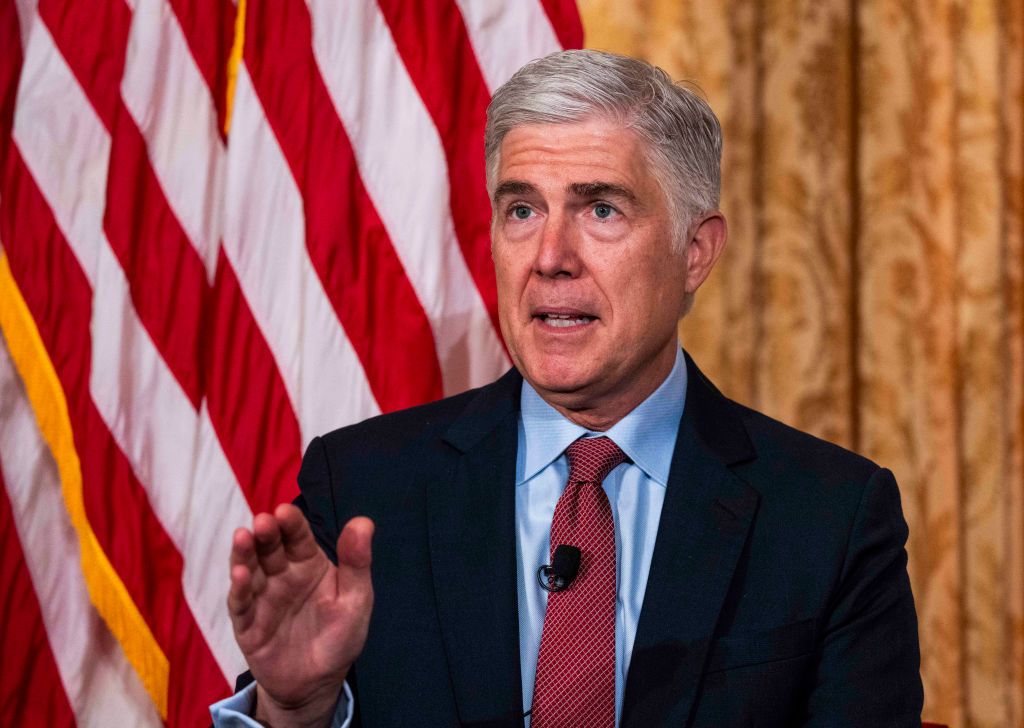
Although some law professors make a living hiding the ball, I will repeat my thesis right up front: Good legal writers are simply good writers – strong English stylists. As my first example, I offered Chief Justice John Roberts , who showed in Learning Resources v. Trump how to choose the optimal subject for English-language storytelling: an actor who can do things (there, the president imposing tariffs unlawfully). To emulate Roberts, focus on the first seven or eight words of your sentences in search of a subject that is a character. But why focus on those first seven or eight words? After all, subjects are moveable. As Master Yoda might say, “Near the end of a sentence, a subject you can find.” In United States v. Hemani , Justice Neil Gorsuch shows why we don’t write like Yoda speaks: English readers look for and prefer an early subject/verb transition, after which they will automatically emphasize new or important information at the end of a sentence. Gorsuch leveraged this tactic right in the first paragraph of Hemani , where he signaled (without saying so) that the Supreme Court had reached a surprising result. Remember back to October 2025 when the court granted certiorari. The cognoscenti ( including my favorite legal podcast ) predicted that Hemani would lose. Hemani seemed like other cases where a “bad man” (who smokes weed and might be a terrorist) goes to jail – at least until Gorsuch wrote his story. With sentence-level choices, Gorsuch immediately revealed that Hemani would prevail. We read that Hemani used marijuana “a few times a week.” But based on that fact alone, the government sought to “disarm him for life.” With this windup, Gorsuch asked whether this was “consistent with the Second Amendment.” No, it was not. Nobody even dissented. Gorsuch made the outcome seem inevitable by placing each of the phrases quoted above at the end of a sentence. Even more, he placed all the key, persuasive information in the same position. Just like the chief in Learning Resources , Gorsuch is not engaged in legal writing so much as strong English style. From outside the legal academy, both George Gopen and Joseph Williams would tell you that English readers give the last few words of a sentence special emphasis. Gopen even calls them a “ stress position .” And Gorsuch treats those stress positions as the most valuable real estate in an English sentence: Only key facts that drive the outcome are welcome to reside there. Focus on the sentence endings and you’ll see the facts crucial to Mr. Hemani. You’ll learn that Hemani spent “most of his life [in Texas].” He held a “stable job.” But the government searched the “family home in 2022.” When interviewed, Hemani was “cooperative.” He admitted using marijuana “about every other day.” Do the same thing, focus only on sentence endings, and you’ll see the factors that damage the government’s case. For example, the government did not prosecute Hemani for “terrorism—the reason for the search in the first place.” Nor did it prosecute him for “anything like [serious drug crimes].” Instead, he was charged merely as an “’unlawful user’ of a controlled substance.” Based on this alone, the government sought “disarmament for life” without contending Hemani was a “drug addict,” a “danger to himself or others,” or that he had done anything with his gun “other than possess it in his home.” To engineer those stresses, Gorsuch again makes an architectural choice that your English teacher would applaud: early subject/verb location. In “Style: Lessons in Clarity and Grace,” Williams notes, “If you have managed your subjects and topics well, you will by default put the words you want to emphasize toward the ends of your sentences.” He recommends curt beginnings: a short transition, a concrete subject, and a verb. And in “The Sense of Structure,” Gopen warns that your reader expects a subject to be followed “almost immediately” by the verb. With very few exceptions, Gorsuch used this architecture, putting his subjects and verbs together, right at the start of his sentences in Hemani . Indeed, he gets so snappy that several sentences rely on implied subjects that readers must supply on their own. (“No matter that the government did not assert Mr. Hemani was a drug addict. No matter that it did not contend that his drug use had ever led him to pose a danger to himself or others.”) In his factual narrative, Gorsuch made this choice in every sentence but four – and those were not an accident. Every time that Gorsuch significantly delayed subject and verb, he filled his initial, dependent clause with information that he thought should not change the outcome: gun ownership, uncharged crimes, and marijuana use. “And because Mr. Hemani admits he owns a gun despite the ban, . . .” “But, suspecting Mr. Hemani and his family members of terrorism-related activities, . . .” “After the agents found cocaine in his parents’ closet, . . .” “Instead, relying solely on his admitted use of marijuana about every other day, . . .” With this choice, a Jedi-level writer is signaling, “These aren’t the droids you’re looking for. Move along.” Thus, by intentionally delaying subject and verb, Gorsuch decreased reader attention on information that had no place in his persuasive mission. But a writer changes that story – perhaps drastically so – if subject and verb are placed haphazardly. Skeptical? Note how some versions of the same information undermine Gorsuch’s persuasive mission when Gorsuch’s own ideas are just moved around. In the first, Mr. Hemani’s work ethic is swallowed in a long, dependent clause, while the reader is invited to focus on the city where he lives. In recent years, while working a stable job and residing with his parents, Hemani has lived in the Dallas area. In the second, the work ethic becomes episodic and is swallowed between subject and verb, while the reader is invited to focus on a grown man living with his parents. Hemani, while working a stable job in recent years, has lived in the Dallas area with his parents. But Gorsuch puts the emphasis where it helps his persuasive mission: Mr. Hemani works a stable job. In recent years, he has lived in the Dallas area with his parents and worked a stable job. Which Hemani would you rather be? The one who worked a stable job? The Dallas resident? Or the one who failed to launch and probably lives in his parents’ basement? So, to calibrate what your reader notices, write like Gorsuch. Prefer subjects and verbs together, near the beginning of a sentence. When you do, you help ensure that the most important information lands in the stress position where your reader will value it. Write first drafts in any style, even intuitively or by ear. But when you line edit, make structural decisions like an architect: Underline subjects and circle verbs. Are they close to each other? Apart from short phrases (like this one), do they start off the sentences? If not, do you have “good reason” to make another choice – for example, de-emphasis? Looking to the sentence endings, does each contain a worthy tenant – something important, novel, complicated or persuasive? If not, has important information been swallowed elsewhere? In a dependent clause? Between subject and verb? Hemingway was right, so right that he now seems cliché. “ Prose is architecture, not interior decoration, and the Baroque is over .” But if he has become cliché, that’s only because he has been right for so long. Sure, some lawyers and professors still primp ornamented, filigreed sentences. But English readers prefer a different architectural style: subject/verb . . . stress position. In Hemani , Gorsuch followed the blueprint.
SCOTUSblog•Kendall Gray10 Sept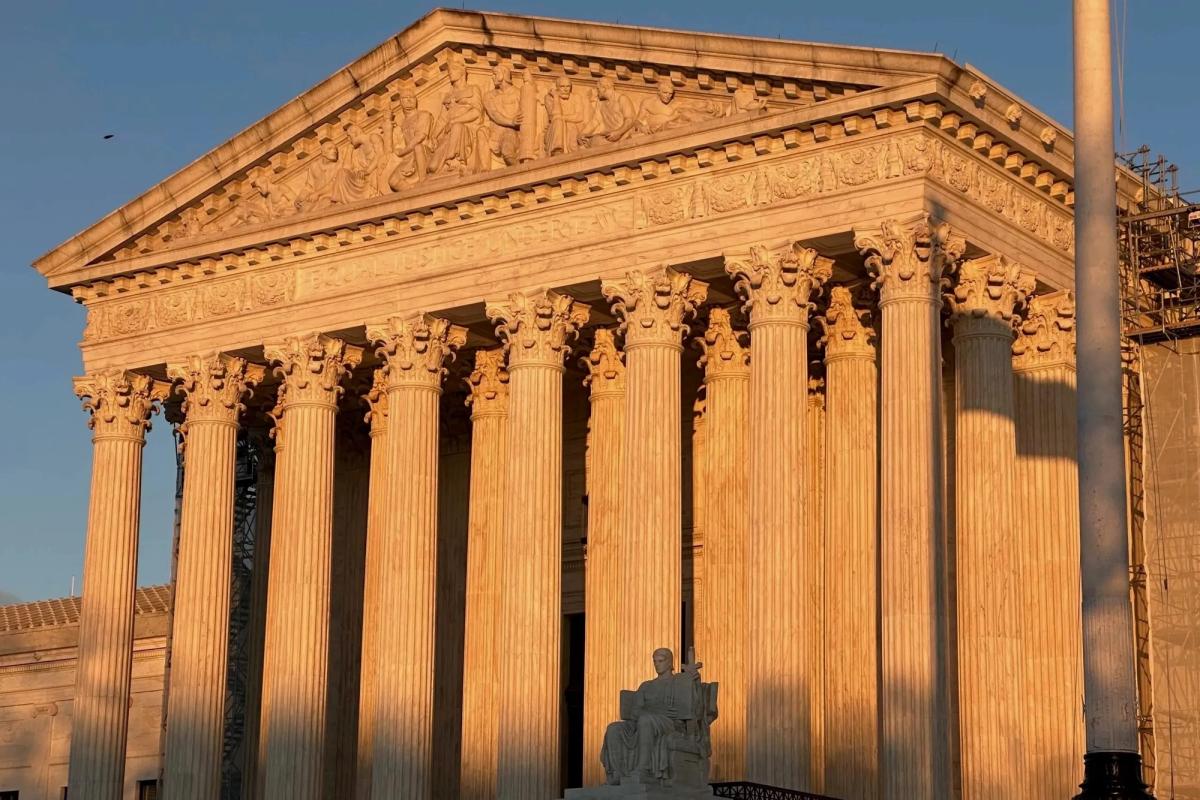
Court reform is a hot topic these days. Scholars , commentators , and politicians argue that the Supreme Court is aggrandizing its powers at the expense of Congress, undermining American democracy, and facilitating the Trump administration’s authoritarian overreach both with substantive rulings like the immunity decision and with its persistent interventions in favor of the president on the shadow docket – to name just a few of the critiques. Reform proposals include term limits (an idea that has long had cross-ideological support), increasing the number of justices (a version of which Rep. James Clyburn endorsed just this past weekend), and narrowing the court’s jurisdiction . Court reform opponents , on the other hand, often argue that reforming the court in response to disfavored opinions inappropriately politicizes and thus undermines an independent judiciary. There may be some truth to this argument. Restructuring the judiciary or dramatically changing the size or operation of the court in our politically polarized environment could, for example, lead to a political tit-for-tat where each party adds seats to the court (for example) whenever they can. Reformers should take into account what types and packages of reforms are more likely to produce stability . But it is a mistake to think about the work of the court as so removed from politics that reforms are inherently inappropriate. I start from the premise that how to interpret and apply the Constitution is an appropriate subject for democratic contestation. For example: Should we interpret the Constitution according to the “original public meaning,” which many originalists argue is the best way to identify what was actually ratified and therefore, they say, what has the strongest claim on democratic legitimacy? On the other hand, should it matter that such an inquiry, by definition, restricts the focus of the inquiry to a time when most people living in the United States could not vote or participate in public debate and might not even have been literate? Or what if the original public meaning is unclear? Does it matter at what level of generality we consider various constitutional provisions or to what extent we take into account how the drafters and ratifiers would have applied them? For example, if we view “equal protection of the law” as a statement of principle, then it is not hard to see why segregated schools are unconstitutional – even if few in 1868 thought that was how the 14th Amendment would be applied. Likewise, how should we decide whether that principle of equality reaches discrimination against women, discrimination on the basis of religion, or discrimination on the basis of sexual orientation and gender identity? What should we do when different provisions or aspects of the Constitution are in tension or conflict with each other? As Justice David Souter pointed out , the First Amendment is written in absolute terms. Yet the Constitution also contains a commitment to national security, albeit a less express one. Sometimes those commitments may be inconsistent. How should judges and justices resolve those dilemmas? These questions are worthy of public and political debate, which the Constitution itself contemplates and allows for. Why else, after all, are Supreme Court justices nominated by the president and confirmed by the Senate? As a result, the role of the court and the types of justices that will be appointed can be important campaign issues, and the nomination and confirmation process offers another opportunity for this public debate. (I’ve written elsewhere about how important confirmation hearings can be to the public’s understanding of what Supreme Court justices do and to different visions of the Constitution.) Indeed, I think that the national argument over Judge Robert Bork’s nomination, which engaged directly with his originalist philosophy, was democracy in action . So democratic input (with a small d) is built in. But a several factors have reduced its impact. One factor is the Constitution’s guarantee of life tenure for the justices. Life tenure means that the timing of justices’ deaths is crucial to the court’s make-up. And it encourages strategic retirements (see Justice Anthony Kennedy). All of that directly affects the number of justices a particular president gets to appoint. President Jimmy Carter appointed none in his single term. President Barack Obama appointed two over the course of two terms. President Donald Trump, in his first term alone, appointed three. The constitutional arrangement also rewards gamesmanship other than strategic retirements, as we saw after the deaths of Justice Antonin Scalia and Justice Ruth Bader Ginsburg. Then-Senate Majority Leader Mitch McConnell refused to allow the Senate to consider Obama’s nominee, Judge Merrick Garland, to replace Scalia because, he said, it was an election year. (The election, at the time of Scalia’s death, was eight months away.) Nevertheless, after Ginsburg’s unexpected death only weeks before the 2020 election, McConnell rushed through Trump’s nomination of Justice Amy Coney Barrett, with the confirmation vote shortly before Election Day. Readers of SCOTUSblog undoubtedly know all of that. But here’s another way of looking at it: We have a minoritarian court, in which its current make-up is further from the democratic input ordinarily provided by the nomination and confirmation process than perhaps ever before. As Kevin McMahon details in his book, “ A Supreme Court Unlike Any Other: The Deepening Divide Between the Justices And the People ,” five current justices were confirmed by the votes of senators who collectively represent millions fewer Americans than the senators who voted not to confirm. Using popular vote totals as a proxy, McMahon has shown that when Clarence Thomas was confirmed, for example, with a vote of 52-48, the senators who voted for his nomination collectively received nearly 3 million fewer votes than those who voted against it. Justice Samuel Alito, too, falls in this category, with a vote difference of 1.8 million. The three Trump justices – Justices Neil Gorsuch, Brett Kavanaugh, and Amy Coney Barrett – are even more minoritarian, as McMahon points out. For one thing, the president who nominated them himself lost the popular vote by more than 2.8 million votes. And in addition, the difference in popular vote totals for the senators voting for and against confirmation has grown dramatically. When Gorsuch was confirmed, for example, with a vote of 54-45, the senators who voted for his confirmation collectively received just under 56.7 million votes, while those who voted against it received 76.5 million, nearly 22 million more. (Another data point, courtesy of Daniel Immerwaher , reviewing Nikolas Bowie and Daphna Renan’s new book “ Supremacy: How Rule by the Courts Replaced Government by the People ”: “In the span of the Presidencies that yielded today’s Court, Republicans won the popular vote less than a third of the time but have appointed two-thirds of the current Justices.”) All of this is perfectly constitutional. But a justices’ nominations and confirmations are not the only ways the Constitution allows for small-d democratic input into the make-up and operation of the Supreme Court. Congress also has the power to add seats to the court; it has done so before. And Congress has the power to control at least some aspects of the court’s jurisdiction and workload. Indeed, the current arrangement, where the court has almost complete discretion over what cases it decides, is due to a series of 20th century laws , culminating in 1988 . (See these posts for longer, albeit not exhaustive, lists of congressional power related to the Supreme Court.) None of this is to advocate for the wisdom or the constitutionality of any particular reform proposal. It is instead to push back against the idea that changing the court necessarily politicizes it inappropriately. The Constitution contemplates and provides a number of mechanisms for democratic input and responses to the Supreme Court. As described, one of those mechanisms, nomination and confirmation, has arguably become a less effective way to provide that input than in the past. We should not ignore the others.
SCOTUSblog•Carolyn Shapiro10 SeptPlus, the dispute over Missouri’s congressional redistricting is back at the Supreme Court.
SCOTUSblog•Kelsey Dallas10 Sept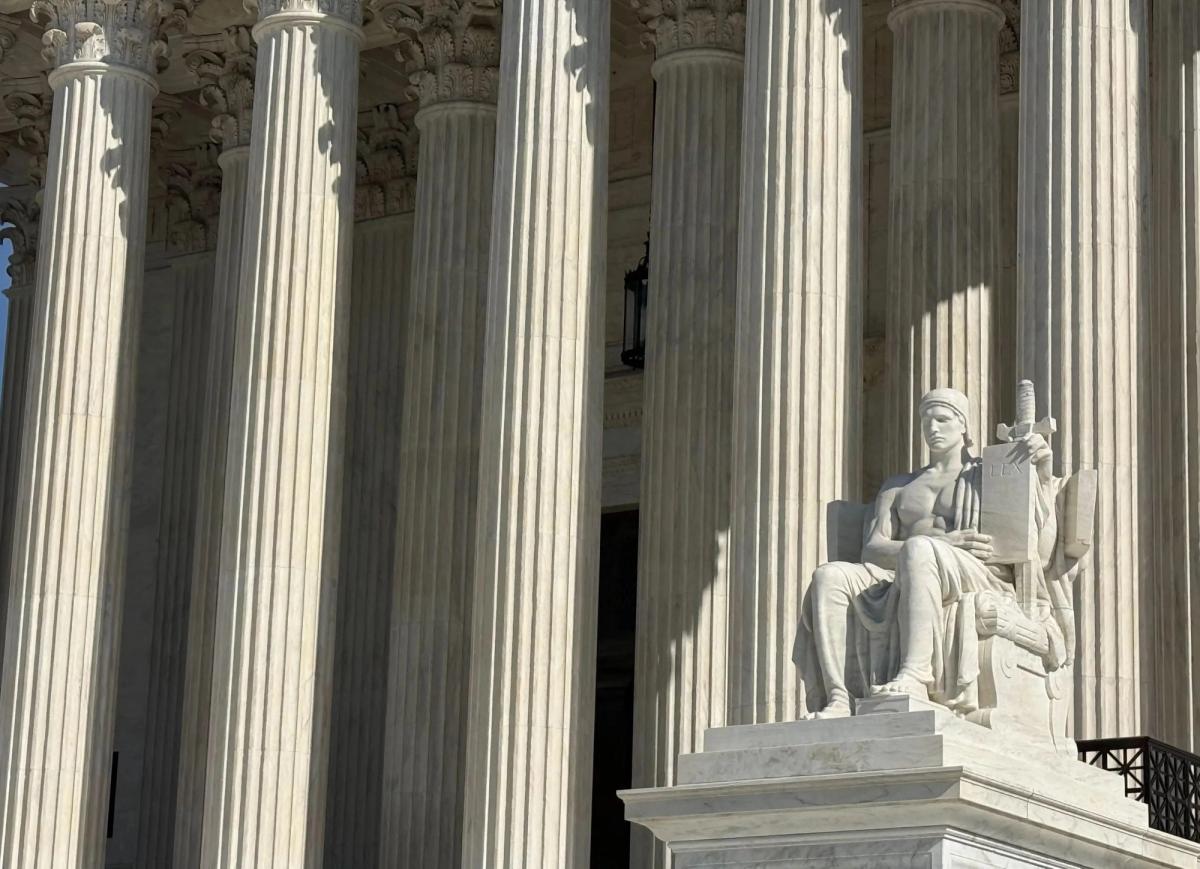
Just one day after Justice Brett Kavanaugh left in place a ruling by the Missouri Supreme Court that barred Missouri from using a new congressional map intended to give Republicans an additional seat in the U.S. House of Representatives in the November elections the opponents of that map returned to the Supreme Court. In a 25-page filing on Wednesday afternoon, Richard von Glahn and a group known as People Not Politicians asked the court to block a subsequent ruling by a federal judge that would require the state to use the new map. Abha Khanna, the lawyer representing the opponents of the map, told the justices that the order by Chief U.S. District Judge Stephen Clark “has been in place for mere hours, but the chaos it guarantees has already taken root.” The fast-moving dispute began last year, when – with the encouragement of President Donald Trump – Missouri redrew its congressional map. The new map, known as HB 1, was intended to give Republicans seven of the state’s eight seats in the U.S. House. Late last year, opponents of the state’s new map submitted more than 300,000 signatures in support of a petition to put the new map up for a statewide vote on the November 2026 ballot. Missouri Secretary of State Denny Hoskins rejected the petition on Aug. 4, 2026. In his view, the state’s constitution “does not authorize a referendum on congressional redistricting plans passed by the General Assembly.” Von Glahn went immediately to a state court, asking it to reverse Hoskins’ decision and block Missouri from using the new map. In a unanimous ruling on Sept. 3, the Missouri Supreme Court granted that request. It wrote that “the plain language of … the Missouri Constitution authorizes a referendum as to ‘any act of the general assembly’ and no exception applies.” Because the referendum petition “was legal, sufficient, and timely,” the court concluded, the new map was never in effect and will not go into effect “unless and until approved by the voters at the November 2026 general election.” The Missouri Supreme Court deemed “wholly unpersuasive” Hoskins’ argument that the failure to use the new map would lead to “confusion, expense, and practical difficulties.” “[T]hese arguments are particularly misplaced given the secretary’s delay created” the problems about which he is now complaining, the court wrote. On Friday night, Hoskins asked the Supreme Court to intervene, telling the justices that the state was “genuinely unsure whether it can switch its governing congressional map in time to run a timely federal election.” He argued that (among other things) the Missouri Supreme Court’s ruling violates the U.S. Constitution’s elections clause , which in his view gives state legislatures – rather than the voters who sign a petition – the power to prescribe the “Times, Places, and Manner” of federal elections. Moreover, he added, the state supreme court’s ruling unconstitutionally disenfranchised “hundreds of thousands” of voters by putting them in new districts where they will be “forced to vote on General Election candidates they had no role in choosing.” This violates the “fundamental right to vote” protected by the Constitution, he contended. Von Glahn countered that the Supreme Court lacks the power to weigh in because the Missouri Supreme Court’s ruling had rested only on state law – known as an “adequate and independent state-law” bar to Supreme Court review. The Missouri Supreme Court indicated that Hoskins could not make his arguments based on federal law because he had not originally made them in rejecting von Glahn’s petition. But even if the Supreme Court could review Hoskins’ appeal, von Glahn continued, he cannot prevail on the merits of his arguments. For example, he said, Hoskins’ “Elections Clause theory runs headlong into more than a century of precedent recognizing that state constitutional referendum procedures may constrain congressional-redistricting legislation.” Kavanaugh turned down Hoskins’ request on Tuesday afternoon without referring it to the full court. Less than an hour later, however, Clark issued a temporary restraining order that directed the state to use the 2025 map. The order came in a case filed on Sept. 4 by (among others) Rep. Robert Onder, a Republican who represents Missouri’s 3rd congressional district. Clark acknowledged that “[c]onducting state elections in accordance with the Missouri Constitution undoubtedly qualifies as an important interest.” But, he countered, the challengers in the federal case “face irreparable harm” without a temporary restraining order “because many Missouri voters would have to cast their general-election votes for candidates whom they had no role in nominating.” On Tuesday night, People Not Politicians and von Glahn – who had joined the federal case – went to the U.S. Court of Appeals for the 8th Circuit, asking that court to pause Clark’s order. But the court of appeals turned that request down. People Not Politicians and von Glahn then went to the Supreme Court on Wednesday afternoon, seeking a stay of Clark’s order. They told the justices that his order “requires Missouri to conduct its congressional election using a map that, under the authoritative decision of Missouri’s highest court, ‘is not the law and has never been the law.’ And,” he contended, “a stay will harm neither Plaintiffs nor the public. To the contrary, leaving the district court’s order in force will cause the very confusion and disruption that Purcell forbids by subjecting election officials to irreconcilable judicial commands on the eve of an election, with a federal court inserting itself to wreak havoc on the State’s elections.” If Clark’s order is put on hold, the map’s opponents continued, “both the public and election officials can proceed under a map that is not marred by legal uncertainty. Officials have confirmed that this outcome is feasible.” Indeed, they noted, immediately after the Missouri Supreme Court’s order on Tuesday, Hoskins “himself instructed elections administrators to implement the 2022 map in accordance with the Missouri Supreme Court’s ruling.” Kavanaugh has instructed Onder and Hoskins to respond by 10 a.m. EDT on Thursday. In a related proceeding, the Missouri Supreme Court ordered Hoskins to file a brief by noon on Wednesday to show why he should not be held in contempt of court for sending an email on Sept. 8 that instructed election officials to use the 2025 map. It instructed von Glahn to respond by 4 p.m. on Wednesday and scheduled oral arguments for 10 a.m. on Thursday. Hoskins has asked Clark to block the contempt proceeding in the state court.
SCOTUSblog•Amy Howe9 Sept