Astra

Product · 42 articles
Share
5 sourcesCryptoBriefingDecryptMacRumorsMashableTechCrunch
22h ago

Anthropic Launches Claude Opus 5.5 With Fable-Level Performance at a Lower Price

Anthropic today launched Claude Opus 5.5 , which it says is the first model in a new 5.5 model family. Opus 5.5 performs at the level of Claude Fable 5.1 on most work, but costs 40 percent less to run than Opus 5. According to Anthropic, Opus 5.5 is a "major step up" from Opus 5 with improvements in performance and safety. Opus 5.5 is comparable to Mythos 5.1 in biology and cybersecurity, so Anthropic is launching it with safeguards similar to those on Fable 5.1. Opus 5.5 also generates output over 30 percent faster than Opus 5. On benchmarks shared by Anthropic, Opus 5.5 surpassed Fable 5.1 on agentic coding, knowledge work, computer use, visual chart recognition, and multidisciplinary reasoning. Anthropic says the model communicates more naturally than prior models, putting important information at the front of a response so it's easier to understand at a glance. It is less likely to use jargon or idiosyncratic phrases, and it follows the writing rules it's given. Claude Opus 5.5 is available on all platforms as of today. With the launch of Opus 5.5, Anthropic is raising the five-hour usage limits on Pro, Max, Team, and seat-based Enterprise plans. Subscribers have also received a rate limit reset that can be used anytime between now and October 22. Tag: Anthropic This article, " Anthropic Launches Claude Opus 5.5 With Fable-Level Performance at a Lower Price " first appeared on MacRumors.com Discuss this article in our forums

Share

All coverage

page 1 of 3

OpenAI's New GPT-6 Sol and Luna Models Bring Astra Improvements to Cheaper Tiers

OpenAI today launched GPT–6 Sol and GPT–6 Luna, two new models that follow GPT–6 Astra. OpenAI says the new models were developed using methods similar to Astra's for improvements in professional work, factuality, coding, computer use, and alignment. GPT–6 Sol is for everyday work, and it costs less than Astra. GPT–6 Luna is an even cheaper model. Luna is optimized for fast responses and higher volume, while Sol has more reasoning capability. The new models outperform their predecessors on OpenAI's benchmark tests, and GPT–6 Sol makes "about half as many mistakes" as GPT–5.6 Sol. GPT–6 Sol shows improvements in coding and computer use compared to GPT–5.6 Sol, and it matches or beats Claude Fable 5.1 scores on some benchmarks. OpenAI compared GPT–6 Sol to Opus 5 on several tests, but Anthropic released a new Opus 5.5 model today that outperforms Astra on some coding and knowledge work benchmarks. GPT–6 Sol and Luna are adopting the improved communication style OpenAI introduced with Astra for simplified conversations with less jargon and fewer low-value details. Answers should be slightly shorter without losing substance, and the new models have lower rates of misleading claims about their coding work in OpenAI's alignment testing. OpenAI is lowering token prices for Sol and Luna compared to their 5.6 counterparts, and prompt caching has been improved. OpenAI says agents will reuse more context, respond faster, and get 90 percent discounts on cached input-token reads. GPT–6 Sol is priced at $2 per million input tokens and $10 per million output tokens, down by half. GPT–6 Luna costs $0.10 per million input tokens and $0.50 per million output tokens, down from $0.20 and $1.20, respectively. GPT–6 Sol costs half as much per token as Opus 5.5, but Anthropic says Opus 5.5 uses fewer tokens per task than Opus 5, so it's not a straight comparison. GPT–6 Sol and GPT–6 Luna are rolling out in ChatGPT Work and Codex starting today for Plus, Pro, Business, Enterprise, and Edu users. GPT–6 Luna is available to Free and Go users in the desktop app. GPT–6 Sol and Luna are not yet available in Chat mode. Tag: OpenAI This article, " OpenAI's New GPT-6 Sol and Luna Models Bring Astra Improvements to Cheaper Tiers " first appeared on MacRumors.com Discuss this article in our forums

MacRumorsMacRumorsJuli Clover21h ago

Oscar Best Picture Category Will Soon Be Dominated by International Films, Claims ‘I’m Still Here’ Producer Rodrigo Teixeira

U.S. films will soon be the minority among the nominees for the top Academy Award, claims one of South America’s most successful producers. Rodrigo Teixeira, who through his RT Films banner has produced the likes of “Frances Ha,” “Call Me by Your Name,” “Ad Astra” “Bergman Island” and “I’m Still Here,” building up long-standing relationships […]

VarietyVarietyAlex Ritman22 Sept

Googlebooks will live or die on the loyalty of a billion Android users

Good morning. Today I’m bumping to Carly Rae Jepsen’s new double album (it’s great!), wishing I had more kidneys so I could afford the new M5 Ultra Mac Studio , marveling at Astra’s ability to decrypt 100-year-old WWI cyphers , and counting down the days until I can play Control Resonant . As a reminder, Inbox is the tech newsletter that goes beyond the news cycle. We cover the most important 9to5Google stories from the last couple of days along with a few highlights from around the web. We publish every Tuesday and Thursday, and if you like what you read, please subscribe . more…

9to5Google9to5GoogleDaniel Bader22 Sept

Justin Sun Establishes the Justin Sun Prize: “My Wealth Came from Mathematics and Will Return to Mathematics”

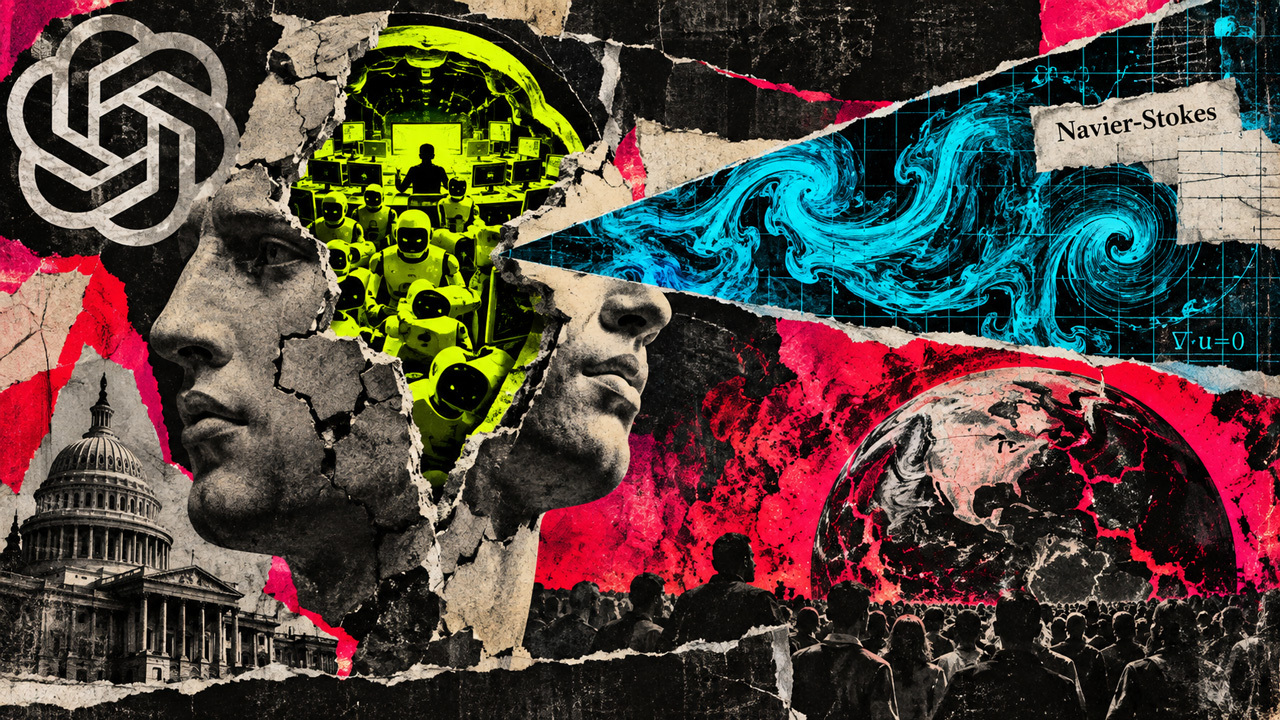
Geneva, Switzerland — September 16, 2026 — The Office of Justin Sun today announced the establishment of the Justin Sun Prize, a zero-trust, decentralized academic bounty mechanism based on a “problem list,” with breakthroughs in fundamental disciplines and machine formal verification as the criteria for awarding prizes, and a top prize of up to US$1 million for a single problem. The prize seeks to redefine scientific rewards in the AI era and accelerate fundamental scientific research through collaboration between humans and AI. The first list of Justin Sun Prize winners was also announced, recognizing solutions and formalized proofs involving 66 mathematical problems. The top prize, worth US$1 million, was awarded to the OpenAI research team in recognition of its solution and formalized proof for the Existence and Smoothness of the Three-Dimensional Navier–Stokes Equations problem. According to information published by OpenAI, the relevant proof was produced by its internal model, and the Lean formalization and verification were completed by GPT‑6 Astra. This problem concerns the Navier–Stokes equations, which describe the motion of fluids and are commonly abbreviated as the N–S equations. The equations were developed in the 19th century by French physicist Claude-Louis Navier, Irish-born British mathematician George Gabriel Stokes, and others, and have a history of approximately two hundred years. In 2000, the Clay Mathematics Institute listed the Navier–Stokes Existence and Smoothness problem as one of the seven Millennium Prize Problems and offered a US$1 million reward for its solution. The Justin Sun Prize does not use traditional nominations or credential thresholds as barriers to entry, nor does it operate on a four-year cycle or the rhythm of lifetime achievement. Instead, it ties the prize directly to mathematical problems and machine-verifiable formalized proofs. Anyone can receive the prize as long as they are the first to achieve a qualifying breakthrough. The vision of the Justin Sun Prize is to become the “Nobel Prize of the AI Era,” responding to the profound transformation of scientific research and incentives in the new era in a more decentralized, formalized, and machine-driven way. The repository of mathematical problems and formalized code will be maintained and publicly updated on an ongoing basis. Once a problem is listed, it is locked in: problems can be added only, never removed; awarded prize funds do not need to be returned under any circumstances. The current problem list already includes formal verification of the Poincaré Conjecture, the Riemann Hypothesis, Goldbach’s Conjecture, and a large number of unsolved problems proposed during the lifetime of the late mathematician and Wolf Prize laureate Paul Erdős.   In addition to the prize, winners will also receive a certificate and a medal. The edge of the medal is inscribed with the Latin phrase “Quod probatur, solvitur,” meaning “Proved, then paid.”   The Justin Sun Prize adheres to three core principles: openness, public benefit, and open source. It is open to all eligible contributors, with no restrictions based on nationality, institution, or identity, and makes no distinction between humans and AI; funds are used exclusively for prize awards and open initiatives and are not intended for profit; the problem list, confirmation standards, proofs, and verification materials are all made available to the public through GitHub, while prize disbursement records are recorded on-chain for permanent traceability and immutability.   “An award named after a person is the least political thing in the world,” said Sun. “More importantly, it gives me an answer to myself—my wealth is rooted in mathematics. It came from mathematics, and it will return to mathematics.”    According to public records, Sun has donated more than US$45 million across technology, environmental protection, disaster relief, and other fields. The Justin Sun Prize will become a central focus of Sun’s philanthropic efforts, continuing to support breakthroughs in fundamental science through an open and verifiable model.   The prize will be paid out in either USDT on TRON (TRC-20) or USDC on Ethereum (ERC-20) based on the recipient’s choice. For more information, please visit www.hejustinsun.com/prize.    About the Office of Justin Sun The Office of Justin Sun supports Justin Sun’s global business, philanthropic and public initiatives across technology, blockchain, artificial intelligence, scientific research, investment, art and space exploration.    Justin Sun is the Ambassador and former Permanent Representative of Grenada to the World Trade Organization and the Founder of TRON. TRON is the leading blockchain for the stablecoin revolution, processing over $13 trillion in volume since its inception. In the world’s emerging markets, people rely on USDT on TRON to access the global financial system.   A protégé of Alibaba founder Jack Ma, Sun has been recognized internationally for his work in the digital asset industry, including a Forbes cover profile in April 2025 and multiple appearances on the Forbes 30 Under 30 list. In August 2025, he flew aboard Blue Origin’s NS-34 mission, becoming the 712th person in history to travel to space. His broader interests span technology, investment, philanthropy, art, gaming, and space exploration.   Office of Justin Sun Contact: info@hejustinsun.com    About Justin Sun Prize  The Justin Sun Prize is an academic initiative established by Justin Sun to support advances in mathematics, formal verification, and AI-assisted scientific discovery. The prize is decentralized and built around the principle that mathematical work should be judged by the strength, rigor, and verifiability of the proof itself, not the prestige or reputation of those submitting it.   Justin Sun established the prize in his own name as a long-term commitment to return wealth created through mathematics and technology back to mathematics itself. Its legacy is intended to be defined by the body of work it recognizes and the laureates whose discoveries stand the test of time. The prize links clearly defined mathematical challenges to machine-verifiable proof. Its guiding principles are openness, public benefit and open-source access.   Visit https://www.hejustinsun.com/prize for more information.    Contact: thejustinsunprize@hejustinsun.com

NewsBTCNewsBTCBlockmanPR16 Sept

Naomi Klein and Astra Taylor: the future according to end times fascism

In a new video, Klein and Taylor outline a ominous evolution taking shape on the far right – and how to stay loyal to this planet and each other The end times fascists are plotting their escape from our world. Our mission is clear An ominous evolution is under way on the far right. It is a dangerous shift that is linked to our era of existential crises, defined by its pandemics, climate emergencies, resource wars and rogue tech. Today’s fascists are part of a dangerous and fractious alliance – from messianic venture capitalists to army-controlling theocrats – united by the belief that the end of the world is upon us and that only a chosen few deserve to be saved. That is the thesis of Naomi Klein and Astra Taylor’s new book, End Times Fascism: And the Fight for the Living World. Since it can be hard to believe that political and corporate leaders would actively give up on our shared future on this singular planet, they also collaborated with film-makers Emma Dessau, Austin Bedell and P Nick Curran to create a video in which we hear directly from many of the people behind this threat – and outline why this is the moment for the rest of us to commit to each other and our shared home. The Guardian is pleased to share it for the first time. End Times Fascism: And the Fight for the Living World is out 15 September via Farrar, Straus and Giroux Naomi Klein is a Guardian US columnist and contributing writer. She is the professor of climate justice and co-director of the Centre for Climate Justice at the University of British Columbia Astra Taylor is a writer, organizer and documentary maker and a co-founder of the Debt Collective Continue reading...

The GuardianThe GuardianNaomi Klein and Astra Taylor13 Sept