Americapage 13

Place · 473 articles
Share

Coverage, page 13

page 13 of 24

The Guardian view on Donald Trump’s oil deal: Venezuela pays for his vanity | Editorial

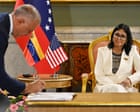
The US president seized a nation’s natural wealth in a modern-day version of gunboat diplomacy to feed his ego – not to lower Americans’ fuel bills Imperialism does not require a flag to be planted or a governor dispatched. It can be a powerful nation deciding who governs a smaller, weaker country, and on what terms and for whose benefit its resources will be developed. Donald Trump’s kidnapping of Venezuela’s Nicolás Maduro, putting his deputy – Delcy Rodríguez – in his place as president, and then her signing a deal handing a fifth of the country’s proven oil reserves to the US , amount to a modern version of 19th-century gunboat diplomacy. Regime change supplied America’s commercial concession. This won’t bother Mr Trump. But it should. The US president has oversold his neocolonial spoils. The additional production Venezuela is supposed to bring online might bring down oil prices eventually, but not anytime soon. Crucially, what Mr Trump calls “t he biggest oil deal in history ” won’t cause the price at the pump to fall before November’s midterms. When so many American voters are struggling to pay energy bills , it’s hard to see how unrealised Orinoco Belt riches are going to help Republican candidates. Do you have an opinion on the issues raised in this article? If you would like to submit a response of up to 300 words by email to be considered for publication in our letters section, please click here . Continue reading...

The GuardianThe GuardianEditorial9 Sept

US allies lack resources to keep pace on AI, top Pentagon official says

Cameron Stanley talks up ‘revolutionary’ AI capabilities and says Washington working with Nato and Five Eyes partners The Pentagon’s top artificial intelligence official said on Tuesday that America’s closest allies lack the resources to keep pace with the US military’s adoption of AI, and that Washington is working to steer them away from mistakes it made along the way. “They don’t have the resources that we do, they don’t have the experience that we do, they don’t have the scale that we do,” Cameron Stanley, chief digital and artificial intelligence officer at the Department of Defense, said at an event at the Billington Cybersecurity summit. Of Nato and the Five Eyes, an intelligence-sharing partnership of the US, UK, Canada, Australia and New Zealand, Stanley said Washington was “actively working with a number of our partners” so “they don’t make the same mistakes that we make”. Continue reading...

The GuardianThe GuardianJoseph Gedeon in Washington9 Sept

The Newer World by Sebastian Barry review – a near-miracle of storytelling

The third in a loose American trilogy follows the epic journey of a formerly enslaved man in the aftermath of the civil war But is not the story as good as the truth?” asks Tennyson Bouguereau, the narrator of Sebastian Barry’s The Newer World. Tennyson, a formerly enslaved man in post-civil war America, recounts his life story in ways that call to mind the age-old debate about whether it’s better to get our history from novelists or historians. While historians might argue that there is no contest, the question hints knowingly at the novelist’s counter-argument. It sent me searching for a line from Barry’s 2008 Costa-award winning novel, The Secret Scripture , in which the narrator describes history as “a fabulous arrangement of surmises and guesses held up as a banner against the assault of withering truth”. In her Reith Lectures, Hilary Mantel suggested that history is “what’s left in the sieve when the centuries have run through it”, but I tend to think of it as more of a butterfly net. Historians chase after and capture the things they deem significant. They leave things out, often deliberately. Barry’s entire body of work is a prime example of fiction’s ability to fill history’s gaps, merging personal tragedies with national ones in ways that (dare I say) demonstrate the supremacy of the form – especially for those of us descended from people for whom history never cared one whit. I was therefore intrigued to learn that he had set out to write the story of a man like Tennyson. Barry’s earlier novels refracted Irish history through the lens of two fictional Irish families, the Dunnes and the McNultys. His first foray into this period of American history in Days Without End , for which he won his second Costa award, also followed one of the McNultys – Thomas McNulty flees the Irish famine for America, where he finds himself drawn into the genocidal work of clearing Native Americans off their land, and then, together with his lover and fellow soldier, John Cole, adopts a Lakota girl, Winona, whose family they have helped slaughter. Barry picked up Winona’s story in A Thousand Moons , published in 2020, which follows her fortunes as she, Thomas and John settle on the same farm outside Paris, Tennessee that is occupied by Tennyson and his twin sister Rosalee among others. Continue reading...

The GuardianThe GuardianSara Collins8 Sept

Trump orders America to stop buying Bombardier — except, presumably, when America needs Bombardier

US President Donald Trump has called for an end to Bombardier aircraft sales in the United States, accusing the Canadian manufacturer of living off American customers while refusing to build its business jets south of the border. The declaration is forceful, patriotic and slightly complicated by the fact that Bombardier already employs thousands of Americans. […]

Aviation24.beAviation24.beAndré Orban7 Sept

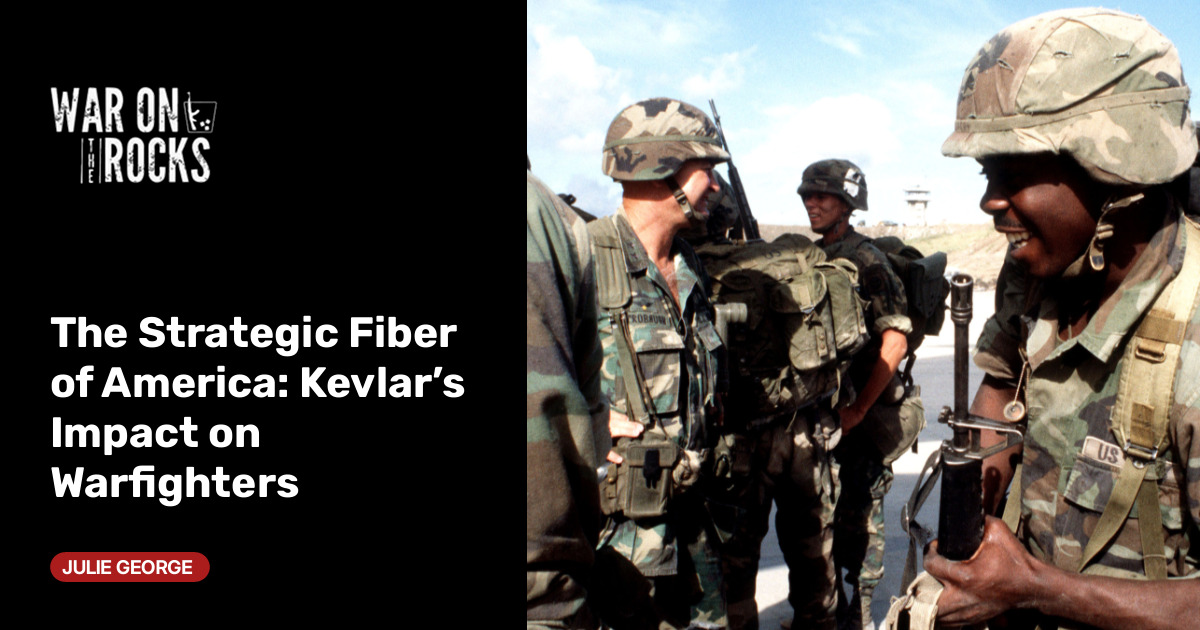
The Strategic Fiber of America: Kevlar’s Impact on Warfighters

Editor’s note: This is the tenth article in a limited series celebrating American defense technologies born from wartime and their effects on broader national security, politics, and society. This series will run for several weeks to commemorate America’s 250th anniversary, and winners will be selected by a reader vote undertaken through our newsletter later this summer. Prior installments can be found at the Arsenal of Innovation page.I was fortunate enough to do something that would be a benefit to mankind. It’s been an extremely satisfying discovery. I don’t think there’s anything like saving someone’s life to bring you satisfaction and happiness.– Stephanie Kwolek,

War on the RocksWar on the RocksJulie George7 Sept