Arcticpage 4

Place · 92 articles
Share

Coverage, page 4

page 4 of 5

Europe’s wildest pilgrimage route: a trek through the mountains of north-west Sweden

A remote 18th-century chapel deep in Sami lands is the goal of the Präststigen, a 37-mile trail that traverses some of the country’s most spectacular scenery I wasn’t exactly in “Sunday best”, but I had made some effort. Well, I’d changed my underwear for the first time in a couple of days and given myself a baby-wipe bath. Still, as we filed into the chapel at Alkavare, I felt more a member of an expedition than a congregation. We sat on the low wooden benches, waterproof jackets rustling and leather walking boots stamping on the flagstone floor to keep warm. Fortunately, the priest, Mogens Amstrup Jacobsen, appeared to be a “man of the Gore-Tex”, as well as a man of the cloth, as he unzipped his own black rain jacket to reveal his dog collar. As the service began, the Arctic wind whipped through cracks in the dry stone walls, insulated only with reindeer hair, and candles flickered in their brass sconces. I had hiked to Alkavare following the Präststigen , or “Priests’ trail”, a 37-mile (60km) route from Kvikkjokk that could stake a claim as Europe’s wildest pilgrimage route, and certainly one of its most beautiful. The Präststigen follows the path that priests would once have taken to the chapel, built in 1788, to perform a service each summer, and today, on the last weekend in July, intrepid hikers and perseverant pilgrims can attend that same service. Continue reading...

The GuardianThe GuardianHugh Collins9 Sept
Europe’s wildest pilgrimage route: a trek through the mountains of north-west Sweden

A remote 18th-century chapel deep in Sami lands is the goal of the Präststigen, a 37-mile trail that traverses some of the country’s most spectacular scenery I wasn’t exactly in “Sunday best”, but I had made some effort. Well, I’d changed my underwear for the first time in a couple of days and given myself a baby-wipe bath. Still, as we filed into the chapel at Alkavare, I felt more a member of an expedition than a congregation. We sat on the low wooden benches, waterproof jackets rustling and leather walking boots stamping on the flagstone floor to keep warm. Fortunately, the priest, Mogens Amstrup Jacobsen, appeared to be a “man of the Gore-Tex”, as well as a man of the cloth, as he unzipped his own black rain jacket to reveal his dog collar. As the service began, the Arctic wind whipped through cracks in the dry stone walls, insulated only with reindeer hair, and candles flickered in their brass sconces. I had hiked to Alkavare following the Präststigen , or “Priests’ trail”, a 37-mile (60km) route from Kvikkjokk that could stake a claim as Europe’s wildest pilgrimage route, and certainly one of its most beautiful. The Präststigen follows the path that priests would once have taken to the chapel, built in 1788, to perform a service each summer, and today, on the last weekend in July, intrepid hikers and perseverant pilgrims can attend that same service. Continue reading...

The GuardianThe GuardianHugh Collins9 Sept
The place that never freezes: the Arctic habitat where global heating threatens more ice, not less

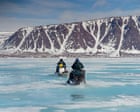
The race to study the North Water between Canada and Greenland before it changes has led to a bold plan for an Inuit-run protected area Electric-blue meltwater sprays up under Terry Noah’s snowmobile as he races across sea ice extending out from Canada’s northernmost public community: Grise Fiord in Nunavut, a hamlet of 144 people closer to Murmansk in Russia than the Canadian city of Toronto. The bay’s cliffs loom higher and higher like stone icebergs as he approaches his destination across the bay. Noah pulls his sled carefully over a seal’s breathing hole, about the circumference of a basketball. Using a custom-made winch, he lowers a submersible instrument into the sea below the ice. Continue reading...

The GuardianThe GuardianWords and pictures by Jimmy Thomson in Nunavut, Canada3 Sept

How decoding beluga whales’ chitchat may save them – and teach us more about ourselves

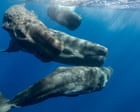
From humpbacks learning the latest songs to sperm whales’ ‘clan codas’, drones and AI learning are helping reveal another dimension to the concept of culture Podcast: Could humans ever communicate with whales? In 2015, the whale researcher Valeria Vergara pitched a small tent at the icy water’s edge on Somerset Island in the remote Canadian high Arctic, shrouded in a freezing fog so thick she struggled to see her own hands. She trailed a cord out to the coast and plopped a hydrophone into the water to record the calls of belugas. As many as 1,000 of the whales, accompanied by their newborn calves, frequented the surrounding bay. Belugas’ ceaseless chatter, made up of dozens of unique sounds, is crucial to keeping these creatures connected in the dim, turbid waters of the Arctic. Continue reading...

The GuardianThe GuardianEmma Bryce27 Aug

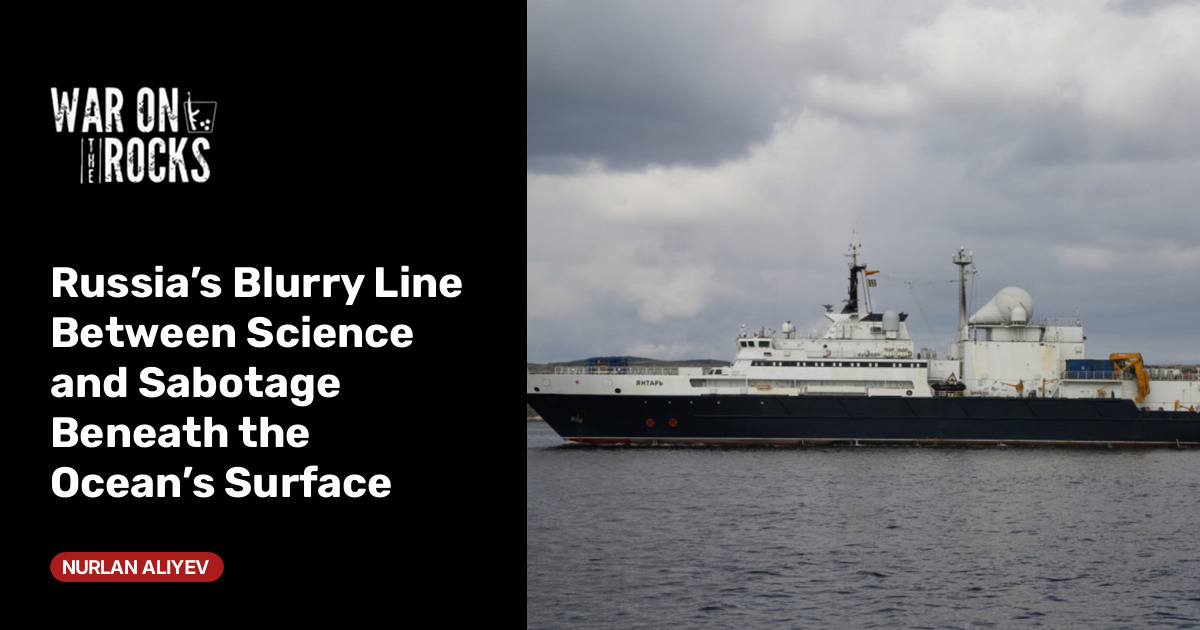
Russia’s Blurry Line Between Science and Sabotage Beneath the Ocean’s Surface

In 2025, Nurlan Aliyev wrote, “The Mayhem of Russia’s “Research” Fleet,” where he argued that NATO must act decisively to safeguard critical undersea infrastructure from Russian sabotage attempts. A year later, we asked him to revisit his arguments. Image: Andrey Luzik via Wikimedia CommonsIn your 2025 article, you argued that NATO needed to act decisively to safeguard critical undersea infrastructure in the Baltic, Barents, and Arctic regions from Russian sabotage. Since then, where has NATO strengthened its deterrence and defense in this area, and where do gaps still remain? Since 2025, NATO and E.U. members have strengthened coordination to protect critical undersea infrastructure through

War on the RocksWar on the RocksNurlan Aliyev12 Aug