War on the Rocks

War on the Rockspage 2

Coverage, page 2

page 2 of 6

New Complications in Countering the Flow of Arms in the Caribbean

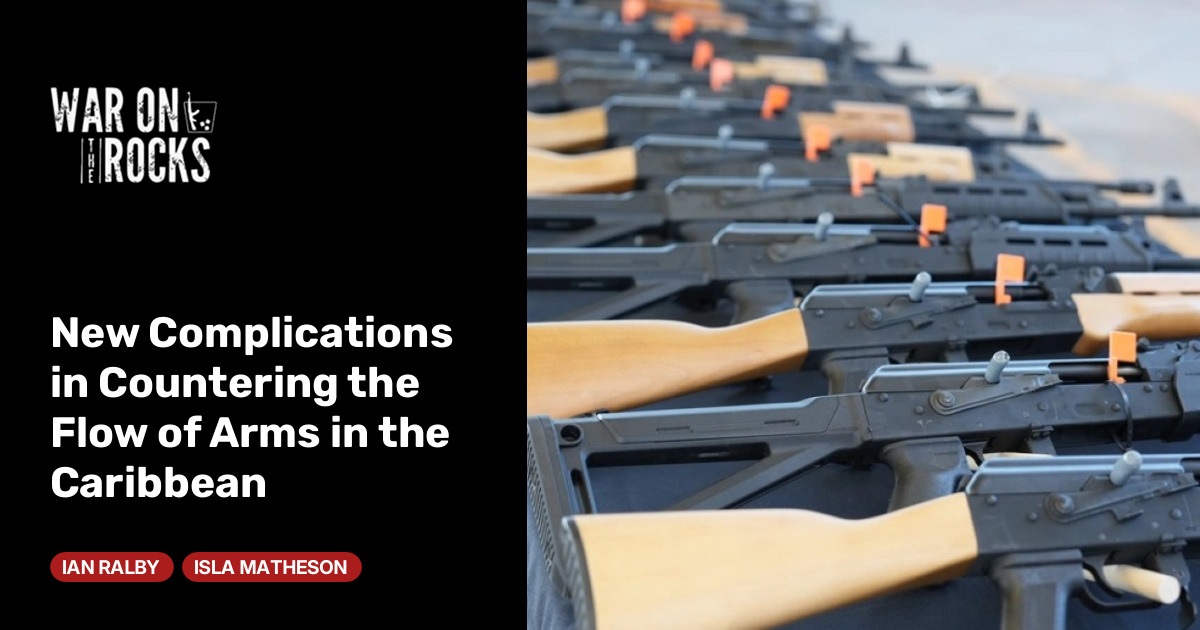
Arms trafficking in the Caribbean has soared in recent years, with many states now ranking firearms trafficking as the number one public safety and security threat. As new methods of arming individuals and gangs emerge across the Caribbean, gun violence continues to rise throughout the region. While armed gangs in Haiti currently possess superior firepower to the police, most countries are trying to get a handle on the problem before it becomes that bad. Some outdated narratives, particularly about South American arms, still color thinking about firearms in the region, but the reality is becoming increasingly complex in the directional
War on the RocksWar on the RocksIsla Matheson7 Sept

The Fruit of Patience: How Regional Shifts Ripened Turkey’s Path to Kurdish Reconciliation

On Aug. 25, at the People’s Palace in Damascus, Mazloum Abdi announced the dissolution of the Syrian Democratic Forces, which he had commanded for a decade. Speaking first in Arabic and then in Kurdish, he said the force had joined the Syrian army and would no longer operate independently. 15 days earlier, Turkey’s parliament had passed a framework law for the disarmament of the Kurdistan Workers’ Party. The group has long been designated as a terrorist organization by the United States, the European Union, the United Kingdom, and Turkey, which have waged a brutal campaign against it for decades. Two

War on the RocksWar on the RocksSamuele C. A. Abrami4 Sept

The Future of Combat Medicine

War has always been a brutal engine of medical innovation, running on a feedback loop: Civilian breakthroughs are adapted for the battlefield, while battlefield necessity pushes advances back into civilian care. We asked three experts to identify the innovations from the last five years most likely to shape the future of combat medicine.Read more below.John Quinn Adjunct Lecturer, College of Remote and Offshore Medicine Foundation Medical Volunteer in UkraineThe war in Ukraine has made it clear that the most important combat-medical innovations are not gadgets, but new distributions of risk, skill, and authority. First, blood-forward resuscitation will require moving whole

War on the RocksWar on the RocksEric Elster3 Sept

Where Does AI Escalation Come From? We Don’t Know. We Should Find Out.

We played a wargame using AI players. Two nuclear-armed nations — Red and Blue — with a long-standing, fierce border dispute were placed into a militarized crisis. Over the course of several turns, the states managed to avoid escalation to war, though there were non-operational nuclear demonstrations. Surprised by the lack of escalation we’d been primed to find by Juan-Pablo Rivera, Gabriel Mukobi, Anka Reuel, Max Lamparth, Chandler Smith, and Jacquelyn Schneider, as well as Kenneth Payne, we tried upping the stakes. We gave Red some new tactical nuclear weapons, altering the balance a bit in their favor. The states

War on the RocksWar on the RocksWilliam Dawson3 Sept

Russia’s Road to El Dorado

As a new convoy of Russian armored vehicles arrives from the port of Lomé to support Russia’s Africa Corps deployment in Mali, that mission has entered its fifth year. Russia’s investment of blood and treasure urgently demands a return, but what could this return be? What is the Russian end goal in Mali?When the Wagner Group, Africa Corps’ predecessor, entered Mali in December 2021, it was pursuing a resources-for-security deal like the one it had achieved in the Central African Republic. Along with my co-authors Chris Faulkner and Colin Clarke in our book, Moscow’s Mercenaries, I documented Wagner’s lessons learned,

War on the RocksWar on the RocksRaphael Parens3 Sept

Is Taiwanese Society Prepared for a China Contingency?

In 2025, Michael Hunzeker and Yuster Yu wrote, “Taiwan’s Biggest Problem in Steeling Itself for War With China is Cultural,” where they argued major cultural changes were needed in both Taiwan’s military and civilian society if it were to be competitive in a conflict with China. A year later, we asked them to revisit their arguments.Image: Taiwan Presidential Office via Wikimedia CommonsIn your 2025 article, you argued that major cultural changes must take place in both the officer corps of Taiwan’s armed forces and broader society if Taiwan is to be competitive in a contingency with China. A year later,

War on the RocksWar on the RocksYuster Yu2 Sept

European Resilience in Digital Infrastructure: The Changing Nature of State-Business Relations

As the war in Ukraine progressed, Russian strikes increasingly degraded Ukraine’s terrestrial communications infrastructure, steadily deepening Kyiv’s dependence on SpaceX’s Starlink. The satellite constellation became indispensable for crucial military functions, including command and control, drone operations, and artillery fire coordination, with no readily available European alternative should access be withdrawn.This reality exemplifies the idea that today, governments rely on critical infrastructure that is privately owned and globally embedded. But these interdependencies can be weaponized, and state-firm relations can become misaligned. Recent controversies over the ability of American and Chinese technology companies to restrict access to critical AI models, alongside NVIDIA’s

War on the RocksWar on the RocksIvan Zaccagnini2 Sept

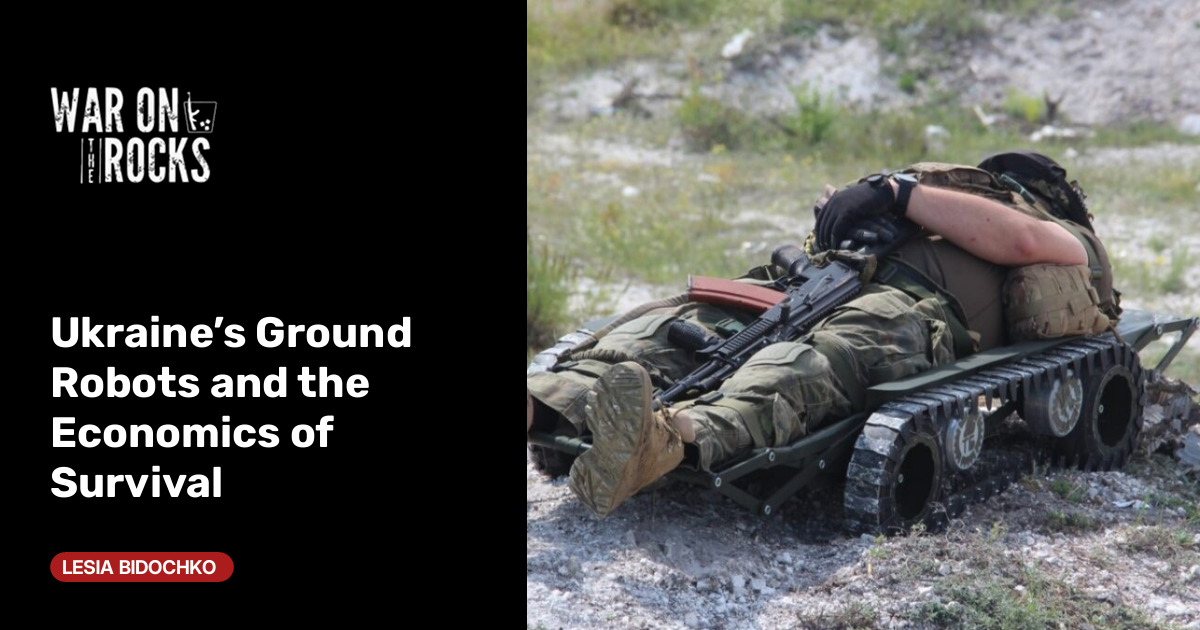
Ukraine’s Ground Robots and the Economics of Survival

In August 2024, special forces from five Ukrainian military intelligence units crossed the Black Sea to raid Russian-held Kinburn Spit. The commandos of these units — Chimera, Aratta, Stuhna, Paragon, Terror, and the Siberian Battalion — landed, fought, destroyed equipment, and withdrew. Two years later, in July 2026, Ukraine returned, but left the soldiers behind. Instead, an uncrewed surface vessel carried a ground robot across the water and released it onto the shore. The robot, equipped with a Wolly 7.62 remotely operated combat module, featuring a machine gun and an AI-assisted targeting system, rolled onto shore and engaged targets. A

War on the RocksWar on the RocksLesia Bidochko2 Sept

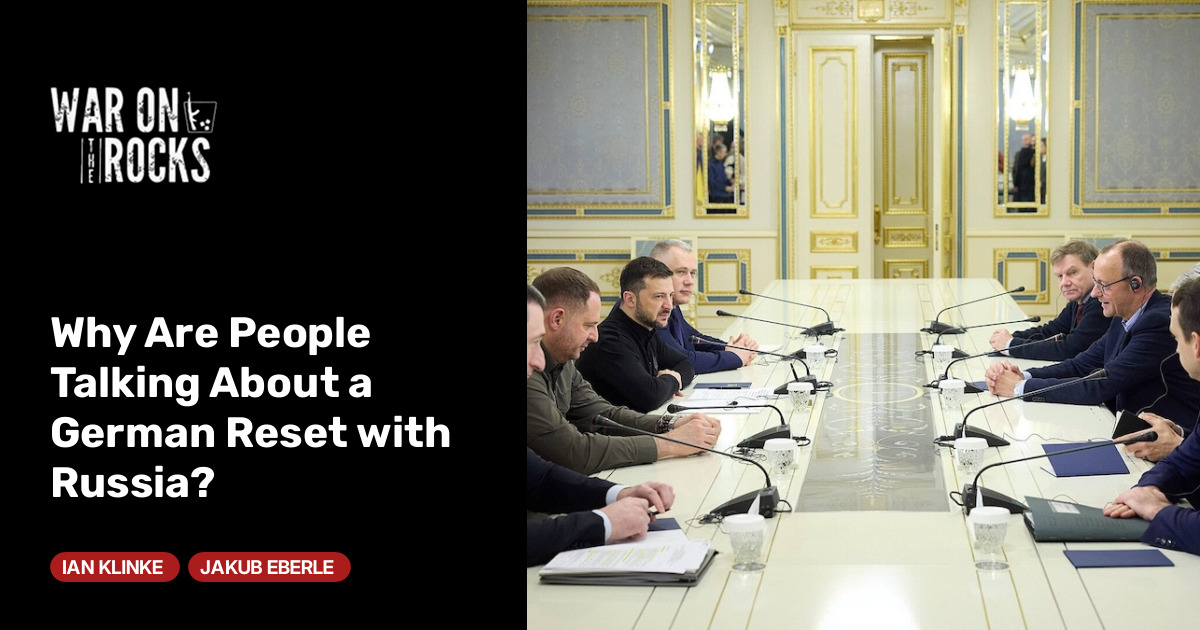
Why Are People Talking About a German Reset with Russia?

The summer of 2026 has raised questions once again among politicians, diplomats, and academics about whether Germany might be about to dither on Russia. Last month, a drone attack on German soil seemed designed to coerce Germany back into business as usual. Earlier, there had been rumblings about two German ex-chancellors brokering a peace treaty between Kyiv and Moscow. Both Angela Merkel and Gerhard Schröder are living embodiments of the ill-reputed Ostpolitik, Germany’s tradition of pragmatic cooperation with the Kremlin over the heads of other Eastern European countries.Is Germany getting ready for a reset with Russia, though? Not really. Berlin’s

War on the RocksWar on the RocksJakub Eberle2 Sept

The Atlantic Brief: U.S. and European Perspectives on Nuclear Deterrence

Date: Wednesday, Sept. 23, 2026Time: 12:00-1:00 PM ETThe second joint webinar by RUSI and War on the Rocks: Two leading defense publications from both sides of the Atlantic present their expert panel. OverviewFor this edition of The Atlantic Brief, the Royal United Services Institute and War on the Rocks will present a dialogue on U.S. and European Perspectives on Nuclear Deterrence. Participating experts from the United Kingdom, continental Europe, and the United States bring decades of first-hand experience in the armed forces, diplomacy, and foreign policy. They will explore evolving views of America’s extended nuclear deterrence, the role of the British

War on the RocksWar on the RocksWOTR Staff1 Sept

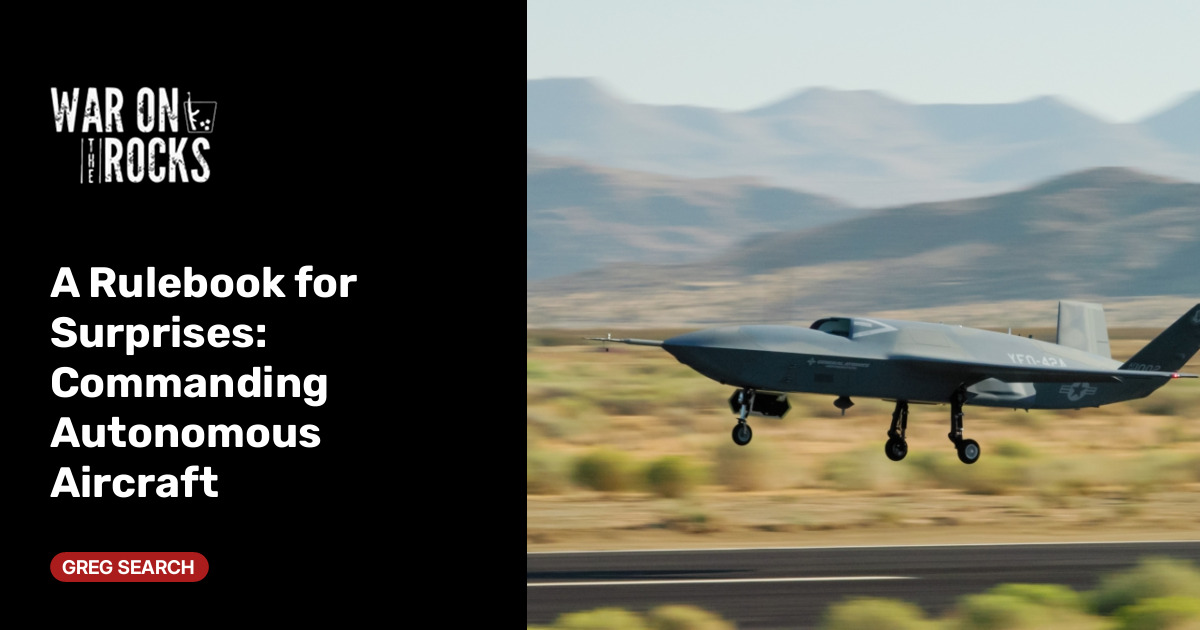
A Rulebook for Surprises: Commanding Autonomous Aircraft

My greatest challenge while flight testing collaborative combat aircraft was not troubleshooting errors at high speed in the cockpit. It was when, in a single keystroke, my job shifted from pilot to something like a dog handler — a supervisor of an autonomous agent. As a test pilot, my instinct is to stop for surprise machine behavior, but that met a system where such unexpected behavior could be a good thing. Managing autonomy means accounting for a new phenomenon — machine behavior that is both correct and unexpected.Historically, aircrews have handled surprises by assuming there’s a malfunction and fixing it,

War on the RocksWar on the RocksGreg Search1 Sept

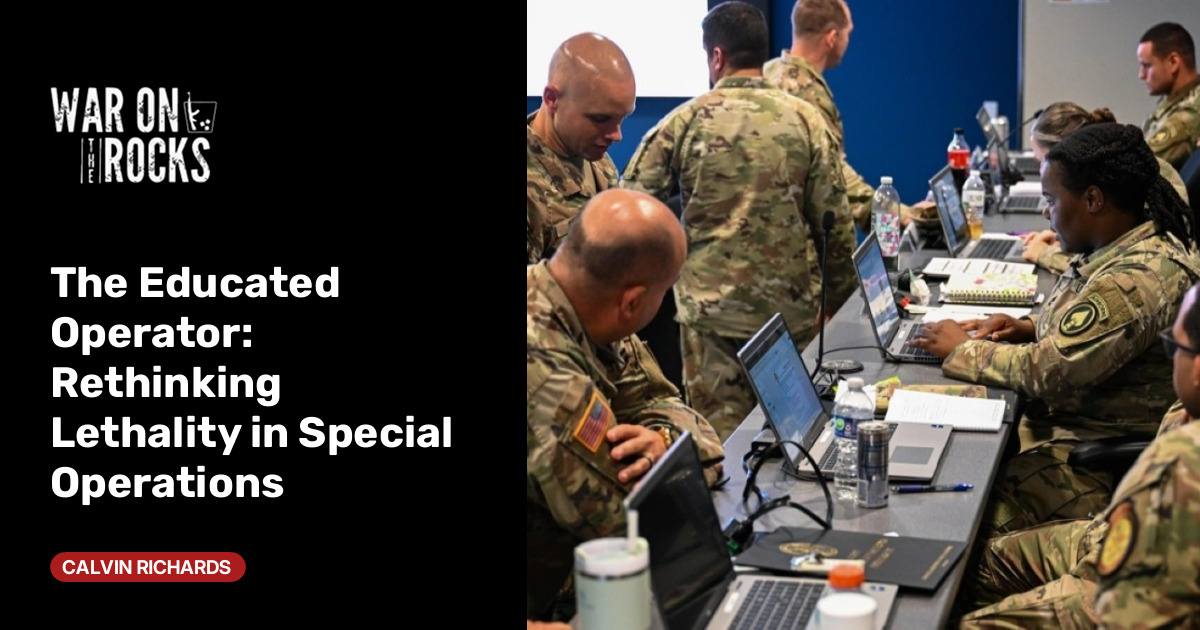
The Educated Operator: Rethinking Lethality in Special Operations

Editor’s Note: While War on the Rocks has a high standard for allowing pseudonyms, this is an unusual case: U.S. Army Special Operations Command requires its uniformed personnel to use pseudonyms when writing for public consumption (Policy 23-16). Meek young men grow up in libraries, believing it their duty to accept the views which Cicero, which Locke, which Bacon, have given; forgetful that Cicero, Locke, and Bacon were only young men in libraries when they wrote these books. –Ralph Waldo Emerson Over the course of more than a dozen combat deployments, it is undeniably true that being dumb has sometimes

War on the RocksWar on the RocksCalvin Richards1 Sept

The Political Constraint on America’s Data-Center Power Buildout

In April, President Donald Trump issued two Defense Production Act determinations covering grid infrastructure and large-scale energy infrastructure. One found that the country’s constrained electric grid posed an increasing threat to national defense and made grid infrastructure and its supply chains essential to national defense. The other found that financing risks, regulatory delays, and market barriers were preventing large-scale energy infrastructure essential to national defense from being provided in a timely manner. Less than three months later, New York Gov. Kathy Hochul imposed a one-year moratorium on new hyperscale data centers. Her order said the pause would keep New Yorkers

War on the RocksWar on the RocksJavaid Iqbal Sofi1 Sept

The Divine Calculus of the Ukraine War’s End

Welcome to The Ukraine Compass, a weekly digest of Ukrainian commentary and analysis from across the political spectrum, only for War on the Rocks members. Each Monday, we bring you a curated selection of articles from Ukrainian media offering insight into how Ukrainians themselves debate the issues shaping their country.American coverage often narrows the view to the battlefield — these pieces widen it, revealing the texture of daily life, politics, and public argument in a nation at war. The perspectives gathered here are varied, candid, and often surprising, together forming a more complete picture of Ukraine as it really is.Frontline and StrategyОбозреватель

War on the RocksWar on the RocksNicole Wiley31 Aug

The Quantum Stack and the Countdown to Q-Day

Quantum’s hype obscures a reality with real geopolitical stakes: the technology works and is advancing every day. Cameron Chehreh (IonQ), JD Dulny (Booz Allen), and Ben Gianni (GDIT) join Jonathan to discuss the race to Q-Day. They cover the shift to post-quantum cryptography, competing hardware modalities, emerging use cases, and why talent gaps and fragile supply chains mean the United States could be at risk of falling behind.Image: Jonathan Steffen via DVIDS.

War on the RocksWar on the RocksJonathan Panter31 Aug

Stop Using AI. Start Commanding It

Walk into the Pentagon, climb the escalator, and an Uncle Sam-style poster points at you: “I want YOU to use AI.” It worked. GenAI.mil hit 1.5 million users in six months, and I have heard enough OpenAI-in-disguise pitches to last a lifetime. The adoption really is great, but the poster contains a problem. “Use” is the verb of tools, and the Department of Defense does not win by using tools. It wins by commanding forces.North of the Pentagon, a task force few know about operates in a Maryland basement. They collect intelligence, develop missions, and execute against targets 24/7 within

War on the RocksWar on the RocksCody Nichols31 Aug

The (Un)importance of the Battle of Tours

Editor’s note: This is the first article in a new occasional series featuring battles that just didn’t matter, may look important, but in fact had negligible strategic or political effects or were absurd, anticlimactic, or structurally irrelevant to the wars they were part of.Some battles never end. Their impact is debated endlessly, sometimes for centuries, as they take on new life with new generations of historians and swindlers alike. Few battles better exemplify this eternal lifespan than the Battle of Tours — also known as the Battle of Poitiers — as it was fought between the two cities in modern-day

War on the RocksWar on the RocksDaniel Wollenberg28 Aug

Beneath the Surface: Overlooked Cyber Security Threats

Cyber security remains a persistent concern for public and private sector organizations alike. Given the potential impact of cyber threats from criminal groups, adversarial states, and extremists, the topic draws substantial attention. Yet, in a field that evolves so quickly, some risks slip through the cracks. We asked four experts to identify and assess a key cyber security threat to U.S. national security that analysts and policymakers often overlook.Read more below. Emily HardingDirector of the Intelligence, National Security, and Technology Program and Vice President of the Defense and Security Department at the Center for Strategic and International Studies Determining the state

War on the RocksWar on the RocksAndrew Reddie27 Aug

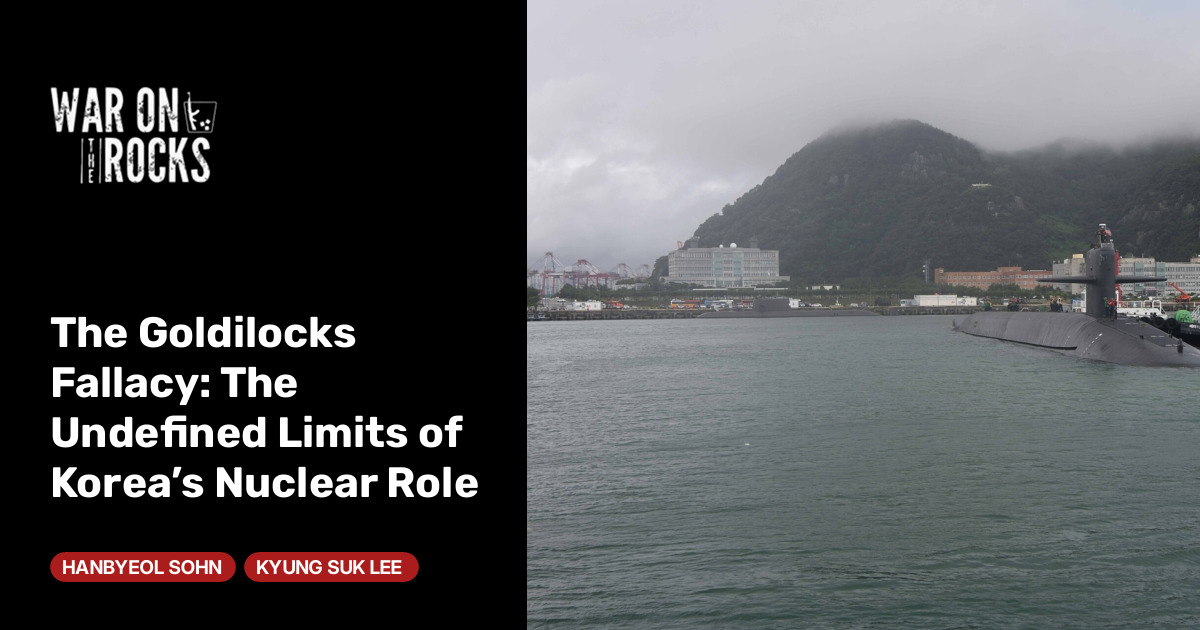
The Goldilocks Fallacy: The Undefined Limits of Korea’s Nuclear Role

“Unthreatening and respectful.” That is how the president of the United States described North Korea on Aug. 16, 2026, in his social media post ordering his secretary of defense to scale back joint exercises with South Korea. Two years earlier in Seoul, the U.S.-South Korean alliance agreed that South Korea’s role in an American nuclear operation would involve exercises and training, formalizing those guidelines at a Nuclear Consultative Group meeting co-chaired by Vipin Narang, then-acting assistant secretary of defense for space policy.Three weeks before the president’s post, on July 24, Narang spoke at the second Deterrence Symposium hosted by South

War on the RocksWar on the RocksKyung Suk Lee27 Aug

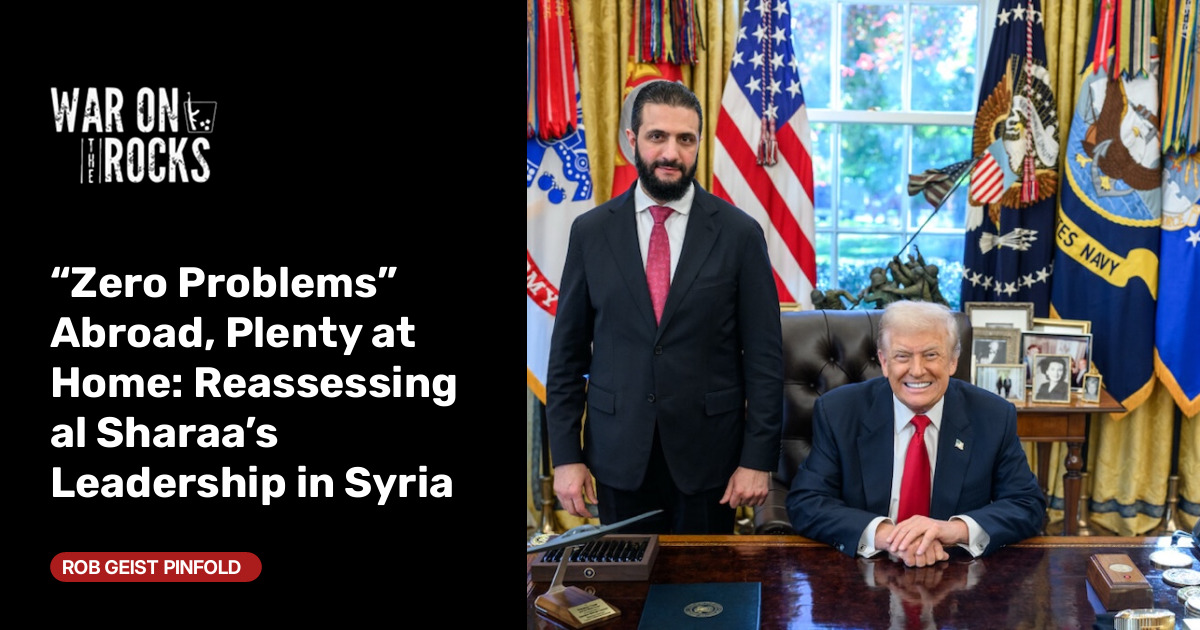
“Zero Problems” Abroad, Plenty at Home: Reassessing al Sharaa’s Leadership in Syria

In 2025, Rob Geist Pinfold wrote, “The March Massacres Show That Syria Urgently Needs Solutions, Not Sanctions,” in which he argued that sanctions relief was a major way the West could positively engage with the new Syrian government. A year later, after sanctions relief materialized and the United States removed Syria from its list of terrorism sponsors, we asked him to revisit his arguments and reassess President Ahmed al Sharaa’s leadership, both foreign and domestic. Image: Voice of America via Wikimedia CommonsIn your 2025 article, you argued that one way the West should engage with post-Assad Syria was through sanctions relief.

War on the RocksWar on the RocksRob Geist Pinfold26 Aug